>
Cypriniformes (Carps) >
Leuciscidae (Minnows) > Pogonichthyinae
Etymology: Pimephales: Greek, pimeles, -es = fat + Greek, phales = whale; if the root is Greek, phales, -etos = penis (Ref. 45335); promelas: From the words pro, meaning forward; and melas, black (referring to the black head of nuptial males) (Ref. 10294).
More on author: Rafinesque.
Environment: milieu / climate zone / intervalo de profundidade / distribution range
Ecologia
; Água doce demersal. Subtropical; 0°C - 33°C (Ref. 35682); 61°N - 29°N
North and Central America: Over much of North America from Quebec to Northwest Territories and British Columbia in Canada and south to Alabama, Texas in USA, and Mexico. Widely introduced, including in Colorado River drainage in Arizona and New Mexico, USA. Not present on Atlantic and Gulf slopes between Potomac River in Virginia and Trinity River in Texas. Several countries report adverse ecological impact after introduction.
Tamanho / Peso / Idade
Maturidade: Lm ? range ? - ? cm
Max length : 10.1 cm TL macho/indeterminado; (Ref. 10294); common length : 7.3 cm TL macho/indeterminado; (Ref. 12193); Idade máx. registada: 5 anos (Ref. 58435)
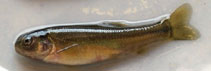
Espinhos dorsais (total) : 0; Raios dorsais moles (total) : 8; Espinhos anais: 0; Raios anais moles: 7. The only species of genus introduced to Europe which differs from other cyprinid species in Europe by the following characters: prominent pad of spongy tissue on nape in males; dorsal fin origin about above pelvic fin origin; anal fin with 7½ branched rays; second simple dorsal ray spinous, about 50% length of the third one; lateral line incomplete, usually not reaching dorsal origin; weak midlateral stripe; 41-54 + 2 scales in midlateral row; and mouth terminal (Ref. 59043).
Body shape (shape guide): fusiform / normal.
Inhabits muddy pools of headwaters, creeks, small rivers, and ponds (Ref. 5723, 86798). Also found in lakes (Ref. 10294). Can tolerate conditions (e.g., turbid, hot, poorly oxygenated, intermittent streams) unsuitable for most fishes (Ref. 5723, 86798). Feeds on detritus and algae (Ref. 10294). Spawns in still-water habitats along shores (Ref. 59043). Introductions consequently caused the spread of the enteric red-mouth disease throughout northern Europe which infected wild and cultured trouts and eels (Ref. 1739). Maintained a relatively high metabolic rate and level of activity under hypoxic conditions (Ref. 77050). Individuals that survived the hypoxic conditions during winter had rapid growth rates after ice-off (Ref. 77048).
"Males defend territories and eggs, and clean plants, stone or other materials by rubbing them with the spongy nape pad and dorsal fin, which contain mucus-secreting cells and taste buds. The mucus may have fungicidal properties" (Ref. 59043).
Page, L.M. and B.M. Burr, 2011. A field guide to freshwater fishes of North America north of Mexico. Boston : Houghton Mifflin Harcourt, 663p. (Ref. 86798)
Categoria na Lista Vermelha da IUCN (Ref. 130435: Version 2025-1)
Ameaça para o homem
Potential pest
Utilização humana
Pescarias: espécies comerciais; Aquário: Espécies comerciais; isco: usually
Ferramentas
Relatórios especiais
Descarregue XML
Fontes da internet
Estimates based on models
Phylogenetic diversity index (Ref.
82804): PD
50 = 0.5625 [Uniqueness, from 0.5 = low to 2.0 = high].
Bayesian length-weight: a=0.00851 (0.00649 - 0.01117), b=3.07 (3.00 - 3.14), in cm total length, based on LWR estimates for this species (Ref.
93245).
Nível Trófico (Ref.
69278): 2.4 ±0.1 se; based on diet studies.
Resiliência (Ref.
120179): Elevada, tempo mínimo de duplicação da população menor que 15 meses (tmax=2).
Fishing Vulnerability (Ref.
59153): Low vulnerability (17 of 100).
🛈