


Uploaden van uw Foto's en video's
Afbeeldingen | Google afbeelding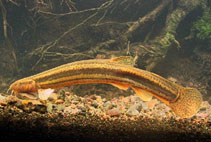 Misgurnus fossilis
Afbeelding van Tveskov, E.
Afbeeldingen | Google afbeelding
Afbeelding van Tveskov, E.
Classificatie / Namen Lokale namen | Synoniemen | Catalog of Fishes(Genus, Soort(en)) | ITIS | CoL | WoRMS | Cloffa
Milieu: milieu / Klimaatzone / Diepte / verspreidingsgebied Ecologie
; zoet water; brak water demersaal; potamodroom (Ref. 51243). Temperate; 4°C - 25°C (Ref. 1672); 62°N - 42°N, 15°E - 61°E
Verspreiding Gebieden | FAO regio's | Ecosystemen | Voorkomen | Verspreidingskaart | Introducties | Faunafri
Europe and Asia: In Europe, north of the Alps, from Meuse eastward to Neva drainages and Lake Ladoga; northern Black Sea basin from Danube eastward to Kuban, absent on the southern section; Caspian basin in Volga and Ural drainages. Not native to Great Britain, Scandinavia, Apennine and Iberian peninsulas, Crimea, and Adriatic, Aegean and White Sea basins. Locally introduced in Rhône drainage (France) and perhaps elsewhere (Ref. 59043).
Lengte bij maturiteit / Grootte / Gewicht / Leeftijd
Maturiteit: Lm ?, range 11 - ? cm
Max length : 30.0 cm TL mannelijk / geslacht onbekend; (Ref. 556); 30.7 cm TL (female); common length : 15.0 cm TL mannelijk / geslacht onbekend; (Ref. 556)
Max length : 30.0 cm TL mannelijk / geslacht onbekend; (Ref. 556); 30.7 cm TL (female); common length : 15.0 cm TL mannelijk / geslacht onbekend; (Ref. 556)
Korte beschrijving Determinatiesleutels | Morfologie | Morfometrie
Dorsale stekels (totaal) : 3; Dorsale zachte stralen (totaal) : 5 - 6; Anale stekels: 3; Anale zachte stralen: 8 - 11; Wervels: 49 - 50. Broad midlateral stripe from eye to caudal base and narrow stripe from opercle at least to pelvic origin. Lamina circularis absent in males (Ref. 59043). Caudal fin with 14-16 rays (Ref. 40476).
Body shape (shape guide): elongated.
Body shape (shape guide): elongated.
Facultative air-breathing (Ref. 126274); Found in lower reaches of slow-flowing rivers, but can also be found in still pools (Ref. 9696), on sandy bottoms of ponds, pools and ditches. Adults are nocturnal which burrow into mud during dry periods and strong frosts. Usually, burrows are 20-30 cm deep, occasionally down to 70 cm during dry periods (Ref. 59043). During the day, they stay buried in the sand. Feed on insect larvae and small mollusks. Seldom captured with hook and line (Ref. 30578). Are sensitive to pollutants which accumulate in the sediment (Ref. 11941). Facultative air-breathers (Ref. 27368). A female specimen measuring 30.7 cm TL was recorded from Netherlands (Ref. 114650).
Levenscyclus en paargedrag Maturiteit | Voortplanting | Paaien | Eieren | Fecunditeit | Larven
Male follows female into dense vegetation and forms a complete ring around her body, behind dorsal fin (Ref. 59043).
Hoofdreferentie
Upload uw referenties | Referenties | Coördinator | Medewerkers
Kottelat, M. and J. Freyhof, 2007. Handbook of European freshwater fishes. Publications Kottelat, Cornol and Freyhof, Berlin. 646 pp. (Ref. 59043)
Status op de Rode Lijst van het IUCN (Ref. 130435: Version 2025-2 (Global))
Niet bedreigd (LC) ; Date assessed: 16 January 2023
CITES
Not Evaluated
Gevaar voor de mens
Harmless
Gebruik door de mens
Visserij: van geen belang; aas: usually
FAO - visserij: aanvoer; Publication: search | FishSource |
Meer informatie
Trofische ecologie
Voedsel (prooien)
Dieetsamenstelling
Voedselconsumptie
Voedselrantsoenen
Predatoren
Voedsel (prooien)
Dieetsamenstelling
Voedselconsumptie
Voedselrantsoenen
Predatoren
Populatiedynamica
Groeiparameters
Max. leeftijden / maten
Lengte-gewicht rel.
Lengte-lengte rel.
Lengtefrequenties
Massaconversie
Rekrutering
Abundantie
Groeiparameters
Max. leeftijden / maten
Lengte-gewicht rel.
Lengte-lengte rel.
Lengtefrequenties
Massaconversie
Rekrutering
Abundantie
Levenscyclus
Voortplanting
Maturiteit
Rijpheid/kieuwen rel.
Fecunditeit
Paaien
Paaibestanden
Eieren
Ontwikkeling van de eieren
Larven
Larvale populatiedynamiek
Voortplanting
Maturiteit
Rijpheid/kieuwen rel.
Fecunditeit
Paaien
Paaibestanden
Eieren
Ontwikkeling van de eieren
Larven
Larvale populatiedynamiek
Fysiologie
Lichaamssamenstelling
Voedingsstoffen
Zuurstofverbruik
Type zwemmen
Zwemsnelheid
Visuele pigmenten
Vis geluid
Ziekten en parasieten
Toxiciteit (LC50)
Lichaamssamenstelling
Voedingsstoffen
Zuurstofverbruik
Type zwemmen
Zwemsnelheid
Visuele pigmenten
Vis geluid
Ziekten en parasieten
Toxiciteit (LC50)
Menselijk gerelateerd
Aquacultuursystemen
Aquacultuurprofielen
Kweeklijnen
Ciguatera gevallen
Postzegels, munten, diversen.
Aquacultuursystemen
Aquacultuurprofielen
Kweeklijnen
Ciguatera gevallen
Postzegels, munten, diversen.
Tools
Biologische quiz | E-boek | Veldgids | Lengtefrequentie Tool | Levenscyclus tool | Verspreidingskaart |
Vangst-MSY |
Speciale rapporten
Bekijk gegevens voor het houden in een aquarium | Bekijk Fact Sheets voor de soort | Bekijk Aquacultuur Fact Sheets
Download XML
Internetbronnen
AFORO (otoliths) | Exoten/Invasieve soorten database | Aquatic Commons | BHL | Cloffa | Websites from users | Bekijk FishWatcher | CISTI | Catalog of Fishes: Genus, Soort(en) | DiscoverLife | ECOTOX | FAO - visserij: aanvoer; Publication: search | Faunafri | Fishipedia | Fishtrace | GloBI | Google Books | Google Scholar | Google | IGFA World Record | Nationale databanken | OneZoom | Open Tree of Life | Otolith Atlas of Taiwan Fishes | Publieke aquaria | PubMed | Reef Life Survey | Socotra Atlas | TreeBase | Tree of Life | Wikipedia: ga naar, zoek | World Records Freshwater Fishing | Zoological Record
Schattingen op basis van modellen
Fylogenetische diversiteitsindex (Ref. 82804): PD50 = 0.5020 [Uniqueness, from 0.5 = low to 2.0 = high].
Bayesian length-weight: a=0.00407 (0.00245 - 0.00678), b=3.10 (2.96 - 3.24), in cm total length, based on LWR estimates for this species & Genus-body shape (Ref. 93245).
Trofisch niveau (Ref. 69278): 3.4 ±0.45 se; based on food items.
Weerstandsvermogen (Ref. 120179): Gemiddeld, minimale populatieverdubbelingstijd 1,4-4,4 jaar (tm=2; Fec=100,000-150,000).