


Lägg till din observation i Fish Watcher
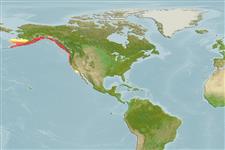
| Native range | All suitable habitat | Point map | Year 2050 |
|
| This map was computer-generated and has not yet been reviewed. |
| Ophiodon elongatus AquaMaps Data sources: GBIF OBIS |
Ladda upp din foton och Videor
Bilder | Videor | Google image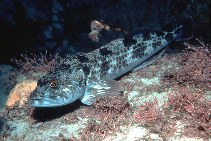 Ophiodon elongatus
Bild av Gotshall, D.W.
Bilder | Videor | Google image
Bild av Gotshall, D.W.
Klassificering / Namn Populärnamn | synonymer | Catalog of Fishes(Släkte, Arter) | ITIS | CoL | WoRMS | Cloffa
> Perciformes/Cottoidei (Sculpins) > Hexagrammidae (Greenlings) > Ophiodontinae
Etymology: Ophiodon: Greek, ophis = serpent + Greek, odous = teeth (Ref. 45335).
More on author: Girard.
Etymology: Ophiodon: Greek, ophis = serpent + Greek, odous = teeth (Ref. 45335).
More on author: Girard.
Miljö: miljö / Klimatzon / djupintervall / distributionsområde Ekologi
marina bottenlevande; oceano-estuarine (Ref. 51243); djupintervall 0 - 475 m (Ref. 6793). Temperate; 61°N - 31°N, 172°W - 116°W
Utbredning Territorier | FAO områden | Ekosystem | Förekomster | Prickkarta | Utplanteringar | Faunafri
Northeast Pacific: Shumagin Islands in the western Gulf of Alaska to Ensenada, Baja California, Mexico. Possibly occurring in the Bering Sea (Ref. 6793).
Längd vid första mognad / Storlek / Vikt / Ålder
Könsmognad: Lm 70.5, range 61 - 76 cm
Max length : 152 cm TL hane/ej könsbestämd; (Ref. 2850); publicerad maxvikt: 59.1 kg (Ref. 40637); rapporterad maxålder: 25 år (Ref. 55701)
Max length : 152 cm TL hane/ej könsbestämd; (Ref. 2850); publicerad maxvikt: 59.1 kg (Ref. 40637); rapporterad maxålder: 25 år (Ref. 55701)
Kort beskrivning Bestämningsnycklar | Morfologi | Morfometri
Taggstrålar i ryggfenan (totalt) : 24 - 27; Mjukstrålar i ryggfenan (totalt) : 21 - 24; Taggstrålar i analfenan: 3; Mjukstrålar i analfenan: 21 - 24; Ryggkotor: 55 - 59. Anal spines of adults buried in flesh, third spine closely applied to first ray (Ref. 6885). Head without scales; fleshy cirrus above each eye; large mouth; maxilla reaching almost to vertical from posterior margin of eye. Jaws with small pointed teeth interspersed with large fanglike teeth (Ref. 48751).
Body shape (shape guide): elongated.
Body shape (shape guide): elongated.
Ranges from the intertidal to 475 m depth (Ref. 6793). Adults are found near rocks, inshore and to 427 m (Ref. 2850). Young occur on sand or mud bottom of bays and inshore areas (Ref. 2850). Both migratory and non-migratory populations exist (Ref. 6885). Adults feed mostly on other fishes but also take crustaceans, octopi and squid (Ref. 4925). Young feed on copepods and other small crustaceans (Ref. 6885). A very important sport and commercial species (Ref. 2850). The liver is rich in vitamin A (Ref. 6885). Marketed fresh and frozen; eaten steamed, fried, broiled, boiled, microwaved and baked (Ref. 9988). Has sharp teeth and gill rakers that can cut fingers if handled.
Livscykel och parningsbeteende Könsmognad | Reproduktion | Lek | Ägg | Fekunditet | Larver
Eggs are deposited in crevices or under rocks (Ref. 6885). Male guards the eggs until they hatch.
Huvudreferens
Ladda upp dina referenser | referenser | Koordinator | Medarbetare
Eschmeyer, W.N., E.S. Herald and H. Hammann, 1983. A field guide to Pacific coast fishes of North America. Boston (MA, USA): Houghton Mifflin Company. xii+336 p. (Ref. 2850)
CITES
Not Evaluated
Hot mot människor
Traumatogenic (Ref. 13513)
Mänskliga användningsområden
Fiskeri: kommersiell; sportfisk: ja
FAO - fiskeri: landningar; Publication: search | FishSource | Havet omkring oss
Ytterligare information
Populationsdynamik
Tillväxtparametrar
Max. åldrar / storlekar
Längd-vikt rel.
Längd-längd rel.
Längd-frekvenser
Massakonvertering
Rekrytering
Abundans
Tillväxtparametrar
Max. åldrar / storlekar
Längd-vikt rel.
Längd-längd rel.
Längd-frekvenser
Massakonvertering
Rekrytering
Abundans
Livscykel
Reproduktion
Könsmognad
Mognad/Gills rel.
Fekunditet
Lek
Lekande aggregat
Ägg
Utveckling av ägg
Larver
Larvdynamik
Reproduktion
Könsmognad
Mognad/Gills rel.
Fekunditet
Lek
Lekande aggregat
Ägg
Utveckling av ägg
Larver
Larvdynamik
Anatomi
Gälyta
Hjärna
Otolit
Gälyta
Hjärna
Otolit
Fysiologi
Kroppssammansättning
Näringsämnen
Syreförbrukning
Typ av simning
Simhastighet
Visuella pigment
Ljud från fisk
Sjukdomar & Parasiter
Toxicitet (LC50)
Kroppssammansättning
Näringsämnen
Syreförbrukning
Typ av simning
Simhastighet
Visuella pigment
Ljud från fisk
Sjukdomar & Parasiter
Toxicitet (LC50)
Människorelaterad
Vattenbrukssystem
Vattenbruksprofiler
Avelslinjer
Ciguatera-fall
Frimärken, mynt, diverse.
Vattenbrukssystem
Vattenbruksprofiler
Avelslinjer
Ciguatera-fall
Frimärken, mynt, diverse.
Verktyg
Organisk frågesport | E-bok | Fälthandbok | Längdfördelnings-verktyg | Livshistorie-verktyg | Prickkarta |
Fångst-MSY |
Särskilda rapporter
Kontrollera för underhåll av akvarium | Kontrollera om det finns faktablad om arter | Kontrollera om det finns faktablad om vattenbruk
Ladda ner XML
Internet-källor
AFORO (otoliths) | Aquatic Commons | BHL | Cloffa | Websites from users | Check FishWatcher | CISTI | Catalog of Fishes: Släkte, Arter | DiscoverLife | ECOTOX | FAO - fiskeri: landningar; Publication: search | Faunafri | Fishipedia | Fishtrace | GloBI | Google Books | Google Scholar | Google | IGFA World Record | OceanAdapt | OneZoom | Open Tree of Life | Otolith Atlas of Taiwan Fishes | PubMed | Reef Life Survey | RFE Identification | Socotra Atlas | TreeBase | Tree of Life | Wikipedia: Go, sök | World Records Freshwater Fishing | Zoobank | Zoologiskt register
Uppskattningar baserade på modeller
Önskad temperatur (Ref. 123201): 4.5 - 8.6, mean 5.9 °C (based on 184 cells).
Index för fylogenetisk mångfald (Ref. 82804): PD50 = 1.0020 [Uniqueness, from 0.5 = low to 2.0 = high].
Bayesian length-weight: a=0.00389 (0.00180 - 0.00842), b=3.12 (2.94 - 3.30), in cm total length, based on all LWR estimates for this body shape (Ref. 93245).
Trofisk nivå (Ref. 69278): 4.5 ±0.6 se; based on diet studies.
Resiliens (Ref. 120179): Mellan, lägsta populationsfördubblingstid 1,4-4,4 år (tm=4; tmax=25;).
Prior r = 0.36, 95% CL = 0.24 - 0.53, Based on 2 full stock assessments.
Näringsämnen (Ref. 124155): Calcium = 25.5 [9.8, 54.9] mg/100g; Iron = 0.351 [0.157, 0.792] mg/100g; Protein = 18.3 [16.1, 20.3] %; Omega3 = 0.589 [0.263, 1.706] g/100g; Selenium = 28.4 [14.8, 68.4] μg/100g; VitaminA = 9.37 [2.88, 31.89] μg/100g; Zinc = 0.289 [0.192, 0.446] mg/100g (wet weight); based on nutrient studies.