>
Eupercaria/misc (Various families in series Eupercaria) >
Scaridae (Parrotfishes) > Scarinae
Etymology: Scarus: Greek, skaros = a fish described by anciente writers as a parrot fish; 1601 (Ref. 45335).
More on author: Forsskål.
Environment: milieu / climate zone / rango de profundidad / distribution range
Ecología
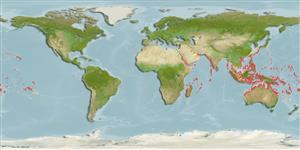
marino asociado a arrecife; rango de profundidad 2 - 25 m (Ref. 58302). Tropical; 36°N - 35°S, 30°E - 123°W
Indo-Pacific: Red Sea south to Sodwana Bay, South Africa (Ref. 5490) and east to the Hawaiian, Marquesan, and Tuamoto islands, north to southern Japan, south to Shark Bay, Western Australia and Lord Howe Island.
Length at first maturity / Tamaño / Peso / Age
Madurez: Lm 12.6, range 11 - 14.8 cm
Max length : 43.0 cm TL macho / no sexado; (Ref. 125599); peso máximo publicado: 1.8 kg (Ref. 125599); edad máxima reportada: 5 años (Ref. 13619)
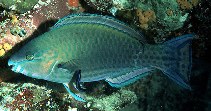
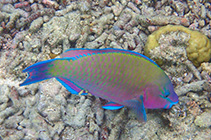
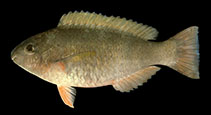
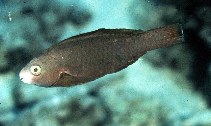
Espinas dorsales (total) : 9; Radios blandos dorsales (total) : 10; Espinas anales: 3; Radios blandos anales: 9. This species is distinguished by the following characters: median predorsal scales 4; 2 scale rows on cheek, 1(5-7), 2(4-7); pectoral-fin rays 13-15 (usually 14); female usually 1 conical tooth on side of upper dental plate, terminal male with single tooth on side of lower dental plate, lips largely covering dental plates; caudal fin slightly emarginate in small female to deeply emarginate in large TP male. Colour of male green to pale brownish with salmon pink or bluish scale margins, a lavender-grey snout, bluish to lavender caudal fin and the nuptial male with a brilliant yellow body; female overall reddish brown to grey, usually pale snout (Ref. 90102).
Body shape (shape guide): fusiform / normal; Cross section: compressed.
Inhabit reef flats and lagoon and seaward reefs to at least 25 m depth (Ref. 1602). Found over corals (Ref. 5213, 58652). Benthopelagic (Ref. 58302). Initial-phase fish stage usually form small feeding schools (Ref. 2334). Graze on benthic algae (Ref. 3488). Secrete a mucus cocoon (Ref. 1602).
Life cycle and mating behavior
Madurez | Reproducción | Puesta | Huevos | Fecundidad | Larva
Oviparous, distinct pairing during breeding (Ref. 205).
Randall, J.E., G.R. Allen and R.C. Steene, 1990. Fishes of the Great Barrier Reef and Coral Sea. University of Hawaii Press, Honolulu, Hawaii. 506 p. (Ref. 2334)
IUCN Red List Status (Ref. 130435: Version 2025-1)
Threat to humans
Reports of ciguatera poisoning (Ref. 130160)
Human uses
Pesquerías: comercial; Acuario: Comercial
Herramientas
Special reports
Download XML
Fuentes de Internet
Estimates based on models
Preferred temperature (Referencia
123201): 24.7 - 29, mean 28.1 °C (based on 2928 cells).
Phylogenetic diversity index (Referencia
82804): PD
50 = 0.5000 [Uniqueness, from 0.5 = low to 2.0 = high].
Bayesian length-weight: a=0.01549 (0.01287 - 0.01864), b=3.04 (3.00 - 3.08), in cm total length, based on LWR estimates for this species (Ref.
93245).
Nivel trófico (Referencia
69278): 2.0 ±0.00 se; based on food items.
Resiliencia (Referencia
120179): Alto, población duplicada en un tiempo mínimo inferior a 15 meses (K=0.35; tmax=5).
Fishing Vulnerability (Ref.
59153): Low to moderate vulnerability (25 of 100).
🛈
Nutrients (Ref.
124155): Calcium = 62.3 [39.0, 112.6] mg/100g; Iron = 1.12 [0.74, 1.78] mg/100g; Protein = 18.7 [16.6, 20.5] %; Omega3 = 0.0906 [, ] g/100g; Selenium = 25.9 [15.1, 44.1] μg/100g; VitaminA = 25.9 [7.2, 99.1] μg/100g; Zinc = 2.66 [1.95, 3.62] mg/100g (wet weight); based on
nutrient studies.