>
Gobiiformes (Gobies) >
Gobiidae (Gobies) > Gobiinae
Etymology: Benthophilus: Greek, benthos = depth of the sea + Greek, phyle, that loves (Ref. 45335).
Eponymy: A A Mahmudbekov was an Azerbaijanian ichthyologist, who devoted his life to the study of the Caspian Sea (where this goby occurs). Among his publications was: On the standard weight of sturgeon fingerlings produced by Kura fish growing plants (1966). (Ref. 128868), visit book page.
Environment: milieu / climate zone / djupintervall / distribution range
Ekologi
; sötvatten; brackvatten bottenlevande; djupintervall 1 - 50 m (Ref. 59043). Temperate; 49°N - 36°N, 37°E - 55°E
Eurasia: Caspian eastern coast of Caspian Sea and Volga delta, up to Volgograd.
Size / Vikt / Age
Könsmognad: Lm ? range ? - ? cm
Max length : 6.6 cm TL hane/ej könsbestämd; (Ref. 50519); rapporterad maxålder: 1.00 år (Ref. 59043)
Short description
Bestämningsnycklar | Morfologi | Morfometri
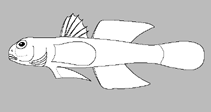
This species is distinguished from its congeners by the following characters: strongly depressed head; a tubercle between eyes; numerous, densely-set granules covering whole body except abdominal area; small tubercles especially on head; tubercles in dorsal row 26-29, ventral row 21-24, upper lateral row up to 20 (smaller on caudal peduncle), in lower one 10 and are tiny; chin barbel slightly compressed with thick base, longer than half eye diameter; D1 IV; origin of D2 behind anal origin; transverse rows of neuromasts on flank usually 20-22; a dark spot often in front of D2; sides with dark blotches and irregular dots (Ref. 59043).
Body shape (shape guide): elongated.
Occurs in fresh and brackish waters with salinity up to 13 ppt. Maximum depth 50 m, with mature adults at 1-11 m. Lives for about a year, spawns in May-August in northern Caspian, April-November in eastern Caspian. Some individuals may spawn for the first time at 6-7 months. Females probably lay eggs in 3 portions and die after spawning while males probably die 3-4 weeks alter (Ref. 59043).
Life cycle and mating behavior
Könsmognad | Reproduktion | Lek | Ägg | Fecundity | Larver
Females probably lay eggs in 2-3portions (Ref. 59043).
McAllister, D.E., 1990. A working list of fishes of the world. Copies available from D.E. McAllister, Canadian Museum of Nature, P.O. Box 3443, Ottawa, Ontario K1P 6P4, Canada. 2661 p. plus 1270 p. Index. (Ref. 27116)
IUCN Red List Status (Ref. 130435: Version 2025-1)
Threat to humans
Harmless
Human uses
Verktyg
Special reports
Download XML
Internet-källor
Estimates based on models
Phylogenetic diversity index (Ref.
82804): PD
50 = 0.5000 [Uniqueness, from 0.5 = low to 2.0 = high].
Bayesian length-weight: a=0.00724 (0.00339 - 0.01546), b=3.10 (2.92 - 3.28), in cm total length, based on LWR estimates for this (Sub)family-body shape (Ref.
93245).
Trofisk nivå (Ref.
69278): 3.2 ±0.3 se; based on size and trophs of closest relatives
Resiliens (Ref.
120179): Hög, lägsta populationsfördubblingstid mindre än 15 månader (tm<1).
Fishing Vulnerability (Ref.
59153): Low vulnerability (10 of 100).
🛈