


Brachaelurus waddi (Bloch & Schneider, 1801)
Blind shark
Waarneming toevoegen in Fish Watcher
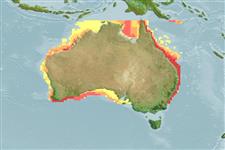
| Native range | All suitable habitat | Point map | Year 2050 |
|
| This map was computer-generated and has not yet been reviewed. |
| Brachaelurus waddi AquaMaps Data sources: GBIF OBIS |
Uploaden van uw Foto's en video's
Afbeeldingen | Google afbeelding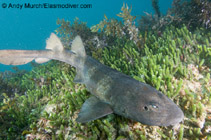 Brachaelurus waddi
Afbeelding van Murch, A.
Afbeeldingen | Google afbeelding
Afbeelding van Murch, A.
Classificatie / Namen Lokale namen | Synoniemen | Catalog of Fishes(Genus, Soort(en)) | ITIS | CoL | WoRMS | Cloffa
Elasmobranchii (haaien en roggen) (sharks and rays) > Orectolobiformes (Carpet sharks) > Brachaeluridae (Blind sharks)
Etymology: Brachaelurus: brachys (Gr.), short, referring to short and stout body; aelurus, from ailouros (Gr.), cat, i.e., a short catshark (See ETYFish); waddi: Name given on a painting (now lost) by British ornithologist John Latham (1740-1837), from which it was described; meaning unknown, possibly based on waddi or waddy, an Australian aboriginal name for a war club and a species of tree (Acacia peuce) endemic to central Australia (See ETYFish).
Eponymy: The original description does not explain the binomial. [...] (Ref. 128868), visit book page.
More on authors: Bloch & Schneider.
Etymology: Brachaelurus: brachys (Gr.), short, referring to short and stout body; aelurus, from ailouros (Gr.), cat, i.e., a short catshark (See ETYFish); waddi: Name given on a painting (now lost) by British ornithologist John Latham (1740-1837), from which it was described; meaning unknown, possibly based on waddi or waddy, an Australian aboriginal name for a war club and a species of tree (Acacia peuce) endemic to central Australia (See ETYFish).
Eponymy: The original description does not explain the binomial. [...] (Ref. 128868), visit book page.
More on authors: Bloch & Schneider.
Milieu: milieu / Klimaatzone / Diepte / verspreidingsgebied Ecologie
Verspreiding Gebieden | FAO regio's | Ecosystemen | Voorkomen | Verspreidingskaart | Introducties | Faunafri
Southwest Pacific: confined to Australia, southern Queensland and New South Wales. Records from Western Australia and northern Territory need confirmation.
Grootte / Gewicht / Leeftijd
Maturiteit: Lm ? range ? - ? cm
Max length : 122 cm TL mannelijk / geslacht onbekend; (Ref. 247); common length : 62.0 cm TL mannelijk / geslacht onbekend; (Ref. 247); common length :66 cm TL (female)
Max length : 122 cm TL mannelijk / geslacht onbekend; (Ref. 247); common length : 62.0 cm TL mannelijk / geslacht onbekend; (Ref. 247); common length :66 cm TL (female)
Korte beschrijving Determinatiesleutels | Morfologie | Morfometrie
Dorsale stekels (totaal) : 0; Anale stekels: 0. Mostly with white spots on body (Ref. 13576). Caudal fin with its upper lobe at a low angle above body axis, with a strong terminal lobe and subterminal notch but no ventral lobe (Ref. 13576).
Body shape (shape guide): elongated.
Body shape (shape guide): elongated.
Usually found close inshore in tide pools (barely deep enough to keep it covered) and at the surf line, but sometimes deeper (Ref. 247). Prefers rocky shoreline areas and coral reefs (Ref. 247, 43278). Feeds on small reef invertebrates (Ref. 247), including crabs, shrimps, cuttlefish, squid and sea anemones (Ref. 43278), and small fishes (Ref. 247). Ovoviviparous (Ref. 43278, 50449). Thrives in an aquaria and capable of living out of water for a long time (Ref. 247).
Levenscyclus en paargedrag Maturiteit | Voortplanting | Paaien | Eieren | Fecunditeit | Larven
Ovoviviparous, embryos feed solely on yolk (Ref. 50449). With 7 or 8 young in a litter (Ref. 247). Distinct pairing with embrace (Ref. 205).
Hoofdreferentie
Upload uw referenties | Referenties | Coördinator | Medewerkers
Compagno, L.J.V., 1984. FAO Species Catalogue. Vol. 4. Sharks of the world. An annotated and illustrated catalogue of shark species known to date. Part 1 - Hexanchiformes to Lamniformes. FAO Fish. Synop. 125(4/1):1-249. Rome, FAO. (Ref. 247)
Status op de Rode Lijst van het IUCN (Ref. 130435: Version 2025-2 (Global))
Niet bedreigd (LC) ; Date assessed: 24 April 2025
CITES
Not Evaluated
Gevaar voor de mens
Harmless (Ref. 247)
Gebruik door de mens
Visserij: bycatch; sportvis: ja
FAO - visserij: soortsprofiel; Publication: search | FishSource |
Meer informatie
Trofische ecologie
Voedsel (prooien)
Dieetsamenstelling
Voedselconsumptie
Voedselrantsoenen
Predatoren
Voedsel (prooien)
Dieetsamenstelling
Voedselconsumptie
Voedselrantsoenen
Predatoren
Populatiedynamica
Groeiparameters
Max. leeftijden / maten
Lengte-gewicht rel.
Lengte-lengte rel.
Lengtefrequenties
Massaconversie
Rekrutering
Abundantie
Groeiparameters
Max. leeftijden / maten
Lengte-gewicht rel.
Lengte-lengte rel.
Lengtefrequenties
Massaconversie
Rekrutering
Abundantie
Levenscyclus
Voortplanting
Maturiteit
Rijpheid/kieuwen rel.
Fecunditeit
Paaien
Paaibestanden
Eieren
Ontwikkeling van de eieren
Larven
Larvale populatiedynamiek
Voortplanting
Maturiteit
Rijpheid/kieuwen rel.
Fecunditeit
Paaien
Paaibestanden
Eieren
Ontwikkeling van de eieren
Larven
Larvale populatiedynamiek
Fysiologie
Lichaamssamenstelling
Voedingsstoffen
Zuurstofverbruik
Type zwemmen
Zwemsnelheid
Visuele pigmenten
Vis geluid
Ziekten en parasieten
Toxiciteit (LC50)
Lichaamssamenstelling
Voedingsstoffen
Zuurstofverbruik
Type zwemmen
Zwemsnelheid
Visuele pigmenten
Vis geluid
Ziekten en parasieten
Toxiciteit (LC50)
Genetica
genoom
Genetica
Heterozygositeit
Erfelijkheid
Genetische diversiteit
genoom
Genetica
Heterozygositeit
Erfelijkheid
Genetische diversiteit
Menselijk gerelateerd
Aquacultuursystemen
Aquacultuurprofielen
Kweeklijnen
Ciguatera gevallen
Postzegels, munten, diversen.
Aquacultuursystemen
Aquacultuurprofielen
Kweeklijnen
Ciguatera gevallen
Postzegels, munten, diversen.
Tools
E-boek | Veldgids | Determinatiesleutels | Lengtefrequentie Tool | Levenscyclus tool | Verspreidingskaart |
Vangst-MSY |
Speciale rapporten
Bekijk gegevens voor het houden in een aquarium | Bekijk Fact Sheets voor de soort | Bekijk Aquacultuur Fact Sheets
Download XML
Internetbronnen
AFORO (otoliths) | Aquatic Commons | BHL | Cloffa | Websites from users | Bekijk FishWatcher | CISTI | Catalog of Fishes: Genus, Soort(en) | DiscoverLife | ECOTOX | FAO - visserij: soortsprofiel; Publication: search | Faunafri | Fishipedia | Fishtrace | GloBI | Google Books | Google Scholar | Google | IGFA World Record | OneZoom | Open Tree of Life | Otolith Atlas of Taiwan Fishes | PubMed | Reef Life Survey | Socotra Atlas | TreeBase | Tree of Life | Wikipedia: ga naar, zoek | World Records Freshwater Fishing | Zoological Record
Schattingen op basis van modellen
Gewenste temperatuur (Ref. 123201): 19.3 - 26.1, mean 24.2 °C (based on 140 cells).
Fylogenetische diversiteitsindex (Ref. 82804): PD50 = 1.0000 [Uniqueness, from 0.5 = low to 2.0 = high].
Bayesian length-weight: a=0.00389 (0.00180 - 0.00842), b=3.12 (2.94 - 3.30), in cm total length, based on all LWR estimates for this body shape (Ref. 93245).
Trofisch niveau (Ref. 69278): 3.9 ±0.62 se; based on food items.
Weerstandsvermogen (Ref. 120179): Zeer laag, minimale populatieverdubbelingstijd meer dan 14 jaar (Fec=7).
Voedingsstoffen (Ref. 124155): Calcium = 11.8 [2.5, 44.6] mg/100g; Iron = 0.368 [0.089, 1.012] mg/100g; Protein = 19.5 [17.3, 21.5] %; Omega3 = 0.0912 [, ] g/100g; Selenium = 38.2 [11.8, 102.1] μg/100g; VitaminA = 42.8 [16.4, 113.8] μg/100g; Zinc = 0.772 [0.380, 1.593] mg/100g (wet weight);