>
Ovalentaria/misc (Various families in series Ovalentaria) >
Pomacentridae (Damselfishes) > Pomacentrinae
Etymology: Chrysiptera: Greek, chrysos = golden + Greek, pteron = fin, wing (Ref. 45335); cymatilis: From the Latin for sea-colored or blue, in reference to its characteristic coloration (Ref. 31117).
Environment: milieu / climate zone / profondeur / distribution range
Écologie
marin récifal; profondeur 3 - 20 m (Ref. 31117), usually 3 - 20 m (Ref. 41819). Tropical
Western Central Pacific: Bismarck Archipelago and Milne Bay Province of Papua
New Guinea and Solomon Is.
Taille / Poids / Âge
Maturité: Lm ? range ? - ? cm
Max length : 3.6 cm SL mâle / non sexé; (Ref. 31117)
Description synthétique
Clés d'identification | Morphologie | Morphométrie
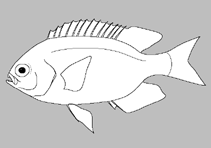
Épines dorsales (Total) : 13; Rayons mous dorsaux (Total) : 10 - 11; Épines anales: 2; Rayons mous anaux: 10 - 12. Tubed lateral line scales 11-14; brilliant deep blue with lighter blue ocellus-like markings on head and breast, and black spot or blotch at base of posterior dorsal rays; caudal fin emarginate (Ref. 31117). Body depth 1.9-2.2 in SL (Ref. 90102).
Adults are found in sheltered seaward coral reefs and lagoons (Ref. 31117), in aggregations within Acropora sp. and Seriatopora histrix (Ref. 41819). Presumably feeding on zooplankton (Ref. 31117). Oviparous, distinct pairing during breeding (Ref. 205). Eggs are demersal and adhere to the substrate (Ref. 205). Males guard and aerate the eggs (Ref. 205). Diurnal species (Ref. 52881).
Life cycle and mating behavior
Maturité | Reproduction | Frai | Œufs | Fécondité | Larves
Oviparous, distinct pairing during breeding (Ref. 205). Eggs are demersal and adhere to the substrate (Ref. 205). Males guard and aerate the eggs (Ref. 205).
Hunnam, P., A. Jenkins, N. Kile and P. Shearman, 2001. Bismarck-Solomon Seas Ecoregion: Papua New Guinea Solomon Islands. p. 86. In Mangubhai, S., B. Masianini, D. Gorman and A. Jenkins (eds). Marine Resource Management and Conservation Planning. (Ref. 41819)
Statut dans la liste rouge de l'IUCN (Ref. 130435: Version 2025-1)
Menace pour l'homme
Harmless
Utilisations par l'homme
Outils
Articles particuliers
Télécharger en XML
Sources Internet
Estimates based on models
Preferred temperature (Réf.
123201): 27.3 - 29.1, mean 27.8 °C (based on 10 cells).
Phylogenetic diversity index (Réf.
82804): PD
50 = 0.5000 [Uniqueness, from 0.5 = low to 2.0 = high].
Bayesian length-weight: a=0.01000 (0.00244 - 0.04107), b=3.04 (2.81 - 3.27), in cm total length, based on all LWR estimates for this body shape (Ref.
93245).
Niveau trophique (Réf.
69278): 3.4 ±0.45 se; based on food items.
Résilience (Réf.
120179): Haut, temps minimum de doublement de population inférieur à 15 mois (Preliminary K or Fecundity.).
Fishing Vulnerability (Ref.
59153): Low vulnerability (10 of 100).
🛈