>
Ovalentaria/misc (Various families in series Ovalentaria) >
Pomacentridae (Damselfishes) > Pomacentrinae
Etymology: Chrysiptera: Greek, chrysos = golden + Greek, pteron = fin, wing (Ref. 45335); cymatilis: From the Latin for sea-colored or blue, in reference to its characteristic coloration (Ref. 31117).
Environment: milieu / climate zone / distribuzione batimetrica / distribution range
Ecologia
marino associati a barriera corallina; distribuzione batimetrica 3 - 20 m (Ref. 31117), usually 3 - 20 m (Ref. 41819). Tropical
Western Central Pacific: Bismarck Archipelago and Milne Bay Province of Papua
New Guinea and Solomon Is.
Size / Peso / Age
Maturità: Lm ? range ? - ? cm
Max length : 3.6 cm SL maschio/sesso non determinato; (Ref. 31117)
Short description
Chiavi di identificazione | Morfologia | Morfometria
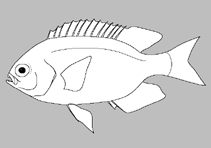
Spine dorsali (totale) : 13; Raggi dorsali molli (totale) : 10 - 11; Spine anali: 2; Raggi anali molli: 10 - 12. Tubed lateral line scales 11-14; brilliant deep blue with lighter blue ocellus-like markings on head and breast, and black spot or blotch at base of posterior dorsal rays; caudal fin emarginate (Ref. 31117). Body depth 1.9-2.2 in SL (Ref. 90102).
Adults are found in sheltered seaward coral reefs and lagoons (Ref. 31117), in aggregations within Acropora sp. and Seriatopora histrix (Ref. 41819). Presumably feeding on zooplankton (Ref. 31117). Oviparous, distinct pairing during breeding (Ref. 205). Eggs are demersal and adhere to the substrate (Ref. 205). Males guard and aerate the eggs (Ref. 205). Diurnal species (Ref. 52881).
Life cycle and mating behavior
Maturità | Riproduzione | Deposizione | Uova | Fecundity | Larve
Oviparous, distinct pairing during breeding (Ref. 205). Eggs are demersal and adhere to the substrate (Ref. 205). Males guard and aerate the eggs (Ref. 205).
Hunnam, P., A. Jenkins, N. Kile and P. Shearman, 2001. Bismarck-Solomon Seas Ecoregion: Papua New Guinea Solomon Islands. p. 86. In Mangubhai, S., B. Masianini, D. Gorman and A. Jenkins (eds). Marine Resource Management and Conservation Planning. (Ref. 41819)
IUCN Red List Status (Ref. 130435: Version 2025-1)
Threat to humans
Harmless
Human uses
Strumenti
Special reports
Download XML
Fonti Internet
Estimates based on models
Preferred temperature (Fonte Biblio.
123201): 27.3 - 29.1, mean 27.8 °C (based on 10 cells).
Phylogenetic diversity index (Fonte Biblio.
82804): PD
50 = 0.5000 [Uniqueness, from 0.5 = low to 2.0 = high].
Bayesian length-weight: a=0.01000 (0.00244 - 0.04107), b=3.04 (2.81 - 3.27), in cm total length, based on all LWR estimates for this body shape (Ref.
93245).
Trophic level (Fonte Biblio.
69278): 3.4 ±0.45 se; based on food items.
Resilienza (Fonte Biblio.
120179): Alto, tempo minimo di raddoppiamento della popolazione meno di 15 mesi (Preliminary K or Fecundity.).
Fishing Vulnerability (Ref.
59153): Low vulnerability (10 of 100).
🛈