


Sternopygus branco Crampton, Hulen & Albert, 2004
अपना अपलोड करें तस्वीरें और वीडियो
Google image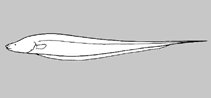 No image available for this species;
drawing shows typical species in Sternopygidae.
Google image
drawing shows typical species in Sternopygidae.
वर्गीकरण / नाम आम नाम | उपशब्द | Catalog of Fishes(वर्ग, प्रजाति) | ITIS | CoL | WoRMS | Cloffa
> Gymnotiformes (Knifefishes) > Sternopygidae (Glass knifefishes) > Sternopyginae
Etymology: Sternopygus: Greek, sternon = sternon, + Greek, pyge = tail (Ref. 45335); branco: Specific epithet from the Portuguese word meaning white, referring to the characteristic pale color of freshly netted live specimens; noun in apposition.
Etymology: Sternopygus: Greek, sternon = sternon, + Greek, pyge = tail (Ref. 45335); branco: Specific epithet from the Portuguese word meaning white, referring to the characteristic pale color of freshly netted live specimens; noun in apposition.
पर्यावरण: पर्यावरण / जलवायु क्षेत्र / गहराई सीमा / वितरण सीमा पारिस्थितिकी
; स्वच्छ जल, अलवण जल बेनथोपिलाजिक. Tropical
वितरण प्रदेशों | ऐफ ऐ ओ क्षेत्र | पारिस्थितिकी प्रणालियों | संयोग | बिन्दु नक्शा | भूमिका | Faunafri
South America: Amazon River, Brazil.
आकार / वज़न / आयु
संक्षिप्त वर्णन पहचान कुंजी | आकृति विज्ञान | मौरफोमैटरिक्स
ऐनल सौफट रेज़: 250 - 340.
Occurs in the main channels of major rivers or side branches; not known to occur in seasonally inundated floodplain forests or in forest steams of the Amazon's terra firme. In the Tefé region, this species is caught with beach seines and trawl nets at depth up to 10 meters in areas with weak currents, such as in large eddies, sheltered bays or "paranás" (side-branches of the main river channels that wind their way through the whitewater "várzea" floodplain); occurs syntopically with Sternopygus macrurus in whitewater habitats, but never with Sternopygus atrabes. This species does not occur where currents near the substrate exceeded 0.1 m/sec. At daytime it is usually encountered near submerged structures such as fallen trees and driftwood, and at night it moves into shallower water and away from structures. Specimens are collected on both sand and mud bottoms. It does not live in groups as indicated by electrode surveys and its sporadic occurrence in nets. Sexually mature males were never encountered, but gravid females were found along the edge of whitewater floodplain areas and in paraná channels during the rising water months of January and February. Feeds mainly on autochthonous insect larvae which it encounters on the substrate; the presence of small pieces of wood in many of the stomachs indicate that it forages among organic detritus on the river bed rather than within rafts of floating meadows or marginal macrophytes (Ref. 55493).
जीवन चक्र और संभोग व्यवहार परिपक्व अवधि | पुनरुत्पत्ति | मछलीऔ का अंडे देना | अंडे | उपजाऊपन | लार्वा
मुख्य संदर्भ
अपने संदर्भ अपलोड करें | संदर्भ | संयोजक : Albert, James S. | सहयोगीयो
Crampton, W.G.R., K.G. Hulen and J.S. Albert, 2004. Redescription of Sternopygus obtusirostris (Gymnotiformes: Sternopygidae) from the Amazon basin, with description of osteology, ecology and electric organ discharges. Ichthyol. Explor. Freshwat. 15(2):121-134. (Ref. 52797)
आईयूसीएन रेड लिस्ट स्थिति (Ref. 130435: Version 2025-2 (Global))
Least Concern (LC) ; Date assessed: 03 December 2020
CITES
Not Evaluated
मनुष्यों के लिए ख़तरा
Harmless
मानव उपयोग
FAO - Publication: search | FishSource |
अधिक जानकारी
जनसंख्या गतिशीलता
विकास मापदंड
अधिकतम आयु/आकार
लंबाई-वजन संबंध
लंबाई-लंबाई संबंध
लंबाई-आवृत्तियाँ
सामूहिक रूपांतरण
भर्ती
बहुतायत
विकास मापदंड
अधिकतम आयु/आकार
लंबाई-वजन संबंध
लंबाई-लंबाई संबंध
लंबाई-आवृत्तियाँ
सामूहिक रूपांतरण
भर्ती
बहुतायत
जीवन चक्र
पुनरुत्पत्ति
परिपक्व अवधि
परिपक्वता/गिल्स संबंध
उपजाऊपन
मछलीऔ का अंडे देना
स्पॉनिंग एकत्रीकरण
अंडे
अंडे का विकास
लार्वा
लारवल गतिकी
पुनरुत्पत्ति
परिपक्व अवधि
परिपक्वता/गिल्स संबंध
उपजाऊपन
मछलीऔ का अंडे देना
स्पॉनिंग एकत्रीकरण
अंडे
अंडे का विकास
लार्वा
लारवल गतिकी
शरीर रचना
गिल क्षेत्र
दिमाग
ओटोलिथ
गिल क्षेत्र
दिमाग
ओटोलिथ
फिजियोलॉजी
शारीरिक संरचना
पोषक तत्व
प्राणवायु की खपत
तैराकी का प्रकार
तैराकी की गति
दृश्य वर्णक
मछली की आवाज
रोग एवं परजीवी
विषाक्तता (LC50s)
शारीरिक संरचना
पोषक तत्व
प्राणवायु की खपत
तैराकी का प्रकार
तैराकी की गति
दृश्य वर्णक
मछली की आवाज
रोग एवं परजीवी
विषाक्तता (LC50s)
आनुवंशिकी
जीनोम
आनुवंशिकी
विषमयुग्मजी
हैरेटिबिलटी
आनुवंशिक विविधता
जीनोम
आनुवंशिकी
विषमयुग्मजी
हैरेटिबिलटी
आनुवंशिक विविधता
साधन
ई-पुस्तक | कार्यक्षेत्र पथप्रदर्शक | लंबाई आवृति इंद्रजालिक | जीवन-इतिहास उपकरण | बिन्दु नक्शा |
कैच-एमएसवाई |
विशेष रिपोर्ट
एक्वेरियम के रखरखाव की जांच करें | प्रजातियों के तथ्य पत्रक की जाँच करें | जलीय कृषि तथ्य पत्रक की जाँच करें
XML डाउनलोड करें
सारांश पृष्ठ | बिंदु डेटा | आम नाम | तस्वीरें
इंटरनेट स्रोत
AFORO (otoliths) | Aquatic Commons | BHL | Cloffa | Websites from users | Check FishWatcher | CISTI | Catalog of Fishes: वर्ग, प्रजाति | DiscoverLife | ECOTOX | FAO - Publication: search | Faunafri | Fishipedia | Fishtrace | GloBI | Google Books | Google Scholar | Google | IGFA World Record | OneZoom | Open Tree of Life | Otolith Atlas of Taiwan Fishes | PubMed | Reef Life Survey | Socotra Atlas | TreeBase | Tree of Life | Wikipedia: Go, खोज | World Records Freshwater Fishing | Zoobank | प्राणीशास्त्रीय अभिलेख
मॉडल पर आधारित अनुमान
जातिवृति विविधता सूचकांक (संदर्भ 82804): PD50 = 0.5010 [Uniqueness, from 0.5 = low to 2.0 = high].
Bayesian length-weight: a=0.00347 (0.00144 - 0.00832), b=3.01 (2.80 - 3.22), in cm total length, based on LWR estimates for this (Sub)family-body shape (Ref. 93245).
ट्रॉफिक स्तर (संदर्भ 69278): 2.6 ±0.27 se; based on food items.