


Sternopygus branco Crampton, Hulen & Albert, 2004
Sube tu fotos y Vídeos
Google image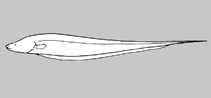 No image available for this species;
drawing shows typical species in Sternopygidae.
Google image
drawing shows typical species in Sternopygidae.
Clasificación / Nombres Nombres comunes | Sinónimos | Catalog of Fishes(Género, Especie) | ITIS | CoL | WoRMS | Cloffa
> Gymnotiformes (Knifefishes) > Sternopygidae (Glass knifefishes) > Sternopyginae
Etymology: Sternopygus: Greek, sternon = sternon, + Greek, pyge = tail (Ref. 45335); branco: Specific epithet from the Portuguese word meaning white, referring to the characteristic pale color of freshly netted live specimens; noun in apposition.
Etymology: Sternopygus: Greek, sternon = sternon, + Greek, pyge = tail (Ref. 45335); branco: Specific epithet from the Portuguese word meaning white, referring to the characteristic pale color of freshly netted live specimens; noun in apposition.
Entorno: milieu / zona climática / rango de profundidad / gama de distribución Ecología
; agua dulce bentopelágico. Tropical
Distribución Territorios | Áreas FAO | Ecosistemas | Ocurrencias, apariciones | Mapa de puntos | Introducciones | Faunafri
South America: Amazon River, Brazil.
Tamaño / Peso / Edad
Descripción breve Claves de identificación | Morfología | Morfometría
Radios blandos anales: 250 - 340.
Occurs in the main channels of major rivers or side branches; not known to occur in seasonally inundated floodplain forests or in forest steams of the Amazon's terra firme. In the Tefé region, this species is caught with beach seines and trawl nets at depth up to 10 meters in areas with weak currents, such as in large eddies, sheltered bays or "paranás" (side-branches of the main river channels that wind their way through the whitewater "várzea" floodplain); occurs syntopically with Sternopygus macrurus in whitewater habitats, but never with Sternopygus atrabes. This species does not occur where currents near the substrate exceeded 0.1 m/sec. At daytime it is usually encountered near submerged structures such as fallen trees and driftwood, and at night it moves into shallower water and away from structures. Specimens are collected on both sand and mud bottoms. It does not live in groups as indicated by electrode surveys and its sporadic occurrence in nets. Sexually mature males were never encountered, but gravid females were found along the edge of whitewater floodplain areas and in paraná channels during the rising water months of January and February. Feeds mainly on autochthonous insect larvae which it encounters on the substrate; the presence of small pieces of wood in many of the stomachs indicate that it forages among organic detritus on the river bed rather than within rafts of floating meadows or marginal macrophytes (Ref. 55493).
Ciclo vital y comportamiento de apareamiento Madurez | Reproducción | Puesta | Huevos | Fecundidad | Larva
Referencia principal
Suba sus referencias | Referencias | Coordinador : Albert, James S. | Colaboradores
Crampton, W.G.R., K.G. Hulen and J.S. Albert, 2004. Redescription of Sternopygus obtusirostris (Gymnotiformes: Sternopygidae) from the Amazon basin, with description of osteology, ecology and electric organ discharges. Ichthyol. Explor. Freshwat. 15(2):121-134. (Ref. 52797)
Situación en la Lista Roja de la UICN (Ref. 130435: Version 2025-2 (Global))
Least Concern (LC) ; Date assessed: 03 December 2020
CITES
Not Evaluated
Amenaza para el ser humano
Harmless
Usos humanos
FAO - Publication: search | FishSource |
Más información
Ecología Trófica
Alimentos (presas)
Composición de la dieta
consumo de alimento
Raciones de comida
Despredadores
Alimentos (presas)
Composición de la dieta
consumo de alimento
Raciones de comida
Despredadores
Dinámica de la población
Coeficiente del crecimiento para
Edades / tallas máximas
Longitud-peso rel.
Longitud-longitud rel.
Longitud-frecuencias
Conversión de masas
Reclutamiento
Abundancia
Coeficiente del crecimiento para
Edades / tallas máximas
Longitud-peso rel.
Longitud-longitud rel.
Longitud-frecuencias
Conversión de masas
Reclutamiento
Abundancia
Ciclo de vida
Reproducción
Madurez
Madurez/Gills rel.
Fecundidad
Puesta
Agregaciones de desove
Huevos
Desarrollo de los huevos
Larva
Dinámica larvaria
Reproducción
Madurez
Madurez/Gills rel.
Fecundidad
Puesta
Agregaciones de desove
Huevos
Desarrollo de los huevos
Larva
Dinámica larvaria
Distribución
Territorios
Áreas FAO
Ecosistemas
Ocurrencias, apariciones
Introducciones
BRUVS - Vídeos
Territorios
Áreas FAO
Ecosistemas
Ocurrencias, apariciones
Introducciones
BRUVS - Vídeos
Anatomía
Superficie branquial
Cerebro
Otolito
Superficie branquial
Cerebro
Otolito
Fisiología
Composición corporal
Nutrientes
Consumo del oxígeno
Tipo de natación
Velocidad de natación
Pigmentos visuales
Sonido de peces
Enfermedades y parásitos
Toxicidad (CL50)
Composición corporal
Nutrientes
Consumo del oxígeno
Tipo de natación
Velocidad de natación
Pigmentos visuales
Sonido de peces
Enfermedades y parásitos
Toxicidad (CL50)
Genética
Genoma
Genética
Heterocigosidad
heritabilidad
Diversidad genética
Genoma
Genética
Heterocigosidad
heritabilidad
Diversidad genética
Relacionados con el ser humano
Sistemas de acuicultura
Perfiles de acuicultura
Razas
Ciguatera cases
Sellos, monedas, varios
Sistemas de acuicultura
Perfiles de acuicultura
Razas
Ciguatera cases
Sellos, monedas, varios
Herramientas
Libro electrónico | Guía de campo | Asistente para frecuencias de tallas | Herramienta de ciclo de vida | Mapa de puntos |
Catch-MSY |
Informes especiales
Comprobar el mantenimiento del acuario | Buscar fichas sobre especies | Consulte las hojas informativas sobre acuicultura
Descargar XML
Fuentes de Internet
AFORO (otoliths) | Aquatic Commons | BHL | Cloffa | Websites from users | Check FishWatcher | CISTI | Catalog of Fishes: Género, Especie | DiscoverLife | ECOTOX | FAO - Publication: search | Faunafri | Fishipedia | Fishtrace | GloBI | Google Books | Google Scholar | Google | IGFA World Record | OneZoom | Open Tree of Life | Otolith Atlas of Taiwan Fishes | PubMed | Reef Life Survey | Socotra Atlas | TreeBase | Árbol de la vida | Wikipedia: Go, búsqueda | World Records Freshwater Fishing | Zoobank | Expediente Zoológico
Estimaciones basadas en modelos
Índice de diversidad filogenética (Referencia 82804): PD50 = 0.5010 [Uniqueness, from 0.5 = low to 2.0 = high].
Bayesian length-weight: a=0.00347 (0.00144 - 0.00832), b=3.01 (2.80 - 3.22), in cm total length, based on LWR estimates for this (Sub)family-body shape (Ref. 93245).
Nivel trófico (Referencia 69278): 2.6 ±0.27 se; based on food items.