


Gymnocranius oblongus Borsa, Béarez & Chen, 2010
muatnaik fotos/gambar dan video
Gambar | imej Google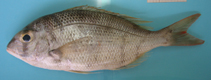 Gymnocranius oblongus
foto/gambar oleh Borsa, P.
Gambar | imej Google
foto/gambar oleh Borsa, P.
klasifikasi / Nama Nama-nama umum | Sinonim (persamaan) | Catalog of Fishes(Marga, Jenis) | ITIS | CoL | WoRMS | Cloffa
> Eupercaria/misc (Various families in series Eupercaria) > Lethrinidae (Emperors or scavengers) > Monotaxinae
Etymology: Gymnocranius: Greek, gymnos = naked + Greek, kranion = skull (Ref. 45335).
Etymology: Gymnocranius: Greek, gymnos = naked + Greek, kranion = skull (Ref. 45335).
Lingkungan: lingkungan / zona iklim / kisaran kedalaman / jangkauan distribusi Ekologi
laut bentopelagis; kisaran kedalaman 10 - 35 m (Ref. 101097). Subtropical; 22°S - 23°S, 166°E - 167°E
Penyebaran Wilayah | Daerah-daerah FAO | Ekosistem | Kemunculan | peta titik | Introduksi | Faunafri
Pacific Ocean: New Caledonia (Ref. 84158).
Ukuran / Berat / umur
deskripsi pendek Kunci identifiaksi (pengenalan) | Morfologi | Morfometrik
A species of Lethrinidae with the following combination of characters: four rows of scales on cheek; 10 soft rays in dorsal fin; ten soft rays in anal fin; body oblong (hence the species epithet) and fusiform, ratio of standard length to body depth between 2.6 and 2.8, increasing with size; dorsal and ventral profiles almost similarly convex; tip of snout only slightly below axis of body; snout slightly rounded; tail elongated with rounded tips; posterior part of jaws reaching to about level of nostril; pored scales on lateral line: 48; scales between middle portion of spinous dorsal fin and lateral line: six. Lower edge of eye slightly (in the smaller individuals examined) to well above a line from tip of snout to middle of caudal fin fork; horizontal or sub-horizontal wavy blue lines or dashes on lower part of snout and on cheeks; pale blue speckles more or less visible on operculum. The lines or dashes become dark red or brown against paler background in preserved specimens; they do not extend up to the upper part of snout and their number slightly increases with size. Forehead, snout and upper lip of fresh specimens can be bright yellow, matched by similar yellow colouration of margin of operculum; loosely defined vertical dark bar crossing the eye; on fresh animals, dorsal, pectoral, anal and caudal fins drab, brownish or yellowish, with reddish to vermilion edges. Each lower jaw has a raw of three small, slender canines on each side of one large canine at front, and a lateral row of eight to 10 conical teeth; numerous villiform teeth form a brush behind the front canines; each upper jaw has a front row of six to 10 small, slender canines followed by four to five conical teeth and a patch of villiform teeth.
Siklus hidup dan perilaku kawin Kematangan | Reproduksi, perkembang biakan | Pemijahan | telur-telur | Fekunditas | Larva
rujukan utama
Unggah referensi Anda | Acuan | Koordinator | mitra
Borsa, P., P. Béarez and W.-J. Chen, 2010. Gymnocranius oblongus, a new large-eye bream species from New Caledonia (Teleostei: Lethrinidae). C. R. Biologies 333:241-247. (Ref. 84158)
Status IUCN Red List (Ref. 130435: Version 2025-2 (Global))
kekurangan data (DD) ; Date assessed: 09 March 2015
CITES
Not Evaluated
ancaman kepada manusia
Harmless
penggunaan manusia
FAO - Publication: search | FishSource |
informasi lanjut
Ekologi trofik
Item makanan (mangsa)
Komposisi makanan
Konsumsi makanan
Ransum makanan
Pemangsa
Item makanan (mangsa)
Komposisi makanan
Konsumsi makanan
Ransum makanan
Pemangsa
Dinamika populasi
Parameter pertumbuhan
Maks. usia / ukuran
Panjang-berat rel.
Panjang-panjang rel.
ukuran frekuensi
Konversi massa
pemulihan
Kelimpahan
Parameter pertumbuhan
Maks. usia / ukuran
Panjang-berat rel.
Panjang-panjang rel.
ukuran frekuensi
Konversi massa
pemulihan
Kelimpahan
Siklus hidup
Reproduksi, perkembang biakan
Kematangan
Kedewasaan / insang rel.
Fekunditas
Pemijahan
Agregasi pemijahan
telur-telur
pekembangan telor
Larva
Dinamika larva
Reproduksi, perkembang biakan
Kematangan
Kedewasaan / insang rel.
Fekunditas
Pemijahan
Agregasi pemijahan
telur-telur
pekembangan telor
Larva
Dinamika larva
Anatomi
Area insang
Otak
Otolith
Area insang
Otak
Otolith
Fisiologi
Komposisi tubuh
Nutrisi
Konsumsi oksigen
Jenis renang
Kecepatan berenang
Pigmen visual
Suara ikan
Penyakit & Parasit
Toksisitas (LC50)
Komposisi tubuh
Nutrisi
Konsumsi oksigen
Jenis renang
Kecepatan berenang
Pigmen visual
Suara ikan
Penyakit & Parasit
Toksisitas (LC50)
Genetika
genom
Genetika
Heterozigositas
Diturunkan
Keanekaragaman Genetik
genom
Genetika
Heterozigositas
Diturunkan
Keanekaragaman Genetik
Yang berhubungan dengan manusia
Sistem akuakultur
profil budidaya air
Strain
Kasus Ciguatera
Perangko, koin, dll.
Sistem akuakultur
profil budidaya air
Strain
Kasus Ciguatera
Perangko, koin, dll.
Alat, peralatan
E-book | Penuntun lapangan | tanda freqkuenci panjang | peringkat sejarah hidup | peta titik |
Tangkap-MSY |
laporan khas
muat turun XML
Sumber internet
AFORO (otoliths) | Aquatic Commons | BHL | Cloffa | Websites from users | semak peneliti ikan | CISTI | Catalog of Fishes: Marga, Jenis | DiscoverLife | ECOTOX | FAO - Publication: search | Faunafri | Fishipedia | Fishtrace | GloBI | Google Books | Google Scholar | Google | IGFA World Record | OneZoom | Open Tree of Life | Otolith Atlas of Taiwan Fishes | PubMed | Reef Life Survey | Socotra Atlas | TreeBase | Tree of Life | Wikipedia: pergi, Cari | World Records Freshwater Fishing | Zoobank | Catatan Zoologi
Estimasi berdasarkan model
Indeks keanekaragaman filogenetik (Acuan 82804): PD50 = 0.5005 [Uniqueness, from 0.5 = low to 2.0 = high].
Bayesian length-weight: a=0.01698 (0.00720 - 0.04003), b=2.98 (2.79 - 3.17), in cm total length, based on LWR estimates for this (Sub)family-body shape (Ref. 93245).
Tingkat Trofik (Acuan 69278): 3.4 ±0.6 se; based on size and trophs of closest relatives
Daya lenting (Acuan 120179): sedang, Waktu penggandaan populasi minimum 1.4 - 4.4 tahun (Preliminary K or Fecundity.).