


Gymnocranius oblongus Borsa, Béarez & Chen, 2010
Envoyez vos Photos et vidéos
Images | Images Google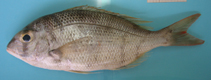 Gymnocranius oblongus
Photo de Borsa, P.
Images | Images Google
Photo de Borsa, P.
Classification / Noms Noms communs | Synonymes | Catalog of Fishes(Genre, Espèce) | ITIS | CoL | WoRMS | Cloffa
> Eupercaria/misc (Various families in series Eupercaria) > Lethrinidae (Emperors or scavengers) > Monotaxinae
Etymology: Gymnocranius: Greek, gymnos = naked + Greek, kranion = skull (Ref. 45335).
Etymology: Gymnocranius: Greek, gymnos = naked + Greek, kranion = skull (Ref. 45335).
Environnement : milieu / zone climatique / profondeur / gamme de distribution Écologie
marin benthopélagique; profondeur 10 - 35 m (Ref. 101097). Subtropical; 22°S - 23°S, 166°E - 167°E
Distribution Territoires | Zones FAO | Écosystèmes | Occurrences | Carte par point | Introductions | Faunafri
Pacific Ocean: New Caledonia (Ref. 84158).
Taille / Poids / Âge
Description synthétique Clés d'identification | Morphologie | Morphométrie
A species of Lethrinidae with the following combination of characters: four rows of scales on cheek; 10 soft rays in dorsal fin; ten soft rays in anal fin; body oblong (hence the species epithet) and fusiform, ratio of standard length to body depth between 2.6 and 2.8, increasing with size; dorsal and ventral profiles almost similarly convex; tip of snout only slightly below axis of body; snout slightly rounded; tail elongated with rounded tips; posterior part of jaws reaching to about level of nostril; pored scales on lateral line: 48; scales between middle portion of spinous dorsal fin and lateral line: six. Lower edge of eye slightly (in the smaller individuals examined) to well above a line from tip of snout to middle of caudal fin fork; horizontal or sub-horizontal wavy blue lines or dashes on lower part of snout and on cheeks; pale blue speckles more or less visible on operculum. The lines or dashes become dark red or brown against paler background in preserved specimens; they do not extend up to the upper part of snout and their number slightly increases with size. Forehead, snout and upper lip of fresh specimens can be bright yellow, matched by similar yellow colouration of margin of operculum; loosely defined vertical dark bar crossing the eye; on fresh animals, dorsal, pectoral, anal and caudal fins drab, brownish or yellowish, with reddish to vermilion edges. Each lower jaw has a raw of three small, slender canines on each side of one large canine at front, and a lateral row of eight to 10 conical teeth; numerous villiform teeth form a brush behind the front canines; each upper jaw has a front row of six to 10 small, slender canines followed by four to five conical teeth and a patch of villiform teeth.
Cycle de vie et comportement reproducteur Maturité | Reproduction | Frai | Œufs | Fécondité | Larves
Référence principale
Téléchargez vos références | Références | Coordinateur | Collaborateurs
Borsa, P., P. Béarez and W.-J. Chen, 2010. Gymnocranius oblongus, a new large-eye bream species from New Caledonia (Teleostei: Lethrinidae). C. R. Biologies 333:241-247. (Ref. 84158)
Statut dans la liste rouge de l'IUCN (Ref. 130435: Version 2025-2 (Global))
Données manquantes (DD) ; Date assessed: 09 March 2015
CITES
Not Evaluated
Menace pour l'homme
Harmless
Utilisations par l'homme
FAO - Publication: search | FishSource |
Plus d'informations
Écologie trophique
Aliments (proies)
Composition du régime alimentaire
Consommation alimentaire
Rations alimentaires
Prédateurs
Aliments (proies)
Composition du régime alimentaire
Consommation alimentaire
Rations alimentaires
Prédateurs
Dynamique des populations
Paramètres de croissance
Âges / tailles maximales
Longueur-poids rel.
Rel. longueur-longueur.
Fréquences de longueurs
Conversion de masse
Recrutement
Abondance
Paramètres de croissance
Âges / tailles maximales
Longueur-poids rel.
Rel. longueur-longueur.
Fréquences de longueurs
Conversion de masse
Recrutement
Abondance
Cycle de vie
Reproduction
Maturité
Maturité/épines rel.
Fécondité
Frai
Agrégats de frai
Œufs
Développement de l'œuf
Larves
Dynamique des populations larvaires
Reproduction
Maturité
Maturité/épines rel.
Fécondité
Frai
Agrégats de frai
Œufs
Développement de l'œuf
Larves
Dynamique des populations larvaires
Anatomie
Surface branchiale
Cerveau
Otolithe
Surface branchiale
Cerveau
Otolithe
Physiologie
Composition corporelle
Nutriments
Consommation d'oxygène
Type de natation
Vitesse de nage
Pigments visuels
Son de poisson
Maladies et parasites
Toxicité (CL50)
Composition corporelle
Nutriments
Consommation d'oxygène
Type de natation
Vitesse de nage
Pigments visuels
Son de poisson
Maladies et parasites
Toxicité (CL50)
Génétique
génôme
Génétique
Hétérozygotie
Héritabilité
Diversité génétique
génôme
Génétique
Hétérozygotie
Héritabilité
Diversité génétique
Liées à l'homme
Systèmes d'aquaculture
Profils d'aquaculture
Souches
Cas de ciguatera
Timbres, pièces de monnaie, divers
Systèmes d'aquaculture
Profils d'aquaculture
Souches
Cas de ciguatera
Timbres, pièces de monnaie, divers
Outils
E-book | Guide de terrain | Générateur de fréquences de longueur | Outil de dynamique de population | Carte par point |
Capture-MSY |
Articles particuliers
Télécharger en XML
Sources Internet
AFORO (otoliths) | Aquatic Commons | BHL | Cloffa | Websites from users | FishWatcher | CISTI | Catalog of Fishes: Genre, Espèce | DiscoverLife | ECOTOX | FAO - Publication: search | Faunafri | Fishipedia | Fishtrace | GloBI | Google Books | Google Scholar | Google | IGFA World Record | OneZoom | Open Tree of Life | Otolith Atlas of Taiwan Fishes | PubMed | Reef Life Survey | Socotra Atlas | TreeBase | Arbre de Vie | Wikipedia: aller à, chercher | World Records Freshwater Fishing | Zoobank | Zoological Record
Estimations basées sur des modèles
Indice de diversité phylogénétique (Réf. 82804): PD50 = 0.5005 [Uniqueness, from 0.5 = low to 2.0 = high].
Bayesian length-weight: a=0.01698 (0.00720 - 0.04003), b=2.98 (2.79 - 3.17), in cm total length, based on LWR estimates for this (Sub)family-body shape (Ref. 93245).
Niveau trophique (Réf. 69278): 3.4 ±0.6 se; based on size and trophs of closest relatives
Résilience (Réf. 120179): Milieu, temps minimum de doublement de population : 1,4 à 4,4 années (Preliminary K or Fecundity.).