>
Gobiiformes (Gobies) >
Gobiidae (Gobies) > Gobiinae
Etymology: Cryptocentrus: Greek, kryptos = hidden + Greek, kentron = sting (Ref. 45335); multicinctus: Name from Latin word meaning many-belts or zones; referring to the diagnostic barred colour pattern which is most evident in the female.
Environment: milieu / climate zone / rango de profundidad / distribution range
Ecología
marino asociado a arrecife(Ref. 92356). Tropical
Western Pacific: Palau, Indonesia, Marshall Is. and Papua New Guinea.
Tamaño / Peso / Age
Madurez: Lm ? range ? - ? cm
Max length : 9.0 cm SL macho / no sexado; (Ref. 92356); 5.9 cm SL (female)
Short description
Claves de identificación | Morfología | Morfometría
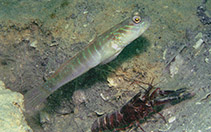
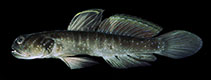
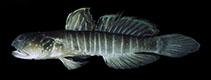
Espinas dorsales (total) : 6 - 7; Radios blandos dorsales (total) : 10; Espinas anales: 1; Radios blandos anales: 9. Characterized by the following: dorsal rays VI-I,10; anal rays I,9; pectoral rays 16; scales in longitudinal series 79-83; predorsal scales 22-28; all scales cycloid; anterior part of breast,
prepelvic region, and pectoral-fin base naked; head naked except side of nape and predorsal region, these scales extending anteriorly to about level of middle of opercle; body depth at pelvic-fin origin 5.4-5.6 in SL; vomerine teeth present; gill opening extending forward to a vertical at posterior edge of preopercle or slightly anterior; dorsal spines progressively longer to fourth, longest 1.0-1.55 in HL; caudal fin lanceolate, 3.1-3.3 in SL; pectoral fins reaching to level of interdorsal space, 4.3-4.8 in SL; pelvic fins reaching posteriorly to between anus and anal-fin origin, 3.1-4.2 in SL; colour pattern features of freshly collected female: general olive colour, 5-6 oblique rows of blue lines and spots on side of head, about six brown bars on body with narrow whitish margins; brownish blotch on caudal peduncle, sometimes with scattered small blue spots on body; brown to greenish median fins with blue streaks corresponding with fin rays, and yellow margin on first dorsal fin; male similar, ground colour often pale (light green to nearly whitish); pattern of dark and pale bars less distinct and side with numerous, widely scattered small blue spots. (Ref. 92356).
Collected specimens were found near the wreck of a Japanese ship on a silty sand bottom in 4 m depth. Observed generally in pairs that share their burrows with a very active, unidentified species of alpheid shrimp (Ref. 92356).
Life cycle and mating behavior
Madurez | Reproducción | Puesta | Huevos | Fecundidad | Larva
Allen, G.R. and J.E. Randall, 2011. Two new species of shrimp-associated gobies (Gobiidae: Cryptocentrus) from the Western Pacific. Marine Biology Research 7(6):554-564. (Ref. 92356)
IUCN Red List Status (Ref. 130435: Version 2025-1)
Threat to humans
Harmless
Human uses
Herramientas
Special reports
Download XML
Fuentes de Internet
Estimates based on models
Phylogenetic diversity index (Referencia
82804): PD
50 = 0.5000 [Uniqueness, from 0.5 = low to 2.0 = high].
Bayesian length-weight: a=0.00724 (0.00339 - 0.01546), b=3.10 (2.92 - 3.28), in cm total length, based on LWR estimates for this (Sub)family-body shape (Ref.
93245).
Nivel trófico (Referencia
69278): 3.3 ±0.4 se; based on size and trophs of closest relatives
Resiliencia (Referencia
120179): Alto, población duplicada en un tiempo mínimo inferior a 15 meses (Preliminary K or Fecundity.).
Fishing Vulnerability (Ref.
59153): Low vulnerability (10 of 100).
🛈