This website uses cookies to enhance your browsing experience and ensure the functionality of our site. For more detailed information about the types of cookies we use and how we protect your privacy, please visit our Privacy Information page.
×
Cookie Settings
This website uses different types of cookies to enhance your experience. Please select your preferences below:
> Gobiiformes (Gobies) > Gobiidae (Gobies) > Gobiinae
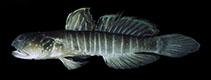
Etymology: Cryptocentrus:Greek, kryptos = hidden + Greek, kentron = sting (Ref. 45335); multicinctus:Name from Latin word meaning many-belts or zones; referring to the diagnostic barred colour pattern which is most evident in the female.
Western Pacific: Palau, Indonesia, Marshall Is. and Papua New Guinea.
Storlek / Vikt / Ålder
Könsmognad: Lm? range ? - ? cm Max length : 9.0 cm SL hane/ej könsbestämd; (Ref. 92356); 5.9 cm SL (female)
Kort beskrivning Bestämningsnycklar | Morfologi | Morfometri
Taggstrålar i ryggfenan (totalt) : 6 - 7; Mjukstrålar i ryggfenan (totalt) : 10; Taggstrålar i analfenan: 1; Mjukstrålar i analfenan: 9. Characterized by the following: dorsal rays VI-I,10; anal rays I,9; pectoral rays 16; scales in longitudinal series 79-83; predorsal scales 22-28; all scales cycloid; anterior part of breast,
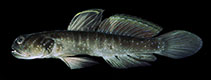
prepelvic region, and pectoral-fin base naked; head naked except side of nape and predorsal region, these scales extending anteriorly to about level of middle of opercle; body depth at pelvic-fin origin 5.4-5.6 in SL; vomerine teeth present; gill opening extending forward to a vertical at posterior edge of preopercle or slightly anterior; dorsal spines progressively longer to fourth, longest 1.0-1.55 in HL; caudal fin lanceolate, 3.1-3.3 in SL; pectoral fins reaching to level of interdorsal space, 4.3-4.8 in SL; pelvic fins reaching posteriorly to between anus and anal-fin origin, 3.1-4.2 in SL; colour pattern features of freshly collected female: general olive colour, 5-6 oblique rows of blue lines and spots on side of head, about six brown bars on body with narrow whitish margins; brownish blotch on caudal peduncle, sometimes with scattered small blue spots on body; brown to greenish median fins with blue streaks corresponding with fin rays, and yellow margin on first dorsal fin; male similar, ground colour often pale (light green to nearly whitish); pattern of dark and pale bars less distinct and side with numerous, widely scattered small blue spots. (Ref. 92356).
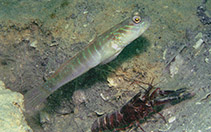
Collected specimens were found near the wreck of a Japanese ship on a silty sand bottom in 4 m depth. Observed generally in pairs that share their burrows with a very active, unidentified species of alpheid shrimp (Ref. 92356).
Allen, G.R. and J.E. Randall, 2011. Two new species of shrimp-associated gobies (Gobiidae: Cryptocentrus) from the Western Pacific. Marine Biology Research 7(6):554-564. (Ref. 92356)
Status på IUCN:s rödlista (Ref. 130435: Version 2025-2 (Global))
Index för fylogenetisk mångfald (Ref. 82804): PD50 = 0.5000 [Uniqueness, from 0.5 = low to 2.0 = high].
Bayesian length-weight: a=0.00741 (0.00347 - 0.01582), b=3.09 (2.91 - 3.27), in cm total length, based on LWR estimates for this (Sub)family-body shape (Ref. 93245).
Trofisk nivå (Ref. 69278): 3.3 ±0.4 se; based on size and trophs of closest relatives
Resiliens (Ref. 120179): Hög, lägsta populationsfördubblingstid mindre än 15 månader (Preliminary K or Fecundity.).
Sårbarhet i fisket (Ref. 59153): Low vulnerability (10 of 100). 🛈