


Nothobranchius prognathus Costa, 2019
Carregue seu(sua) Fotos e vídeos
Imagem do Google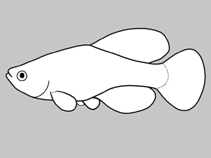 No image available for this species;
drawing shows typical species in Nothobranchiidae.
Imagem do Google
drawing shows typical species in Nothobranchiidae.
Classificação / Nomes Nomes comuns | Sinônimos | Catalog of Fishes(Gênero, Espécies) | ITIS | CoL | WoRMS | Cloffa
> Cyprinodontiformes (Rivulines, killifishes and live bearers) > Nothobranchiidae (African rivulines)
Etymology: Nothobranchius: Greek, nothos = false + Greek, brangchia = gill (Ref. 45335); prognathus: Name from the Latin prognathus, referring to the distinctive lower jaw of the new species that is anteriorly projected slightly beyond the upper jaw; an adjective (Ref. 119668).
Etymology: Nothobranchius: Greek, nothos = false + Greek, brangchia = gill (Ref. 45335); prognathus: Name from the Latin prognathus, referring to the distinctive lower jaw of the new species that is anteriorly projected slightly beyond the upper jaw; an adjective (Ref. 119668).
Meio ambiente: milieu / Zona climática / intervalo de profundidade / faixa de distribuição Ecologia
; Água doce pelágico(a,os,as). Tropical
Distribuição Territórios | Áreas da FAO | Ecossistemas | Ocorrências | Mapa de pontos | Introduções | Faunafri
Africa: upper Wami River in eastern Tanzania (Ref. 119668).
Tamanho / Peso / Idade
Descrição suscinta Chaves de identificação | Morfologia | Morfometria
Espinhos dorsais (total) : 0; Raios dorsais (total) : 15 - 16; Espinhos anais: 0; Raios anais : 17 - 18. Diagnosis: Nothobranchius prognathus differs from all other species of the Nothobranchius melanospilus complex in possessing lower jaw anteriorly projecting beyond upper jaw vs. not projecting; pelvic fins medially united in males vs. bases just in contact, but not united; and presence of three longitudinal series of scales on frontal region vs. two (Ref. 119668). It is also distinguished from all other species of the N. melanospilus complex by the combination of the following morphological character states: dorsal-fin origin anterior to anal-fin origin in both sexes vs. posterior in N. melanospilus; anterior supraorbital series of neuromasts divided in two sections vs. arranged in a single continuous row in N. melanospilus; mandibular neuromasts 14-16 vs. 17-21 in N. melanospilus; in females, few dark spots on anterior part of flank vs. dots absent on anterior part in N. melanospilus; body depth 32.7-35.5% of standard length in males, 32.1-33.4% of standard length in females vs. 27.5-32.2% and 27.1-30.9% of standard length in N. melanospilus and 28.7-30.9% and 25.8% of standard length in N. kwalensis; dorsal-fin base length 27.9-29.9% of standard length in males, 23.5-25.0% of standard length in females vs. 24.6-27.9% and 19.9-23.4% of standard length in N. melanospilus and 24.1-27.3% and 2.9% of standard length in N. kwalensis; head depth 90.4-99.2% of head length in males, 85-6-90.3% of head length in females vs. 78.0-87.8% and 74.6-80.7% of head length in N. melanospilus and 79.0-82.9% and 69.5% of head length in N. kwalensis; eye diameter 20.9-25.9% of head length in males, 21.1-24.4% of head length in females vs. 26.8-28.4% and 27.1% in N. kwalensis (Ref. 119668).
Body shape (shape guide): fusiform / normal; Cross section: compressed.
Body shape (shape guide): fusiform / normal; Cross section: compressed.
Ciclo de vida ou comportamento de acasalamento Maturidade | Reprodução | Desova | Ovos | Fecundidade | Larvas
Referência principal
Carregar suas referências | Referências | Coordenador | Colaboradores
Costa, W.J.E.M., 2019. Two new species of seasonal killifishes of the Nothobranchius melanospilus species complex from the East Africa biodiversity hotspot (Cyprinodontiformes: Aplocheilidae). Vert. Zool. 69(1):73-82. (Ref. 119668)
Status na Lista Vermelha da UICN (Ref. 130435: Version 2025-2 (Global))
Quase ameaçada (NT) (B1b(iii)+2b(iii)); Date assessed: 18 May 2020
CITES
Not Evaluated
Ameaça para os humanos
Harmless
Uso pelos humanos
FAO - Publication: search | FishSource |
Mais informação
Ecologia Trófica
Itens alimentares (presas)
Composição da dieta
Consumo alimentar
Rações alimentares
Predadores
Itens alimentares (presas)
Composição da dieta
Consumo alimentar
Rações alimentares
Predadores
Ecologia
Ecologia
Ecologia
Dinâmica populacional
Parâmetros de crescimento
Idade máxima / tamanhos
Relação comprimento-peso.
Relação comprimento-comprimento.
Frequências de comprimento
Conversão de massa
Recrutamento
Abundância
Parâmetros de crescimento
Idade máxima / tamanhos
Relação comprimento-peso.
Relação comprimento-comprimento.
Frequências de comprimento
Conversão de massa
Recrutamento
Abundância
Ciclo de vida
Reprodução
Maturidade
Maturidade/Rel. das guelras
Fecundidade
Desova
Agregações de desova
Ovos
Desenvolvimento dos ovos
Larvas
Dinâmica larval
Reprodução
Maturidade
Maturidade/Rel. das guelras
Fecundidade
Desova
Agregações de desova
Ovos
Desenvolvimento dos ovos
Larvas
Dinâmica larval
Anatomia
Área branquial
Cérebro
Otólito
Área branquial
Cérebro
Otólito
Fisiologia
Composição corporal
Nutrientes
Consumo de oxigênio
Tipo de natação
Velocidade de natação
Pigmentos visuais
Som de peixe
Doenças e Parasitas
Toxicidade (LC50s)
Composição corporal
Nutrientes
Consumo de oxigênio
Tipo de natação
Velocidade de natação
Pigmentos visuais
Som de peixe
Doenças e Parasitas
Toxicidade (LC50s)
Genética
genoma
Genética
Heterozigosidade
Hereditariedade
Diversidade genética
genoma
Genética
Heterozigosidade
Hereditariedade
Diversidade genética
Relacionado a humanos
Sistemas de aquicultura
Perfis para aquacultura
Estirpes
Casos de Ciguatera
Selos, moedas, diversos.
Sistemas de aquicultura
Perfis para aquacultura
Estirpes
Casos de Ciguatera
Selos, moedas, diversos.
Ferramentas
Livro eletrônico | Guia de campo | Ferramenta auxiliar de frequências de comprimento | Ferramenta sobre a história de vida | Mapa de pontos |
Catch-MSY |
Relatórios especiais
Checar Manutenção em Aquário | Checar Planilhas de Fatos sobre as Espécies | Checar Planilhas de Fatos sobre Aquicultura
Baixar XML
Fontes da internet
AFORO (otoliths) | Aquatic Commons | BHL | Cloffa | Websites from users | Checar Observador de Peixes (FishWatcher) | CISTI | Catalog of Fishes: Gênero, Espécies | DiscoverLife | ECOTOX | FAO - Publication: search | Faunafri | Fishipedia | Fishtrace | GloBI | Google Books | Google Scholar | Google | IGFA World Record | OneZoom | Open Tree of Life | Otolith Atlas of Taiwan Fishes | PubMed | Reef Life Survey | Socotra Atlas | TreeBase | Árvore da vida | Wikipedia: Ir para, procura | World Records Freshwater Fishing | Zoobank | Registro zoológico
Estimativas baseadas em modelos
Índice de diversidade filogenética (Ref. 82804): PD50 = 0.5000 [Uniqueness, from 0.5 = low to 2.0 = high].
Bayesian length-weight: a=0.00603 (0.00250 - 0.01453), b=3.13 (2.93 - 3.33), in cm total length, based on LWR estimates for this (Sub)family-body shape (Ref. 93245).
Nível Trófico (Ref. 69278): 3.2 ±0.4 se; based on size and trophs of closest relatives