


Nothobranchius prognathus Costa, 2019
Ladda upp din foton och Videor
Google image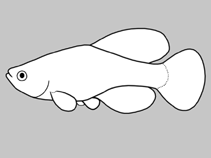 No image available for this species;
drawing shows typical species in Nothobranchiidae.
Google image
drawing shows typical species in Nothobranchiidae.
Klassificering / Namn Populärnamn | synonymer | Catalog of Fishes(Släkte, Arter) | ITIS | CoL | WoRMS | Cloffa
> Cyprinodontiformes (Rivulines, killifishes and live bearers) > Nothobranchiidae (African rivulines)
Etymology: Nothobranchius: Greek, nothos = false + Greek, brangchia = gill (Ref. 45335); prognathus: Name from the Latin prognathus, referring to the distinctive lower jaw of the new species that is anteriorly projected slightly beyond the upper jaw; an adjective (Ref. 119668).
Etymology: Nothobranchius: Greek, nothos = false + Greek, brangchia = gill (Ref. 45335); prognathus: Name from the Latin prognathus, referring to the distinctive lower jaw of the new species that is anteriorly projected slightly beyond the upper jaw; an adjective (Ref. 119668).
Miljö: miljö / Klimatzon / djupintervall / distributionsområde Ekologi
; sötvatten pelagiska. Tropical
Utbredning Territorier | FAO områden | Ekosystem | Förekomster | Prickkarta | Utplanteringar | Faunafri
Africa: upper Wami River in eastern Tanzania (Ref. 119668).
Storlek / Vikt / Ålder
Kort beskrivning Bestämningsnycklar | Morfologi | Morfometri
Taggstrålar i ryggfenan (totalt) : 0; Mjukstrålar i ryggfenan (totalt) : 15 - 16; Taggstrålar i analfenan: 0; Mjukstrålar i analfenan: 17 - 18. Diagnosis: Nothobranchius prognathus differs from all other species of the Nothobranchius melanospilus complex in possessing lower jaw anteriorly projecting beyond upper jaw vs. not projecting; pelvic fins medially united in males vs. bases just in contact, but not united; and presence of three longitudinal series of scales on frontal region vs. two (Ref. 119668). It is also distinguished from all other species of the N. melanospilus complex by the combination of the following morphological character states: dorsal-fin origin anterior to anal-fin origin in both sexes vs. posterior in N. melanospilus; anterior supraorbital series of neuromasts divided in two sections vs. arranged in a single continuous row in N. melanospilus; mandibular neuromasts 14-16 vs. 17-21 in N. melanospilus; in females, few dark spots on anterior part of flank vs. dots absent on anterior part in N. melanospilus; body depth 32.7-35.5% of standard length in males, 32.1-33.4% of standard length in females vs. 27.5-32.2% and 27.1-30.9% of standard length in N. melanospilus and 28.7-30.9% and 25.8% of standard length in N. kwalensis; dorsal-fin base length 27.9-29.9% of standard length in males, 23.5-25.0% of standard length in females vs. 24.6-27.9% and 19.9-23.4% of standard length in N. melanospilus and 24.1-27.3% and 2.9% of standard length in N. kwalensis; head depth 90.4-99.2% of head length in males, 85-6-90.3% of head length in females vs. 78.0-87.8% and 74.6-80.7% of head length in N. melanospilus and 79.0-82.9% and 69.5% of head length in N. kwalensis; eye diameter 20.9-25.9% of head length in males, 21.1-24.4% of head length in females vs. 26.8-28.4% and 27.1% in N. kwalensis (Ref. 119668).
Body shape (shape guide): fusiform / normal; Cross section: compressed.
Body shape (shape guide): fusiform / normal; Cross section: compressed.
Livscykel och parningsbeteende Könsmognad | Reproduktion | Lek | Ägg | Fekunditet | Larver
Huvudreferens
Ladda upp dina referenser | referenser | Koordinator | Medarbetare
Costa, W.J.E.M., 2019. Two new species of seasonal killifishes of the Nothobranchius melanospilus species complex from the East Africa biodiversity hotspot (Cyprinodontiformes: Aplocheilidae). Vert. Zool. 69(1):73-82. (Ref. 119668)
Status på IUCN:s rödlista (Ref. 130435: Version 2025-2 (Global))
Near Threatened (NT) (B1b(iii)+2b(iii)); Date assessed: 18 May 2020
CITES
Not Evaluated
Hot mot människor
Harmless
Mänskliga användningsområden
FAO - Publication: search | FishSource |
Ytterligare information
Trofisk ekologi
Livsmedelsartiklar (preys)
Födosammansättning
Födointag
Matransoner
Predatorer
Livsmedelsartiklar (preys)
Födosammansättning
Födointag
Matransoner
Predatorer
Ekologi
Ekologi
Ekologi
Populationsdynamik
Tillväxtparametrar
Max. åldrar / storlekar
Längd-vikt rel.
Längd-längd rel.
Längd-frekvenser
Massakonvertering
Rekrytering
Abundans
Tillväxtparametrar
Max. åldrar / storlekar
Längd-vikt rel.
Längd-längd rel.
Längd-frekvenser
Massakonvertering
Rekrytering
Abundans
Livscykel
Reproduktion
Könsmognad
Mognad/Gills rel.
Fekunditet
Lek
Lekande aggregat
Ägg
Utveckling av ägg
Larver
Larvdynamik
Reproduktion
Könsmognad
Mognad/Gills rel.
Fekunditet
Lek
Lekande aggregat
Ägg
Utveckling av ägg
Larver
Larvdynamik
Anatomi
Gälyta
Hjärna
Otolit
Gälyta
Hjärna
Otolit
Fysiologi
Kroppssammansättning
Näringsämnen
Syreförbrukning
Typ av simning
Simhastighet
Visuella pigment
Ljud från fisk
Sjukdomar & Parasiter
Toxicitet (LC50)
Kroppssammansättning
Näringsämnen
Syreförbrukning
Typ av simning
Simhastighet
Visuella pigment
Ljud från fisk
Sjukdomar & Parasiter
Toxicitet (LC50)
Genetik
Genom
Genetik
Heterozygositet
Ärftlighet
Genetisk mångfald
Genom
Genetik
Heterozygositet
Ärftlighet
Genetisk mångfald
Människorelaterad
Vattenbrukssystem
Vattenbruksprofiler
Avelslinjer
Ciguatera-fall
Frimärken, mynt, diverse.
Vattenbrukssystem
Vattenbruksprofiler
Avelslinjer
Ciguatera-fall
Frimärken, mynt, diverse.
Verktyg
Särskilda rapporter
Kontrollera för underhåll av akvarium | Kontrollera om det finns faktablad om arter | Kontrollera om det finns faktablad om vattenbruk
Ladda ner XML
Internet-källor
AFORO (otoliths) | Aquatic Commons | BHL | Cloffa | Websites from users | Check FishWatcher | CISTI | Catalog of Fishes: Släkte, Arter | DiscoverLife | ECOTOX | FAO - Publication: search | Faunafri | Fishipedia | Fishtrace | GloBI | Google Books | Google Scholar | Google | IGFA World Record | OneZoom | Open Tree of Life | Otolith Atlas of Taiwan Fishes | PubMed | Reef Life Survey | Socotra Atlas | TreeBase | Tree of Life | Wikipedia: Go, sök | World Records Freshwater Fishing | Zoobank | Zoologiskt register
Uppskattningar baserade på modeller
Index för fylogenetisk mångfald (Ref. 82804): PD50 = 0.5000 [Uniqueness, from 0.5 = low to 2.0 = high].
Bayesian length-weight: a=0.00603 (0.00250 - 0.01453), b=3.13 (2.93 - 3.33), in cm total length, based on LWR estimates for this (Sub)family-body shape (Ref. 93245).
Trofisk nivå (Ref. 69278): 3.2 ±0.4 se; based on size and trophs of closest relatives