


Orthochromis indermauri Schedel, Vreven, Katemo Manda, Abwe, Chocha Manda & Schliewen, 2018
Hochladen Photos und videos
Google Bild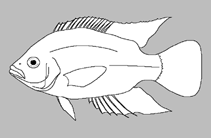 No image available for this species;
drawing shows typical species in Cichlidae.
Google Bild
drawing shows typical species in Cichlidae.
Klassifizierung / Names Namen | Synonyme | Catalog of Fishes(Gattung, Arten) | ITIS | CoL | WoRMS | Cloffa
> Cichliformes (Cichlids, convict blennies) > Cichlidae (Cichlids) > Pseudocrenilabrinae
Etymology: Orthochromis: Greek, ortho = straight + Greek, chromis = a fish, perhaps a perch (Ref. 45335); indermauri: The species name indermauri honours the Swiss ichthyologist Dr. Adrian Indermaur, who was the first to document this new species with underwater photographs, videos, and with aquarium observations, thereby contributing to a large extent to our knowledge of behaviour and ecology of this species (Ref. 122085).
Eponymy: Dr Adrian Indermaur (d: 1984) is a Swiss ichthyologist who is (2014) Head of the animal facility at the Waler Salzburger Laboratory. [...] (Ref. 128868), visit book page.
Etymology: Orthochromis: Greek, ortho = straight + Greek, chromis = a fish, perhaps a perch (Ref. 45335); indermauri: The species name indermauri honours the Swiss ichthyologist Dr. Adrian Indermaur, who was the first to document this new species with underwater photographs, videos, and with aquarium observations, thereby contributing to a large extent to our knowledge of behaviour and ecology of this species (Ref. 122085).
Eponymy: Dr Adrian Indermaur (d: 1984) is a Swiss ichthyologist who is (2014) Head of the animal facility at the Waler Salzburger Laboratory. [...] (Ref. 128868), visit book page.
Umwelt: Milieu / Klimazone / Tiefenbereich / Verbreitungsgebiet Ökologie
; süßwasser benthopelagisch; pH range: 8.0 - 8.6. Tropical; 23°C - 28°C (Ref. 122085)
Verbreitung Territorien | FAO Gebiete | Ökosysteme | Vorkommen | Punkt Karte | Einführungen | Faunafri
Africa: lower reaches of Lufubu River, tributary of Lake Tanganyika, in Zambia (Ref. 122085).
Größe / Gewicht / Alter
Kurzbeschreibung Bestimmungsschlüssel | Morphologie | Morphometrie
Rückenflossenstacheln (insgesamt) : 17 - 18; Rückenflossenweichstrahlen (insgesamt) : 8 - 10; Afterflossenstacheln: 3; Afterflossenweichstrahlen: 7 - 9; Wirbelzahl: 28 - 29. Diagnosis: Orthochromis indermauri is distinguished from all species currently placed in Orthochromis, except O. torrenticola, by having hypurals 1 and 2 clearly separated or separated by distinct seam vs. always fused (Ref. 122085). It is further distinguished from Malagarasi-Orthochromis species, except O. mazimeroensis, O. malagaraziensis, and O. rubrolabialis, by having fewer caudal vertebrae, 14-15 vs. 16-18, and total vertebrae, 28-29 vs. 30-32; it is also distinguished from O. luichensis, O. malagaraziensis, O. mazimeroensis, O. mosoensis by having more inner series of teeth in upper jaw, 3-5 vs. 1-2; moreover, it differs from O. kasuluensis by having fewer anal-fin rays, 7-9 vs. 10; from O. malagaraziensis by having more scales between upper lateral line and dorsal-fin origin, 5-7 vs. 3-4, and by having more ceratobranchial gill rakers, 8-11 vs. 6-7; from O. mazimeroensis by having more abdominal vertebrae, 14-15 vs. 12-13; from O. mosoensis and O. rubrolabialis by having more ceratobranchial gill rakers, 8-11 vs. 5-7, and total gill rakers, 11-15 vs. 8-10; from O. uvinzae by having fewer horizontal line scales, 25-29 vs. 30-32, fewer dorsal-fin spines, 17-18 vs. 19-20, and by position of pterygiophore supporting last dorsal-fin spine, vertebral count 16-17 vs. 18-19 (Ref. 122085). It is distinguished from O. kalungwishiensis, O. luongoensis, and O. torrenticola by having fewer horizontal line scales, 28-29 vs. 30-32, and by having fewer caudal vertebrae, 14-15 vs. 17-18; further, it differs from O. luongoensis and O. machadoi by having fewer series of scales on cheek, 0-1 vs. 2-5; from O. kalungwishiensis by having fewer total vertebrae, 28-29 vs. 31-33 (Ref. 122085). It is distinguished from Schwetzochromis neodon by having fewer horizontal line scales, 28-29 vs. 30-31, more circumpeduncular scales, 16 vs. 12, fewer caudal vertebrae, 14-15 vs. 16-17, fewer total vertebrae, 28-29 vs. 30-32, fewer dorsal-fin rays, 8-10 vs. 11-12, and by having hypurals 1 and 2 clearly separated or separated by distinct seam vs. fused; it differs from Haplochromis snoeksi by having fewer scales on cheek, 0-1 vs. 2-3, fewer horizontal line scales, 25-29 vs. 30-31, more abdominal vertebrae, 14-15 vs. 13, fewer caudal vertebrae, 14-15 vs. 17, fewer total vertebrae, 28-29 vs. 30, more anal-fin rays, 7-9 vs. 5-6, more dorsal-fin spines, 17-18 vs. 16, more ceratobranchial gill rakers, 8-11 vs. 6, and total gill rakers, 11-15 vs. 9; from Haplochromis bakongo by having more inner series of teeth, 3-5 vs. 1-2, more dorsal-fin spines, 17-18 vs. 14-15, and in position of pterygiophore supporting last dorsal-fin spine, vertebral count 16-18 vs. 13-14; from Haplochromis moeruensis by having hypurals 1 and 2 clearly separated or separated by distinct seam vs. always fused; meristic values of O. indermauri overlap with those of Haplochromis vanheusdeni but is distinguished in head mask, nostril stripe present vs. absent, caudal corner of cheek with blackish element vs. no such element present, and by size and colouration of eggspot-like maculae on anal fin, deep red centre vs. orange centre in Haplochromis vanheusdeni (Ref. 122085). It is distinguished from O. mporokoso and O. katumbii by having fewer caudal vertebrae, 14-15 vs. 16-17, fewer total vertebrae, 28-29 vs. 30-31, and by having hypurals 1 and 2 and hypurals 3 and 4 clearly separated or separated by distinct seam vs. always fused; further from O. mporokoso by having fewer series of scales on cheek, 0-1 vs. 2-4; from O. katumbii by having fewer horizontal line scales, 25-29 vs. 30-31; it is distinguished from O. kimpala by having fewer series of scales on cheek, 0-1 vs. 3-4, and by having more dorsal-fin spines, 17-18 vs. 15-16; meristic values of O. indermauri overlap with those of O. gecki but is distinguished by having a wider interorbital width, 13.5-18.2% of head length vs. 9.6-12.9% (Ref. 122085).
Body shape (shape guide): fusiform / normal.
Body shape (shape guide): fusiform / normal.
Found in part of river which is rocky with some patches of sand and gravel, about 20 meters wide and on average 50 cm deep (Ref. 122085). This species is benthic-rheophilic and prefers stretches of fast flowing water where it is found between and among large rocks or patches of gravel (Ref. 122085). It is a maternal mouthbrooder (Ref. 122085).
Lebenszyklus und Paarungsverhalten Geschlechtsreife | Fortpflanzung | Ablaichen | Eier | Fruchtbarkeit | Larven
Hauptreferenz
Laden Sie Ihre Referenzen hoch | Referenzen | Koordinator : Kullander, Sven O. | Partner
Schedel, F.D.B., E.J.W.M.N. Vreven, B. Katemo Manda, E. Abwe, A. Chocha Manda and U.K. Schliewen, 2018. Description of five new rheophilic Orthochromis species (Teleostei: Cichlidae) from the Upper Congo drainage in Zambia and the Democratic Republic of the Congo. Zootaxa 4461(3):301-349. (Ref. 122085)
CITES
Not Evaluated
Bedrohung für Menschen
Harmless
Nutzung durch Menschen
FAO - Publication: search | FishSource |
Mehr Information
Trophische Ökologie
Lebensmittel (Beutetiere)
Nahrungszusammensetzung
Nahrungsaufnahme
Lebensmittelrationen
Räuber
Lebensmittel (Beutetiere)
Nahrungszusammensetzung
Nahrungsaufnahme
Lebensmittelrationen
Räuber
Populationsdynamik
Wachstumsparameter
Max. Alter/Größen
Länge-Gewicht-Rel.
Länge-Länge-Verhältnis.
Längenhäufigkeiten
Massenkonvertierung
Rekrutierung
Dichte
Wachstumsparameter
Max. Alter/Größen
Länge-Gewicht-Rel.
Länge-Länge-Verhältnis.
Längenhäufigkeiten
Massenkonvertierung
Rekrutierung
Dichte
Lebenszyklus
Fortpflanzung
Geschlechtsreife
Reifung/Kiemen rel.
Fruchtbarkeit
Ablaichen
Laichaggregationen
Eier
Eientwicklung
Larven
Larven Pop.Dyn.
Fortpflanzung
Geschlechtsreife
Reifung/Kiemen rel.
Fruchtbarkeit
Ablaichen
Laichaggregationen
Eier
Eientwicklung
Larven
Larven Pop.Dyn.
Anatomie
Kiemenoberfläche
Gehirn
Otolith
Kiemenoberfläche
Gehirn
Otolith
Physiologie
Körperliche Zusammensetzung
Nährstoffe
Sauerstoffverbrauch
Schwimmart
Schwimmgeschwindigkeit
Visuelle Pigmente
Fischgeräusche
Krankheiten und Parasiten
Toxizität (LC50s)
Körperliche Zusammensetzung
Nährstoffe
Sauerstoffverbrauch
Schwimmart
Schwimmgeschwindigkeit
Visuelle Pigmente
Fischgeräusche
Krankheiten und Parasiten
Toxizität (LC50s)
Genetik
Genom
Genetik
Heterozygotie
Vererbbarkeit
Genetische Vielfalt
Genom
Genetik
Heterozygotie
Vererbbarkeit
Genetische Vielfalt
Menschenbezogen
Aquakultur-Systeme
Aquakultur Profile
Zuchtlinien
Ciguatera-Fälle
Briefmarken, Münzen, Verschiedenes.
Aquakultur-Systeme
Aquakultur Profile
Zuchtlinien
Ciguatera-Fälle
Briefmarken, Münzen, Verschiedenes.
Tools
Zusatzinformationen
Download XML
Zusammenfassung | Punktdaten | Namen | Photos
Internet Quellen
AFORO (otoliths) | Aquatic Commons | BHL | Cloffa | Websites from users | FishWatcher Einträge suchen | CISTI | Catalog of Fishes: Gattung, Arten | DiscoverLife | ECOTOX | FAO - Publication: search | Faunafri | Fishipedia | Fishtrace | GloBI | Google Books | Google Scholar | Google | IGFA World Record | OneZoom | Open Tree of Life | Otolith Atlas of Taiwan Fishes | PubMed | Reef Life Survey | Socotra Atlas | TreeBase | Tree of Life | Wikipedia: Gehe zu, Suchen | World Records Freshwater Fishing | Zoobank | Zoologischer Rekord
Schätzungen auf der Grundlage von Modellen
Phylogenetischer Diversitätsindex (Ref. 82804): PD50 = 0.5000 [Uniqueness, from 0.5 = low to 2.0 = high].
Bayesian length-weight: a=0.00389 (0.00180 - 0.00842), b=3.12 (2.94 - 3.30), in cm total length, based on all LWR estimates for this body shape (Ref. 93245).
Widerstandsfähigkeit (Ref. 120179): hoch, Verdopplung der Population dauert weniger als 15 Monate. (Preliminary K or Fecundity.).