


Orthochromis indermauri Schedel, Vreven, Katemo Manda, Abwe, Chocha Manda & Schliewen, 2018
Tải lên của bạn hình ảnh Và Video
Google image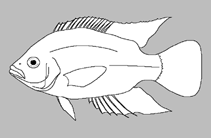 No image available for this species;
drawing shows typical species in Cichlidae.
Google image
drawing shows typical species in Cichlidae.
Phân loại / Tên Tên thường gặp | Các synonym ( Các tên trùng) | Catalog of Fishes(Giống, Các loài) | ITIS | CoL | WoRMS | Cloffa
> Cichliformes (Cichlids, convict blennies) > Cichlidae (Cichlids) > Pseudocrenilabrinae
Etymology: Orthochromis: Greek, ortho = straight + Greek, chromis = a fish, perhaps a perch (Ref. 45335); indermauri: The species name indermauri honours the Swiss ichthyologist Dr. Adrian Indermaur, who was the first to document this new species with underwater photographs, videos, and with aquarium observations, thereby contributing to a large extent to our knowledge of behaviour and ecology of this species (Ref. 122085).
Eponymy: Dr Adrian Indermaur (d: 1984) is a Swiss ichthyologist who is (2014) Head of the animal facility at the Waler Salzburger Laboratory. [...] (Ref. 128868), visit book page.
Etymology: Orthochromis: Greek, ortho = straight + Greek, chromis = a fish, perhaps a perch (Ref. 45335); indermauri: The species name indermauri honours the Swiss ichthyologist Dr. Adrian Indermaur, who was the first to document this new species with underwater photographs, videos, and with aquarium observations, thereby contributing to a large extent to our knowledge of behaviour and ecology of this species (Ref. 122085).
Eponymy: Dr Adrian Indermaur (d: 1984) is a Swiss ichthyologist who is (2014) Head of the animal facility at the Waler Salzburger Laboratory. [...] (Ref. 128868), visit book page.
Môi trường: môi trường / vùng khí hậu / Mức độ sâu / phạm vi phân phối Sinh thái học
; nước ngọt sống nổi và đáy; pH range: 8.0 - 8.6. Tropical; 23°C - 28°C (Ref. 122085)
Sự phân bố Lãnh thổ | Các khu vực của FAO | Các hệ sinh thái | Những lần xuất hiện | Bản đồ điểm | Những chỉ dẫn | Faunafri
Africa: lower reaches of Lufubu River, tributary of Lake Tanganyika, in Zambia (Ref. 122085).
Bộ gần gũi / Khối lượng (Trọng lượng) / Tuổi
Chín muồi sinh dục: Lm ? range ? - ? cm
Max length : 6.9 cm SL con đực/không giới tính; (Ref. 122085)
Max length : 6.9 cm SL con đực/không giới tính; (Ref. 122085)
Mô tả ngắn gọn Khóa để định loại | Hình thái học | Sinh trắc học
Các tia vây lưng cứng (tổng cộng) : 17 - 18; Các vây lưng mềm (tổng cộng) : 8 - 10; Tia cứng vây hậu môn: 3; Tia mềm vây hậu môn: 7 - 9; Động vật có xương sống: 28 - 29. Diagnosis: Orthochromis indermauri is distinguished from all species currently placed in Orthochromis, except O. torrenticola, by having hypurals 1 and 2 clearly separated or separated by distinct seam vs. always fused (Ref. 122085). It is further distinguished from Malagarasi-Orthochromis species, except O. mazimeroensis, O. malagaraziensis, and O. rubrolabialis, by having fewer caudal vertebrae, 14-15 vs. 16-18, and total vertebrae, 28-29 vs. 30-32; it is also distinguished from O. luichensis, O. malagaraziensis, O. mazimeroensis, O. mosoensis by having more inner series of teeth in upper jaw, 3-5 vs. 1-2; moreover, it differs from O. kasuluensis by having fewer anal-fin rays, 7-9 vs. 10; from O. malagaraziensis by having more scales between upper lateral line and dorsal-fin origin, 5-7 vs. 3-4, and by having more ceratobranchial gill rakers, 8-11 vs. 6-7; from O. mazimeroensis by having more abdominal vertebrae, 14-15 vs. 12-13; from O. mosoensis and O. rubrolabialis by having more ceratobranchial gill rakers, 8-11 vs. 5-7, and total gill rakers, 11-15 vs. 8-10; from O. uvinzae by having fewer horizontal line scales, 25-29 vs. 30-32, fewer dorsal-fin spines, 17-18 vs. 19-20, and by position of pterygiophore supporting last dorsal-fin spine, vertebral count 16-17 vs. 18-19 (Ref. 122085). It is distinguished from O. kalungwishiensis, O. luongoensis, and O. torrenticola by having fewer horizontal line scales, 28-29 vs. 30-32, and by having fewer caudal vertebrae, 14-15 vs. 17-18; further, it differs from O. luongoensis and O. machadoi by having fewer series of scales on cheek, 0-1 vs. 2-5; from O. kalungwishiensis by having fewer total vertebrae, 28-29 vs. 31-33 (Ref. 122085). It is distinguished from Schwetzochromis neodon by having fewer horizontal line scales, 28-29 vs. 30-31, more circumpeduncular scales, 16 vs. 12, fewer caudal vertebrae, 14-15 vs. 16-17, fewer total vertebrae, 28-29 vs. 30-32, fewer dorsal-fin rays, 8-10 vs. 11-12, and by having hypurals 1 and 2 clearly separated or separated by distinct seam vs. fused; it differs from Haplochromis snoeksi by having fewer scales on cheek, 0-1 vs. 2-3, fewer horizontal line scales, 25-29 vs. 30-31, more abdominal vertebrae, 14-15 vs. 13, fewer caudal vertebrae, 14-15 vs. 17, fewer total vertebrae, 28-29 vs. 30, more anal-fin rays, 7-9 vs. 5-6, more dorsal-fin spines, 17-18 vs. 16, more ceratobranchial gill rakers, 8-11 vs. 6, and total gill rakers, 11-15 vs. 9; from Haplochromis bakongo by having more inner series of teeth, 3-5 vs. 1-2, more dorsal-fin spines, 17-18 vs. 14-15, and in position of pterygiophore supporting last dorsal-fin spine, vertebral count 16-18 vs. 13-14; from Haplochromis moeruensis by having hypurals 1 and 2 clearly separated or separated by distinct seam vs. always fused; meristic values of O. indermauri overlap with those of Haplochromis vanheusdeni but is distinguished in head mask, nostril stripe present vs. absent, caudal corner of cheek with blackish element vs. no such element present, and by size and colouration of eggspot-like maculae on anal fin, deep red centre vs. orange centre in Haplochromis vanheusdeni (Ref. 122085). It is distinguished from O. mporokoso and O. katumbii by having fewer caudal vertebrae, 14-15 vs. 16-17, fewer total vertebrae, 28-29 vs. 30-31, and by having hypurals 1 and 2 and hypurals 3 and 4 clearly separated or separated by distinct seam vs. always fused; further from O. mporokoso by having fewer series of scales on cheek, 0-1 vs. 2-4; from O. katumbii by having fewer horizontal line scales, 25-29 vs. 30-31; it is distinguished from O. kimpala by having fewer series of scales on cheek, 0-1 vs. 3-4, and by having more dorsal-fin spines, 17-18 vs. 15-16; meristic values of O. indermauri overlap with those of O. gecki but is distinguished by having a wider interorbital width, 13.5-18.2% of head length vs. 9.6-12.9% (Ref. 122085).
Body shape (shape guide): fusiform / normal.
Body shape (shape guide): fusiform / normal.
Found in part of river which is rocky with some patches of sand and gravel, about 20 meters wide and on average 50 cm deep (Ref. 122085). This species is benthic-rheophilic and prefers stretches of fast flowing water where it is found between and among large rocks or patches of gravel (Ref. 122085). It is a maternal mouthbrooder (Ref. 122085).
Vòng đời và hành vi giao phối Chín muồi sinh dục | Sự tái sinh sản | Đẻ trứng | Các trứng | Sự sinh sản | Ấu trùng
Tài liệu tham khảo chính
Tải lên tài liệu tham khảo của bạn | Các tài liệu tham khảo | Người điều phối : Kullander, Sven O. | Người cộng tác
Schedel, F.D.B., E.J.W.M.N. Vreven, B. Katemo Manda, E. Abwe, A. Chocha Manda and U.K. Schliewen, 2018. Description of five new rheophilic Orthochromis species (Teleostei: Cichlidae) from the Upper Congo drainage in Zambia and the Democratic Republic of the Congo. Zootaxa 4461(3):301-349. (Ref. 122085)
CITES
Not Evaluated
Mối đe dọa đối với con người
Harmless
Sử dụng của con người
FAO - Publication: search | FishSource |
Thêm thông tin
Sinh thái dinh dưỡng
Thức ăn (con mồi)
Thành phần thức ăn
Thành phần thức ăn
Khẩu phần ăn
Các động vật ăn mồi
Thức ăn (con mồi)
Thành phần thức ăn
Thành phần thức ăn
Khẩu phần ăn
Các động vật ăn mồi
Biến động dân số
Các thông số tăng trưởng
Độ tuổi / kích thước tối đa
Chiều dài-trọng lượng tương đối
Chiều dài-chiều dài tương đối.
Chiều dài-tần số
Chuyển đổi khối lượng
Bổ xung
Sự phong phú
Các thông số tăng trưởng
Độ tuổi / kích thước tối đa
Chiều dài-trọng lượng tương đối
Chiều dài-chiều dài tương đối.
Chiều dài-tần số
Chuyển đổi khối lượng
Bổ xung
Sự phong phú
Vòng đời
Sự tái sinh sản
Chín muồi sinh dục
Độ trưởng thành/Mang liên quan
Sự sinh sản
Đẻ trứng
Tập hợp sinh sản
Các trứng
Sự phát triển của trứng
Ấu trùng
Sự biến động ấu trùng
Sự tái sinh sản
Chín muồi sinh dục
Độ trưởng thành/Mang liên quan
Sự sinh sản
Đẻ trứng
Tập hợp sinh sản
Các trứng
Sự phát triển của trứng
Ấu trùng
Sự biến động ấu trùng
Sự phân bố
Lãnh thổ
Các khu vực của FAO
Các hệ sinh thái
Những lần xuất hiện
Những chỉ dẫn
BRUVS - Video
Lãnh thổ
Các khu vực của FAO
Các hệ sinh thái
Những lần xuất hiện
Những chỉ dẫn
BRUVS - Video
Giải phẫu
Vùng mang
Não
sỏi tai
Vùng mang
Não
sỏi tai
Sinh lý học
Thành phần cơ thể
Chất dinh dưỡng
Thành phần ô-xy
Kiểu bơi
Tốc độ bơi
Sắc tố thị giác
Tiếng cá
Bệnh tật & Ký sinh trùng
Độc tính (LC50)
Thành phần cơ thể
Chất dinh dưỡng
Thành phần ô-xy
Kiểu bơi
Tốc độ bơi
Sắc tố thị giác
Tiếng cá
Bệnh tật & Ký sinh trùng
Độc tính (LC50)
Di truyền
Bộ gen
Di truyền
Sự dị hợp tử
Di sản
Đa dạng di truyền
Bộ gen
Di truyền
Sự dị hợp tử
Di sản
Đa dạng di truyền
Liên quan đến con người
Hệ thống nuôi trồng thủy sản
Các tổng quan nuôi trồng thủy sản
Các giống
Các trường hợp ngộ độc Ciguatera
Tem, tiền xu, v.v.
Hệ thống nuôi trồng thủy sản
Các tổng quan nuôi trồng thủy sản
Các giống
Các trường hợp ngộ độc Ciguatera
Tem, tiền xu, v.v.
Các công cụ
Sách điện tử | Hướng dẫn hiện trường | Tần suất chiều dài Wizard | Công cụ của vòng đời | Bản đồ điểm |
Bắt-MSY |
Báo cáo đặc biệt
Kiểm tra bảo trì bể cá | Kiểm tra các tờ thông tin về loài | Kiểm tra các tờ thông tin về nuôi trồng thủy sản
Tải xuống XML
Các nguồn internet
AFORO (otoliths) | Aquatic Commons | BHL | Cloffa | Websites from users | Check FishWatcher | CISTI | Catalog of Fishes: Giống, Các loài | DiscoverLife | ECOTOX | FAO - Publication: search | Faunafri | Fishipedia | Fishtrace | GloBI | Google Books | Google Scholar | Google | IGFA World Record | OneZoom | Open Tree of Life | Otolith Atlas of Taiwan Fishes | PubMed | Reef Life Survey | Socotra Atlas | TreeBase | Cây Đời sống | Wikipedia: Go, tìm | World Records Freshwater Fishing | Zoobank | Tạp chí Zoological Record
Ước tính dựa trên mô hình
Chỉ số đa dạng phát sinh loài (Tài liệu tham khảo 82804): PD50 = 0.5000 [Uniqueness, from 0.5 = low to 2.0 = high].
Bayesian length-weight: a=0.00389 (0.00180 - 0.00842), b=3.12 (2.94 - 3.30), in cm total length, based on all LWR estimates for this body shape (Ref. 93245).
Thích nghi nhanh (Tài liệu tham khảo 120179): Chiêù cao, thời gian nhân đôi của chủng quần tối thiểu là dưới 15 tháng (Preliminary K or Fecundity.).