


Nothobranchius moameensis Nagy, Watters & Bellstedt, 2020
muatnaik fotos/gambar dan video
imej Google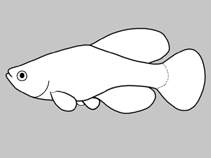 No image available for this species;
drawing shows typical species in Nothobranchiidae.
imej Google
drawing shows typical species in Nothobranchiidae.
klasifikasi / Nama Nama-nama umum | Sinonim (persamaan) | Catalog of Fishes(Marga, Jenis) | ITIS | CoL | WoRMS | Cloffa
> Cyprinodontiformes (Rivulines, killifishes and live bearers) > Nothobranchiidae (African rivulines)
Etymology: Nothobranchius: Greek, nothos = false + Greek, brangchia = gill (Ref. 45335); moameensis: The specific name, moameensis, is given in reference to the Moame River, in which drainage system this species is found; an adjective derived from the geographical name (Ref. 123150).
Etymology: Nothobranchius: Greek, nothos = false + Greek, brangchia = gill (Ref. 45335); moameensis: The specific name, moameensis, is given in reference to the Moame River, in which drainage system this species is found; an adjective derived from the geographical name (Ref. 123150).
Lingkungan: lingkungan / zona iklim / kisaran kedalaman / jangkauan distribusi Ekologi
; air tawar bentopelagis; pH range: 7.4 - 9.3. Tropical; 23°C - 32°C (Ref. 123150)
Penyebaran Wilayah | Daerah-daerah FAO | Ekosistem | Kemunculan | peta titik | Introduksi | Faunafri
Africa: ephemeral pools and marshes of Moame and other smaller river systems south of Lake Victoria in northern Tanzania (Ref. 123150).
Ukuran / Berat / umur
deskripsi pendek Kunci identifiaksi (pengenalan) | Morfologi | Morfometrik
Duri punggung (Keseluruhan (total)) : 0; duri punggung lunak (Keseluruhan (total)) : 15 - 19; Duri dubur: 0; Sirip dubur lunak: 16 - 19. Diagnosis: Nothobranchius moameensis belongs to the N. ugandensis species group presenting the following combination of characters in males: body colouration light blue with red to red-brown scale margins; frontal part of head red-brown and throat light blue or red; caudal fin uniform red; and anal fin light blue or yellow with red-brown spotted pattern (Ref. 123150). Nothobranchius moameensis differs from all other members of the N. ugandensis species group by a light blue anal fin with red-brown dots proximally and medially, and with light blue or yellow distal zone without markings; interorbital width 52-59% of head length vs. 38-51%; and caudal peduncle length 111-121% of its depth vs. 96-103% or 122-157% (Ref. 123150). Furthermore, it differs from N. attenboroughi by a greater body depth, 31.6-33.2% of standard length vs. 25.7-31.0%; a greater head depth, 87.1-94.3% of head length vs. 80.1-86.2%; and a dorsal fin positioned anterior to the anal fin, preanal length mean 62.2% of standard length and predorsal length mean 60.9% of standard length vs. posteriorly positioned with mean values of 59.8% of standard length and 60.6% of standard length, respectively, in N. attenboroughi (Ref. 123150).
Body shape (shape guide): fusiform / normal; Cross section: compressed.
Body shape (shape guide): fusiform / normal; Cross section: compressed.
Found in an ephemeral pool, circular with a diameter of about 10 m, and less than a meter at the deepest point; in turbid water and the bottom of the pool not visible (Ref. 123150).
Siklus hidup dan perilaku kawin Kematangan | Reproduksi, perkembang biakan | Pemijahan | telur-telur | Fekunditas | Larva
rujukan utama
Unggah referensi Anda | Acuan | Koordinator | mitra
Nagy, B., B.R. Watters, P.D.W. van der Merwe, F.P.D. Cotterill and D.U. Bellstedt, 2020. Review of the Nothobranchius ugandensis species group from the inland plateau of eastern Africa with descriptions of six new species (Teleostei: Nothobranchiidae). Ichthyol. Explor. Freshwat. 30(1):21-73. (Ref. 123150)
Status IUCN Red List (Ref. 130435: Version 2025-2 (Global))
terancam (EN) (B1ab(iii)+2ab(iii)); Date assessed: 18 May 2020
CITES
Not Evaluated
ancaman kepada manusia
Harmless
penggunaan manusia
FAO - Publication: search | FishSource |
informasi lanjut
Ekologi trofik
Item makanan (mangsa)
Komposisi makanan
Konsumsi makanan
Ransum makanan
Pemangsa
Item makanan (mangsa)
Komposisi makanan
Konsumsi makanan
Ransum makanan
Pemangsa
Dinamika populasi
Parameter pertumbuhan
Maks. usia / ukuran
Panjang-berat rel.
Panjang-panjang rel.
ukuran frekuensi
Konversi massa
pemulihan
Kelimpahan
Parameter pertumbuhan
Maks. usia / ukuran
Panjang-berat rel.
Panjang-panjang rel.
ukuran frekuensi
Konversi massa
pemulihan
Kelimpahan
Siklus hidup
Reproduksi, perkembang biakan
Kematangan
Kedewasaan / insang rel.
Fekunditas
Pemijahan
Agregasi pemijahan
telur-telur
pekembangan telor
Larva
Dinamika larva
Reproduksi, perkembang biakan
Kematangan
Kedewasaan / insang rel.
Fekunditas
Pemijahan
Agregasi pemijahan
telur-telur
pekembangan telor
Larva
Dinamika larva
Anatomi
Area insang
Otak
Otolith
Area insang
Otak
Otolith
Fisiologi
Komposisi tubuh
Nutrisi
Konsumsi oksigen
Jenis renang
Kecepatan berenang
Pigmen visual
Suara ikan
Penyakit & Parasit
Toksisitas (LC50)
Komposisi tubuh
Nutrisi
Konsumsi oksigen
Jenis renang
Kecepatan berenang
Pigmen visual
Suara ikan
Penyakit & Parasit
Toksisitas (LC50)
Genetika
genom
Genetika
Heterozigositas
Diturunkan
Keanekaragaman Genetik
genom
Genetika
Heterozigositas
Diturunkan
Keanekaragaman Genetik
Yang berhubungan dengan manusia
Sistem akuakultur
profil budidaya air
Strain
Kasus Ciguatera
Perangko, koin, dll.
Sistem akuakultur
profil budidaya air
Strain
Kasus Ciguatera
Perangko, koin, dll.
Alat, peralatan
E-book | Penuntun lapangan | tanda freqkuenci panjang | peringkat sejarah hidup | peta titik |
Tangkap-MSY |
laporan khas
muat turun XML
Sumber internet
AFORO (otoliths) | Aquatic Commons | BHL | Cloffa | Websites from users | semak peneliti ikan | CISTI | Catalog of Fishes: Marga, Jenis | DiscoverLife | ECOTOX | FAO - Publication: search | Faunafri | Fishipedia | Fishtrace | GloBI | Google Books | Google Scholar | Google | IGFA World Record | OneZoom | Open Tree of Life | Otolith Atlas of Taiwan Fishes | PubMed | Reef Life Survey | Socotra Atlas | TreeBase | Tree of Life | Wikipedia: pergi, Cari | World Records Freshwater Fishing | Zoobank | Catatan Zoologi
Estimasi berdasarkan model
Indeks keanekaragaman filogenetik (Acuan 82804): PD50 = 0.5000 [Uniqueness, from 0.5 = low to 2.0 = high].
Bayesian length-weight: a=0.00603 (0.00250 - 0.01453), b=3.13 (2.93 - 3.33), in cm total length, based on LWR estimates for this (Sub)family-body shape (Ref. 93245).
Tingkat Trofik (Acuan 69278): 3.2 ±0.4 se; based on size and trophs of closest relatives