


Nothobranchius moameensis Nagy, Watters & Bellstedt, 2020
Hochladen Photos und videos
Google Bild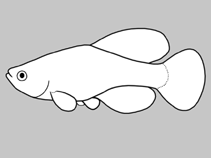 No image available for this species;
drawing shows typical species in Nothobranchiidae.
Google Bild
drawing shows typical species in Nothobranchiidae.
Klassifizierung / Names Namen | Synonyme | Catalog of Fishes(Gattung, Arten) | ITIS | CoL | WoRMS | Cloffa
> Cyprinodontiformes (Rivulines, killifishes and live bearers) > Nothobranchiidae (African rivulines)
Etymology: Nothobranchius: Greek, nothos = false + Greek, brangchia = gill (Ref. 45335); moameensis: The specific name, moameensis, is given in reference to the Moame River, in which drainage system this species is found; an adjective derived from the geographical name (Ref. 123150).
Etymology: Nothobranchius: Greek, nothos = false + Greek, brangchia = gill (Ref. 45335); moameensis: The specific name, moameensis, is given in reference to the Moame River, in which drainage system this species is found; an adjective derived from the geographical name (Ref. 123150).
Umwelt: Milieu / Klimazone / Tiefenbereich / Verbreitungsgebiet Ökologie
; süßwasser benthopelagisch; pH range: 7.4 - 9.3. Tropical; 23°C - 32°C (Ref. 123150)
Verbreitung Territorien | FAO Gebiete | Ökosysteme | Vorkommen | Punkt Karte | Einführungen | Faunafri
Africa: ephemeral pools and marshes of Moame and other smaller river systems south of Lake Victoria in northern Tanzania (Ref. 123150).
Größe / Gewicht / Alter
Kurzbeschreibung Bestimmungsschlüssel | Morphologie | Morphometrie
Rückenflossenstacheln (insgesamt) : 0; Rückenflossenweichstrahlen (insgesamt) : 15 - 19; Afterflossenstacheln: 0; Afterflossenweichstrahlen: 16 - 19. Diagnosis: Nothobranchius moameensis belongs to the N. ugandensis species group presenting the following combination of characters in males: body colouration light blue with red to red-brown scale margins; frontal part of head red-brown and throat light blue or red; caudal fin uniform red; and anal fin light blue or yellow with red-brown spotted pattern (Ref. 123150). Nothobranchius moameensis differs from all other members of the N. ugandensis species group by a light blue anal fin with red-brown dots proximally and medially, and with light blue or yellow distal zone without markings; interorbital width 52-59% of head length vs. 38-51%; and caudal peduncle length 111-121% of its depth vs. 96-103% or 122-157% (Ref. 123150). Furthermore, it differs from N. attenboroughi by a greater body depth, 31.6-33.2% of standard length vs. 25.7-31.0%; a greater head depth, 87.1-94.3% of head length vs. 80.1-86.2%; and a dorsal fin positioned anterior to the anal fin, preanal length mean 62.2% of standard length and predorsal length mean 60.9% of standard length vs. posteriorly positioned with mean values of 59.8% of standard length and 60.6% of standard length, respectively, in N. attenboroughi (Ref. 123150).
Body shape (shape guide): fusiform / normal; Cross section: compressed.
Body shape (shape guide): fusiform / normal; Cross section: compressed.
Found in an ephemeral pool, circular with a diameter of about 10 m, and less than a meter at the deepest point; in turbid water and the bottom of the pool not visible (Ref. 123150).
Lebenszyklus und Paarungsverhalten Geschlechtsreife | Fortpflanzung | Ablaichen | Eier | Fruchtbarkeit | Larven
Hauptreferenz
Laden Sie Ihre Referenzen hoch | Referenzen | Koordinator | Partner
Nagy, B., B.R. Watters, P.D.W. van der Merwe, F.P.D. Cotterill and D.U. Bellstedt, 2020. Review of the Nothobranchius ugandensis species group from the inland plateau of eastern Africa with descriptions of six new species (Teleostei: Nothobranchiidae). Ichthyol. Explor. Freshwat. 30(1):21-73. (Ref. 123150)
IUCN Rote Liste Status (Ref. 130435: Version 2025-2 (Global))
stark gefährdet (EN) (B1ab(iii)+2ab(iii)); Date assessed: 18 May 2020
CITES
Not Evaluated
Bedrohung für Menschen
Harmless
Nutzung durch Menschen
FAO - Publication: search | FishSource |
Mehr Information
Trophische Ökologie
Lebensmittel (Beutetiere)
Nahrungszusammensetzung
Nahrungsaufnahme
Lebensmittelrationen
Räuber
Lebensmittel (Beutetiere)
Nahrungszusammensetzung
Nahrungsaufnahme
Lebensmittelrationen
Räuber
Populationsdynamik
Wachstumsparameter
Max. Alter/Größen
Länge-Gewicht-Rel.
Länge-Länge-Verhältnis.
Längenhäufigkeiten
Massenkonvertierung
Rekrutierung
Dichte
Wachstumsparameter
Max. Alter/Größen
Länge-Gewicht-Rel.
Länge-Länge-Verhältnis.
Längenhäufigkeiten
Massenkonvertierung
Rekrutierung
Dichte
Lebenszyklus
Fortpflanzung
Geschlechtsreife
Reifung/Kiemen rel.
Fruchtbarkeit
Ablaichen
Laichaggregationen
Eier
Eientwicklung
Larven
Larven Pop.Dyn.
Fortpflanzung
Geschlechtsreife
Reifung/Kiemen rel.
Fruchtbarkeit
Ablaichen
Laichaggregationen
Eier
Eientwicklung
Larven
Larven Pop.Dyn.
Anatomie
Kiemenoberfläche
Gehirn
Otolith
Kiemenoberfläche
Gehirn
Otolith
Physiologie
Körperliche Zusammensetzung
Nährstoffe
Sauerstoffverbrauch
Schwimmart
Schwimmgeschwindigkeit
Visuelle Pigmente
Fischgeräusche
Krankheiten und Parasiten
Toxizität (LC50s)
Körperliche Zusammensetzung
Nährstoffe
Sauerstoffverbrauch
Schwimmart
Schwimmgeschwindigkeit
Visuelle Pigmente
Fischgeräusche
Krankheiten und Parasiten
Toxizität (LC50s)
Genetik
Genom
Genetik
Heterozygotie
Vererbbarkeit
Genetische Vielfalt
Genom
Genetik
Heterozygotie
Vererbbarkeit
Genetische Vielfalt
Menschenbezogen
Aquakultur-Systeme
Aquakultur Profile
Zuchtlinien
Ciguatera-Fälle
Briefmarken, Münzen, Verschiedenes.
Aquakultur-Systeme
Aquakultur Profile
Zuchtlinien
Ciguatera-Fälle
Briefmarken, Münzen, Verschiedenes.
Tools
Zusatzinformationen
Download XML
Zusammenfassung | Punktdaten | Namen | Photos
Internet Quellen
AFORO (otoliths) | Aquatic Commons | BHL | Cloffa | Websites from users | FishWatcher Einträge suchen | CISTI | Catalog of Fishes: Gattung, Arten | DiscoverLife | ECOTOX | FAO - Publication: search | Faunafri | Fishipedia | Fishtrace | GloBI | Google Books | Google Scholar | Google | IGFA World Record | OneZoom | Open Tree of Life | Otolith Atlas of Taiwan Fishes | PubMed | Reef Life Survey | Socotra Atlas | TreeBase | Tree of Life | Wikipedia: Gehe zu, Suchen | World Records Freshwater Fishing | Zoobank | Zoologischer Rekord
Schätzungen auf der Grundlage von Modellen
Phylogenetischer Diversitätsindex (Ref. 82804): PD50 = 0.5000 [Uniqueness, from 0.5 = low to 2.0 = high].
Bayesian length-weight: a=0.00603 (0.00250 - 0.01453), b=3.13 (2.93 - 3.33), in cm total length, based on LWR estimates for this (Sub)family-body shape (Ref. 93245).
Trophische Ebene (Ref. 69278): 3.2 ±0.4 se; based on size and trophs of closest relatives