


Enneapterygius phoenicosoma Motomura, Ota, & Meguro, 2015
Red-bodied triplefin
Envoyez vos Photos et vidéos
Images Google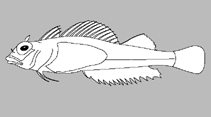 No image available for this species;
drawing shows typical species in Tripterygiidae.
Images Google
drawing shows typical species in Tripterygiidae.
Classification / Noms Noms communs | Synonymes | Catalog of Fishes(Genre, Espèce) | ITIS | CoL | WoRMS | Cloffa
> Blenniiformes (Blennies) > Tripterygiidae (Triplefin blennies) > Tripterygiinae
Etymology: Enneapterygius: Greek, ennea = nine times + Greek, pterygion = little fin (Ref. 45335); phoenicosoma: Name from Greek 'phoenico' for red and 'soma' for body, referring to the red body of nuptial males; noun in apposition.
Etymology: Enneapterygius: Greek, ennea = nine times + Greek, pterygion = little fin (Ref. 45335); phoenicosoma: Name from Greek 'phoenico' for red and 'soma' for body, referring to the red body of nuptial males; noun in apposition.
Environnement : milieu / zone climatique / profondeur / gamme de distribution Écologie
Distribution Territoires | Zones FAO | Écosystèmes | Occurrences | Carte par point | Introductions | Faunafri
Western Pacific: Japan, Caroline Is., and Vanuatu.
Taille / Poids / Âge
Description synthétique Clés d'identification | Morphologie | Morphométrie
Épines dorsales (Total) : 14 - 16; Rayons mous dorsaux (Total) : 8 - 10; Épines anales: 1; Rayons mous anaux: 16 - 18. This species is distinguished by the following set of characters: second dorsal-fin spines 11-13 (mode 12) ; third dorsal-fin soft rays 8-10 (9); pectoral-fin rays 15-17 (16); anal-fin soft rays 16-18 (17); scale rows in longitudinal series 32-35 (33); pored lateral-line scales 16-19 (17); notched lateral-line scales 16-19 (18); scale row between last pored lateral-line scale and first notched lateral-line scale 1; mandibular pore formula 4-6+1+4-6 (4+1+4); dorsal-fin spines and rays long [e.g., lengths of second spine 8.6-12.6% of SL (mean 10.1%) and third spine 7.2-9.8% of SL (8.5%) in first dorsal fin; first spine 12.8-17.2% of SL (15.2%), second spine 13.8-18.2% of SL (15.9%), and third spine 14.2-18.4% of SL (15.8%) in second dorsal fin; and first soft ray 14.8-19.5% of SL (17.3%), second soft ray 14.7-18.9% of SL (16.9%), and third soft ray 13.9-19.1% of SL (15.9%) in third dorsal fin]; second dorsal-fin base short [25.0-32.9% of SL (mean 29.2%)]; anal-fin base short [36.9-43.5% of SL (mean 40.5%)]; the nasal tentacle unbranched, flat, broadened distally; lower two-thirds of head, including lower half of eye, snout, lips, cheek, and opercle, and pectoral-fin base, dense black in nuptial males; upper head and body is reddish-brown in males and females, reddish in nuptial males, with H-shaped and/or upside-down Y-shaped oblique brown bars on lateral surface of body in both sexes; the caudal-fin base with vertical brownish band, its width subequal to pupil diameter, and narrow vertical white band behind brownish band in both sexes; narrow, indistinct, white line along posterior margin of black area on pectoral-fin base in nuptial males; pectoral, pelvic, and anal fins reddish in nuptial males; no black fins (Ref. 118055).
Cross section: oval.
Cross section: oval.
This species is usually found in open tide-pools and areas with strong regular surges generated by wave swells. Individuals often inhabit the surface of large rocks, but also slits and holes in large rocks, at depths of less than 25 m (usually less than 15 m). Spawning at Shikoku is reported to occur from early morning until about 10 am starting in June (Ref. 118055).
Cycle de vie et comportement reproducteur Maturité | Reproduction | Frai | Œufs | Fécondité | Larves
Référence principale
Téléchargez vos références | Références | Coordinateur : Fricke, Ronald | Collaborateurs
Motomura, H., R. Ota, M. Meguro and S. Tashiro, 2015. Enneapterygius phoenicosoma, a new species of triplefin (Tripterygiidae) from the Western Pacific Ocean. Species Diversity 20:1-12. (Ref. 118055)
Statut dans la liste rouge de l'IUCN (Ref. 130435: Version 2025-2 (Global))
Préoccupation mineure (LC) ; Date assessed: 05 March 2024
CITES
Not Evaluated
Menace pour l'homme
Harmless
Utilisations par l'homme
Pêcheries: sans intérêt
FAO - Publication: search | FishSource |
Plus d'informations
Écologie trophique
Aliments (proies)
Composition du régime alimentaire
Consommation alimentaire
Rations alimentaires
Prédateurs
Aliments (proies)
Composition du régime alimentaire
Consommation alimentaire
Rations alimentaires
Prédateurs
Écologie
Écologie
Écologie
Dynamique des populations
Paramètres de croissance
Âges / tailles maximales
Longueur-poids rel.
Rel. longueur-longueur.
Fréquences de longueurs
Conversion de masse
Recrutement
Abondance
Paramètres de croissance
Âges / tailles maximales
Longueur-poids rel.
Rel. longueur-longueur.
Fréquences de longueurs
Conversion de masse
Recrutement
Abondance
Cycle de vie
Reproduction
Maturité
Maturité/épines rel.
Fécondité
Frai
Agrégats de frai
Œufs
Développement de l'œuf
Larves
Dynamique des populations larvaires
Reproduction
Maturité
Maturité/épines rel.
Fécondité
Frai
Agrégats de frai
Œufs
Développement de l'œuf
Larves
Dynamique des populations larvaires
Anatomie
Surface branchiale
Cerveau
Otolithe
Surface branchiale
Cerveau
Otolithe
Physiologie
Composition corporelle
Nutriments
Consommation d'oxygène
Type de natation
Vitesse de nage
Pigments visuels
Son de poisson
Maladies et parasites
Toxicité (CL50)
Composition corporelle
Nutriments
Consommation d'oxygène
Type de natation
Vitesse de nage
Pigments visuels
Son de poisson
Maladies et parasites
Toxicité (CL50)
Génétique
génôme
Génétique
Hétérozygotie
Héritabilité
Diversité génétique
génôme
Génétique
Hétérozygotie
Héritabilité
Diversité génétique
Liées à l'homme
Systèmes d'aquaculture
Profils d'aquaculture
Souches
Cas de ciguatera
Timbres, pièces de monnaie, divers
Systèmes d'aquaculture
Profils d'aquaculture
Souches
Cas de ciguatera
Timbres, pièces de monnaie, divers
Outils
E-book | Guide de terrain | Générateur de fréquences de longueur | Outil de dynamique de population | Carte par point |
Capture-MSY |
Articles particuliers
Télécharger en XML
Sources Internet
AFORO (otoliths) | Aquatic Commons | BHL | Cloffa | Websites from users | FishWatcher | CISTI | Catalog of Fishes: Genre, Espèce | DiscoverLife | ECOTOX | FAO - Publication: search | Faunafri | Fishipedia | Fishtrace | GloBI | Google Books | Google Scholar | Google | IGFA World Record | OneZoom | Open Tree of Life | Otolith Atlas of Taiwan Fishes | PubMed | Reef Life Survey | Socotra Atlas | TreeBase | Arbre de Vie | Wikipedia: aller à, chercher | World Records Freshwater Fishing | Zoobank | Zoological Record
Estimations basées sur des modèles
Indice de diversité phylogénétique (Réf. 82804): PD50 = 0.5000 [Uniqueness, from 0.5 = low to 2.0 = high].
Bayesian length-weight: a=0.00617 (0.00290 - 0.01310), b=3.04 (2.86 - 3.22), in cm total length, based on LWR estimates for this (Sub)family-body shape (Ref. 93245).
Niveau trophique (Réf. 69278): 3.2 ±0.3 se; based on size and trophs of closest relatives
Résilience (Réf. 120179): Haut, temps minimum de doublement de population inférieur à 15 mois (Preliminary K or Fecundity.).