


Enneapterygius phoenicosoma Motomura, Ota, & Meguro, 2015
Red-bodied triplefin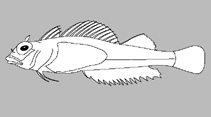
分類 / 名前 共通名の | 類義語 | Catalog of Fishes(部類, 種) | ITIS | CoL | WoRMS | Cloffa
> Blenniiformes (Blennies) > Tripterygiidae (Triplefin blennies) > Tripterygiinae
Etymology: Enneapterygius: Greek, ennea = nine times + Greek, pterygion = little fin (Ref. 45335); phoenicosoma: Name from Greek 'phoenico' for red and 'soma' for body, referring to the red body of nuptial males; noun in apposition.
Etymology: Enneapterygius: Greek, ennea = nine times + Greek, pterygion = little fin (Ref. 45335); phoenicosoma: Name from Greek 'phoenico' for red and 'soma' for body, referring to the red body of nuptial males; noun in apposition.
環境:環境 / 気候帯 / 深さの範囲 / 分布範囲 生態学
分布 領土 | 国連食糧農業機関の区域 | エコシステム | 事件 | 目的のマップ | 導入 | Faunafri
Western Pacific: Japan, Caroline Is., and Vanuatu.
サイズ / 重さ / 年齢
簡単な記述 検索表 | 形態学 | 形態計測学
背面の脊椎 (合計) : 14 - 16; 背鰭 (合計) : 8 - 10; 肛門の骨: 1; 臀鰭: 16 - 18. This species is distinguished by the following set of characters: second dorsal-fin spines 11-13 (mode 12) ; third dorsal-fin soft rays 8-10 (9); pectoral-fin rays 15-17 (16); anal-fin soft rays 16-18 (17); scale rows in longitudinal series 32-35 (33); pored lateral-line scales 16-19 (17); notched lateral-line scales 16-19 (18); scale row between last pored lateral-line scale and first notched lateral-line scale 1; mandibular pore formula 4-6+1+4-6 (4+1+4); dorsal-fin spines and rays long [e.g., lengths of second spine 8.6-12.6% of SL (mean 10.1%) and third spine 7.2-9.8% of SL (8.5%) in first dorsal fin; first spine 12.8-17.2% of SL (15.2%), second spine 13.8-18.2% of SL (15.9%), and third spine 14.2-18.4% of SL (15.8%) in second dorsal fin; and first soft ray 14.8-19.5% of SL (17.3%), second soft ray 14.7-18.9% of SL (16.9%), and third soft ray 13.9-19.1% of SL (15.9%) in third dorsal fin]; second dorsal-fin base short [25.0-32.9% of SL (mean 29.2%)]; anal-fin base short [36.9-43.5% of SL (mean 40.5%)]; the nasal tentacle unbranched, flat, broadened distally; lower two-thirds of head, including lower half of eye, snout, lips, cheek, and opercle, and pectoral-fin base, dense black in nuptial males; upper head and body is reddish-brown in males and females, reddish in nuptial males, with H-shaped and/or upside-down Y-shaped oblique brown bars on lateral surface of body in both sexes; the caudal-fin base with vertical brownish band, its width subequal to pupil diameter, and narrow vertical white band behind brownish band in both sexes; narrow, indistinct, white line along posterior margin of black area on pectoral-fin base in nuptial males; pectoral, pelvic, and anal fins reddish in nuptial males; no black fins (Ref. 118055).
Cross section: oval.
Cross section: oval.
This species is usually found in open tide-pools and areas with strong regular surges generated by wave swells. Individuals often inhabit the surface of large rocks, but also slits and holes in large rocks, at depths of less than 25 m (usually less than 15 m). Spawning at Shikoku is reported to occur from early morning until about 10 am starting in June (Ref. 118055).
ライフサイクルと交尾行動 成熟 | 繁殖 | 放精 | 卵 | 生産力 | 幼生
主な参考文献
参考文献のアップロード | 参考文献 | コーディネーター : Fricke, Ronald | 協力者
Motomura, H., R. Ota, M. Meguro and S. Tashiro, 2015. Enneapterygius phoenicosoma, a new species of triplefin (Tripterygiidae) from the Western Pacific Ocean. Species Diversity 20:1-12. (Ref. 118055)
CITES
Not Evaluated
人間に対する脅威
Harmless
人間の用途
水産業: 興味がない
FAO - Publication: search | FishSource |
より多くの情報
養殖生態
食料品(獲物)
餌の構成
摂食量
食料配給
捕食動物
食料品(獲物)
餌の構成
摂食量
食料配給
捕食動物
生態学
生態学
生態学
人口動態
成長のパラメーター
最大年齢/サイズ
長さ-重量比。
長短関係。
体長組成
質量変換
補充
豊度
成長のパラメーター
最大年齢/サイズ
長さ-重量比。
長短関係。
体長組成
質量変換
補充
豊度
ライフサイクル
繁殖
成熟
成熟度/エラ
生産力
放精
産卵群
卵
卵の開発
幼生
幼生の動力
繁殖
成熟
成熟度/エラ
生産力
放精
産卵群
卵
卵の開発
幼生
幼生の動力
解剖学
カマ
脳
オトリス
カマ
脳
オトリス
生理学
体組成
栄養素
酸素消費
水泳タイプ
泳ぐ速さ
視覚色素
フィッシュ・サウンド
病気と寄生虫
毒性(LC50)
体組成
栄養素
酸素消費
水泳タイプ
泳ぐ速さ
視覚色素
フィッシュ・サウンド
病気と寄生虫
毒性(LC50)
遺伝子の
ゲノム
遺伝子の
ヘテロ接合性
遺伝
遺伝的多様性
ゲノム
遺伝子の
ヘテロ接合性
遺伝
遺伝的多様性
用具
特記事項
XMLをダウンロードして下さい
インターネットの情報源
AFORO (otoliths) | Aquatic Commons | BHL | Cloffa | Websites from users | Check FishWatcher | CISTI | Catalog of Fishes: 部類, 種 | DiscoverLife | ECOTOX | FAO - Publication: search | Faunafri | Fishipedia | Fishtrace | GloBI | Google Books | Google Scholar | Google | IGFA World Record | OneZoom | Open Tree of Life | Otolith Atlas of Taiwan Fishes | PubMed | Reef Life Survey | Socotra Atlas | TreeBase | 生命の木 | Wikipedia: 行く, 検索する | World Records Freshwater Fishing | Zoobank | 動物に関する記録
モデルに基づく推定値
系統多様性指数 (参照 82804): PD50 = 0.5000 [Uniqueness, from 0.5 = low to 2.0 = high].
Bayesian length-weight: a=0.00617 (0.00290 - 0.01310), b=3.04 (2.86 - 3.22), in cm total length, based on LWR estimates for this (Sub)family-body shape (Ref. 93245).
栄養段階 (参照 69278): 3.2 ±0.3 se; based on size and trophs of closest relatives
回復力 (参照 120179): 高い, 15か月以下の倍増期間の最小個体群 (Preliminary K or Fecundity.).