


Enteromius pinnimaculatus Mipounga, Cutler, Mve Beh, Adam & Sidlauskas, 2019
Uploaden van uw Foto's en video's
Google afbeelding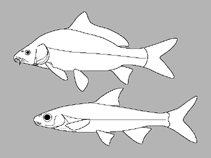 No image available for this species;
drawing shows typical species in Cyprinidae.
Google afbeelding
drawing shows typical species in Cyprinidae.
Classificatie / Namen Lokale namen | Synoniemen | Catalog of Fishes(Genus, Soort(en)) | ITIS | CoL | WoRMS | Cloffa
> Cypriniformes (Carps) > Cyprinidae (Minnows or carps) > Smiliogastrinae
Etymology: Enteromius: Greek, enteron = intestine + Greek, myo, mys = muscle (Ref. 45335); pinnimaculatus: The specific epithet pinnimaculatus refers to the multiple small dark spots on the dorsal fin, which is a rare characteristic within Enteromius; an adjective in the nominative singular (Ref. 120231).
Etymology: Enteromius: Greek, enteron = intestine + Greek, myo, mys = muscle (Ref. 45335); pinnimaculatus: The specific epithet pinnimaculatus refers to the multiple small dark spots on the dorsal fin, which is a rare characteristic within Enteromius; an adjective in the nominative singular (Ref. 120231).
Milieu: milieu / Klimaatzone / Diepte / verspreidingsgebied Ecologie
; zoet water benthopelagisch. Tropical
Verspreiding Gebieden | FAO regio's | Ecosystemen | Voorkomen | Verspreidingskaart | Introducties | Faunafri
Africa: Gabon.
Grootte / Gewicht / Leeftijd
Korte beschrijving Determinatiesleutels | Morfologie | Morfometrie
Dorsale stekels (totaal) : 0; Dorsale zachte stralen (totaal) : 10 - 11; Anale stekels: 0; Anale zachte stralen: 8; Wervels: 33 - 35. Diagnosis: A series of three or four dark spots along the flanks and a dorsal fin with multiple dar spots separates Enteromius pinnimaculatus from all other known species of Enteromius except E. walkeri; nevertheless, E. pinnimaculatus sometimes has one or more spots on the anal fin and lacks the dark spot immediately ventral to the dorsal-fin origin, while E. walkeri lacks pigmentation on the anal fin and has an additional dark spot ventral to the dorsal-fin origin; larger E. pinnimaculatus have noticeable pigmentation along the dorsal and ventral margins of most scale rows, while adult E. walkeri have two narrow bands of dark pigmentation dorsal and ventral to the lateral-line scale series on the anterior part of the body, but much less pronounced pigmentation at the intersection of other scale rows; the two species separate on the number of branched pectoral-fin rays, 11-12 in E. pinnimaculatus vs. 13-14 in E. walkeri, and the number of unbranched dorsal-fin rays, 3 in E. pinnimaculatus vs. 4 in E. walkeri, though an extra element at the anterior of the dorsal fin in E. walkeri is minute and only observed on radiographs; with the exception of developmentally aberrant individuals, specimens of E. pinnimaculatus have 33 vertebrae, while specimens of E. walkeri have 34 (Ref. 120231). Enteromius pinnimaculatus differs modally from E. walkeri in the number of total lateral line scales, 20 vs. 24; the number of lateral line scales to the point of caudal flexion, 18 vs. 22; the number of circumpeduncular scales, 10 vs. 12; and the number of branched dorsal-fin rays, 7 vs. 8; Enteromius pinnimaculatus reaches only half the maximum body size of E. walkeri; it has smaller pectoral fins than E. walkeri as well as shorter anterior barbels, with the difference in barbel length very pronounced in individuals of similar size; it also has, on average, a shallower body depth than E. walkeri and a longer caudal peduncle (Ref. 120231).
The species is omnivorous, with plant and insect material in the diet (Ref. 120231).
Levenscyclus en paargedrag Maturiteit | Voortplanting | Paaien | Eieren | Fecunditeit | Larven
Hoofdreferentie
Upload uw referenties | Referenties | Coördinator | Medewerkers
Mipounga, H.K., J. Cutler, J.H. Mve Beh, B. Adam and B.L. Sidlauskas, 2019. Enteromius pinnimaculatus sp. nov. (Cypriniformes: Cyprinidae) from southern Gabon. J. Fish Biol. 96(5):1218-1233. (Ref. 120231)
CITES
Not Evaluated
Gevaar voor de mens
Harmless
Gebruik door de mens
Visserij: van geen belang
FAO - Publication: search | FishSource |
Meer informatie
Trofische ecologie
Voedsel (prooien)
Dieetsamenstelling
Voedselconsumptie
Voedselrantsoenen
Predatoren
Voedsel (prooien)
Dieetsamenstelling
Voedselconsumptie
Voedselrantsoenen
Predatoren
Ecologie
Ecologie
Ecologie
Populatiedynamica
Groeiparameters
Max. leeftijden / maten
Lengte-gewicht rel.
Lengte-lengte rel.
Lengtefrequenties
Massaconversie
Rekrutering
Abundantie
Groeiparameters
Max. leeftijden / maten
Lengte-gewicht rel.
Lengte-lengte rel.
Lengtefrequenties
Massaconversie
Rekrutering
Abundantie
Levenscyclus
Voortplanting
Maturiteit
Rijpheid/kieuwen rel.
Fecunditeit
Paaien
Paaibestanden
Eieren
Ontwikkeling van de eieren
Larven
Larvale populatiedynamiek
Voortplanting
Maturiteit
Rijpheid/kieuwen rel.
Fecunditeit
Paaien
Paaibestanden
Eieren
Ontwikkeling van de eieren
Larven
Larvale populatiedynamiek
Anatomie
Kieuwoppervlak
Hersenen
Otoliet
Kieuwoppervlak
Hersenen
Otoliet
Fysiologie
Lichaamssamenstelling
Voedingsstoffen
Zuurstofverbruik
Type zwemmen
Zwemsnelheid
Visuele pigmenten
Vis geluid
Ziekten en parasieten
Toxiciteit (LC50)
Lichaamssamenstelling
Voedingsstoffen
Zuurstofverbruik
Type zwemmen
Zwemsnelheid
Visuele pigmenten
Vis geluid
Ziekten en parasieten
Toxiciteit (LC50)
Genetica
genoom
Genetica
Heterozygositeit
Erfelijkheid
Genetische diversiteit
genoom
Genetica
Heterozygositeit
Erfelijkheid
Genetische diversiteit
Menselijk gerelateerd
Aquacultuursystemen
Aquacultuurprofielen
Kweeklijnen
Ciguatera gevallen
Postzegels, munten, diversen.
Aquacultuursystemen
Aquacultuurprofielen
Kweeklijnen
Ciguatera gevallen
Postzegels, munten, diversen.
Tools
Speciale rapporten
Bekijk gegevens voor het houden in een aquarium | Bekijk Fact Sheets voor de soort | Bekijk Aquacultuur Fact Sheets
Download XML
Internetbronnen
AFORO (otoliths) | Aquatic Commons | BHL | Cloffa | Websites from users | Bekijk FishWatcher | CISTI | Catalog of Fishes: Genus, Soort(en) | DiscoverLife | ECOTOX | FAO - Publication: search | Faunafri | Fishipedia | Fishtrace | GloBI | Google Books | Google Scholar | Google | IGFA World Record | OneZoom | Open Tree of Life | Otolith Atlas of Taiwan Fishes | PubMed | Reef Life Survey | Socotra Atlas | TreeBase | Tree of Life | Wikipedia: ga naar, zoek | World Records Freshwater Fishing | Zoobank | Zoological Record
Schattingen op basis van modellen
Fylogenetische diversiteitsindex (Ref. 82804): PD50 = 0.5000 [Uniqueness, from 0.5 = low to 2.0 = high].
Bayesian length-weight: a=0.01122 (0.00521 - 0.02417), b=3.01 (2.84 - 3.18), in cm total length, based on LWR estimates for this Genus-body shape (Ref. 93245).
Trofisch niveau (Ref. 69278): 3.0 ±0.3 se; based on size and trophs of closest relatives
Weerstandsvermogen (Ref. 120179): Hoog, minimale populatieverdubbelingstijd minder dan 15 maanden (Preliminary K or Fecundity.).