


Enteromius pinnimaculatus Mipounga, Cutler, Mve Beh, Adam & Sidlauskas, 2019
Ladda upp din foton och Videor
Google image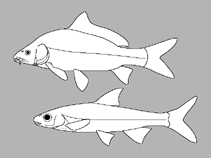 No image available for this species;
drawing shows typical species in Cyprinidae.
Google image
drawing shows typical species in Cyprinidae.
Klassificering / Namn Populärnamn | synonymer | Catalog of Fishes(Släkte, Arter) | ITIS | CoL | WoRMS | Cloffa
> Cypriniformes (Carps) > Cyprinidae (Minnows or carps) > Smiliogastrinae
Etymology: Enteromius: Greek, enteron = intestine + Greek, myo, mys = muscle (Ref. 45335); pinnimaculatus: The specific epithet pinnimaculatus refers to the multiple small dark spots on the dorsal fin, which is a rare characteristic within Enteromius; an adjective in the nominative singular (Ref. 120231).
Etymology: Enteromius: Greek, enteron = intestine + Greek, myo, mys = muscle (Ref. 45335); pinnimaculatus: The specific epithet pinnimaculatus refers to the multiple small dark spots on the dorsal fin, which is a rare characteristic within Enteromius; an adjective in the nominative singular (Ref. 120231).
Miljö: miljö / Klimatzon / djupintervall / distributionsområde Ekologi
; sötvatten bentopelagisk. Tropical
Utbredning Territorier | FAO områden | Ekosystem | Förekomster | Prickkarta | Utplanteringar | Faunafri
Africa: Gabon.
Storlek / Vikt / Ålder
Kort beskrivning Bestämningsnycklar | Morfologi | Morfometri
Taggstrålar i ryggfenan (totalt) : 0; Mjukstrålar i ryggfenan (totalt) : 10 - 11; Taggstrålar i analfenan: 0; Mjukstrålar i analfenan: 8; Ryggkotor: 33 - 35. Diagnosis: A series of three or four dark spots along the flanks and a dorsal fin with multiple dar spots separates Enteromius pinnimaculatus from all other known species of Enteromius except E. walkeri; nevertheless, E. pinnimaculatus sometimes has one or more spots on the anal fin and lacks the dark spot immediately ventral to the dorsal-fin origin, while E. walkeri lacks pigmentation on the anal fin and has an additional dark spot ventral to the dorsal-fin origin; larger E. pinnimaculatus have noticeable pigmentation along the dorsal and ventral margins of most scale rows, while adult E. walkeri have two narrow bands of dark pigmentation dorsal and ventral to the lateral-line scale series on the anterior part of the body, but much less pronounced pigmentation at the intersection of other scale rows; the two species separate on the number of branched pectoral-fin rays, 11-12 in E. pinnimaculatus vs. 13-14 in E. walkeri, and the number of unbranched dorsal-fin rays, 3 in E. pinnimaculatus vs. 4 in E. walkeri, though an extra element at the anterior of the dorsal fin in E. walkeri is minute and only observed on radiographs; with the exception of developmentally aberrant individuals, specimens of E. pinnimaculatus have 33 vertebrae, while specimens of E. walkeri have 34 (Ref. 120231). Enteromius pinnimaculatus differs modally from E. walkeri in the number of total lateral line scales, 20 vs. 24; the number of lateral line scales to the point of caudal flexion, 18 vs. 22; the number of circumpeduncular scales, 10 vs. 12; and the number of branched dorsal-fin rays, 7 vs. 8; Enteromius pinnimaculatus reaches only half the maximum body size of E. walkeri; it has smaller pectoral fins than E. walkeri as well as shorter anterior barbels, with the difference in barbel length very pronounced in individuals of similar size; it also has, on average, a shallower body depth than E. walkeri and a longer caudal peduncle (Ref. 120231).
The species is omnivorous, with plant and insect material in the diet (Ref. 120231).
Livscykel och parningsbeteende Könsmognad | Reproduktion | Lek | Ägg | Fekunditet | Larver
Huvudreferens
Ladda upp dina referenser | referenser | Koordinator | Medarbetare
Mipounga, H.K., J. Cutler, J.H. Mve Beh, B. Adam and B.L. Sidlauskas, 2019. Enteromius pinnimaculatus sp. nov. (Cypriniformes: Cyprinidae) from southern Gabon. J. Fish Biol. 96(5):1218-1233. (Ref. 120231)
CITES
Not Evaluated
Hot mot människor
Harmless
Mänskliga användningsområden
Fiskeri: saknar intresse
FAO - Publication: search | FishSource |
Ytterligare information
Trofisk ekologi
Livsmedelsartiklar (preys)
Födosammansättning
Födointag
Matransoner
Predatorer
Livsmedelsartiklar (preys)
Födosammansättning
Födointag
Matransoner
Predatorer
Ekologi
Ekologi
Ekologi
Populationsdynamik
Tillväxtparametrar
Max. åldrar / storlekar
Längd-vikt rel.
Längd-längd rel.
Längd-frekvenser
Massakonvertering
Rekrytering
Abundans
Tillväxtparametrar
Max. åldrar / storlekar
Längd-vikt rel.
Längd-längd rel.
Längd-frekvenser
Massakonvertering
Rekrytering
Abundans
Livscykel
Reproduktion
Könsmognad
Mognad/Gills rel.
Fekunditet
Lek
Lekande aggregat
Ägg
Utveckling av ägg
Larver
Larvdynamik
Reproduktion
Könsmognad
Mognad/Gills rel.
Fekunditet
Lek
Lekande aggregat
Ägg
Utveckling av ägg
Larver
Larvdynamik
Anatomi
Gälyta
Hjärna
Otolit
Gälyta
Hjärna
Otolit
Fysiologi
Kroppssammansättning
Näringsämnen
Syreförbrukning
Typ av simning
Simhastighet
Visuella pigment
Ljud från fisk
Sjukdomar & Parasiter
Toxicitet (LC50)
Kroppssammansättning
Näringsämnen
Syreförbrukning
Typ av simning
Simhastighet
Visuella pigment
Ljud från fisk
Sjukdomar & Parasiter
Toxicitet (LC50)
Genetik
Genom
Genetik
Heterozygositet
Ärftlighet
Genetisk mångfald
Genom
Genetik
Heterozygositet
Ärftlighet
Genetisk mångfald
Människorelaterad
Vattenbrukssystem
Vattenbruksprofiler
Avelslinjer
Ciguatera-fall
Frimärken, mynt, diverse.
Vattenbrukssystem
Vattenbruksprofiler
Avelslinjer
Ciguatera-fall
Frimärken, mynt, diverse.
Verktyg
Särskilda rapporter
Kontrollera för underhåll av akvarium | Kontrollera om det finns faktablad om arter | Kontrollera om det finns faktablad om vattenbruk
Ladda ner XML
Internet-källor
AFORO (otoliths) | Aquatic Commons | BHL | Cloffa | Websites from users | Check FishWatcher | CISTI | Catalog of Fishes: Släkte, Arter | DiscoverLife | ECOTOX | FAO - Publication: search | Faunafri | Fishipedia | Fishtrace | GloBI | Google Books | Google Scholar | Google | IGFA World Record | OneZoom | Open Tree of Life | Otolith Atlas of Taiwan Fishes | PubMed | Reef Life Survey | Socotra Atlas | TreeBase | Tree of Life | Wikipedia: Go, sök | World Records Freshwater Fishing | Zoobank | Zoologiskt register
Uppskattningar baserade på modeller
Index för fylogenetisk mångfald (Ref. 82804): PD50 = 0.5000 [Uniqueness, from 0.5 = low to 2.0 = high].
Bayesian length-weight: a=0.01122 (0.00521 - 0.02417), b=3.01 (2.84 - 3.18), in cm total length, based on LWR estimates for this Genus-body shape (Ref. 93245).
Trofisk nivå (Ref. 69278): 3.0 ±0.3 se; based on size and trophs of closest relatives
Resiliens (Ref. 120179): Hög, lägsta populationsfördubblingstid mindre än 15 månader (Preliminary K or Fecundity.).