Klassifizierung / Names
Namen | Synonyme | Catalog of Fishes(Gattung, Arten) | ITIS | CoL | WoRMS | Cloffa
>
Gobiiformes (Gobies) >
Gobiidae (Gobies) > Gobiinae
Etymology: Tomiyamichthys: occurring on sand-rubble bottoms in the vicinity of coral reefs; elliotensis: Named after its type locality, Lady Elliot Island on the Great Barrier Reef.
Environment: milieu / climate zone / Tiefenbereich / distribution range
Ökologie
seewasser riff-verbunden; tiefenbereich 15 - 24 m (Ref. 131301). Tropical; 20°C - 28°C (Ref. 131301)
Western Pacific: Australia.
Size / Gewicht / Alter
Geschlechtsreife: Lm ? range ? - ? cm
Max length : 3.9 cm SL Männchen/unbestimmt; (Ref. 131301); 5.3 cm SL (female)
Kurzbeschreibung
Bestimmungsschlüssel | Morphologie | Morphometrie
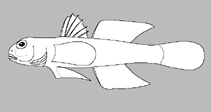
Rückenflossenstacheln (insgesamt) : 7; Rückenflossenweichstrahlen (insgesamt) : 10; Afterflossenstacheln: 1; Afterflossenweichstrahlen: 10; Wirbelzahl: 26. This species is distinguished by the following characters: D VI-I,10, no elongated dorsal-fin spine, the longest 1.0-1.3 in HL; A I,10; pectoral-fin rays 17-18 (usually17); lateral scale series 78-84; entirely with cycloid scales, none on cheek, opercle, predorsal, and pectoral-fin base; gill opening extending to about the level of posterior edge of preopercle; caudal fin rounded, about equal to head length or 3.2-3.6 in SL; pattern of cephalic sensory-canal pores consisting of B’, C, D, E, F, G, H’, M’, N and O’ pores; gill rakers poorly developed, 2 + 4-6. Colouration: when alive, overall whitish with midlateral row of 4 large, ovate, brown spots, 5 or 6 diagonal yellow-orange bands on first dorsal fin, a brown stripe along middle of second dorsal fin; anal fin with several yellow-orange stripes; pelvic fins bluish with yellow fin rays (Ref. 31301).
Cross section: compressed.
Collected from relatively flat sandy bottoms exposed to periodic strong tidal currents in 15-24 m depth with temperature ranging from 20 to 28 °C across the year. Most individuals observed appeared to be solitary, while about 20% of burrows encountered had a pair of shrimpgobies guarding the entrance. Observations during peak tidal currents showed that nearly all shrimpgoby burrows were completely covered by shifting sands; only during slack tides would the alpheid shrimp reopen the burrow entrances. Many other species of shrimpgoby were commonly observed within 1 or 2 m of burrows of the new species, including Amblyeleotris diagonalis, A. novaecaledoniae, A. ogasawarensis, A. rubrimarginata, A. steinitzi, A. wheeleri, Ctenogobiops mitodes, C. pomastictus, and Stonogobiops xanthorhinica (Ref. 131301).
Life cycle and mating behavior
Geschlechtsreife | Fortpflanzung | Ablaichen | Eier | Fecundity | Larven
Allen, G.R., M.V. Erdmann and C.L. Dudgeon, 2023. Tomiyamichthys elliotensis, a new species of shrimpgoby (Teleostei: Gobiidae) from Lady Elliot Island, Queensland, Australia. J. Ocean Sci. Found. 40:57-69. (Ref. 131301)
IUCN Rote Liste Status (Ref. 130435: Version 2025-1)
Bedrohung für Menschen
Harmless
Nutzung durch Menschen
Fischereien: nicht kommerziell
Tools
Zusatzinformationen
Download XML
Internet Quellen
Estimates based on models
Phylogenetic diversity index (Ref.
82804): PD
50 = 0.5000 [Uniqueness, from 0.5 = low to 2.0 = high].
Trophic level (Ref.
69278): 3.2 ±0.3 se; based on size and trophs of closest relatives
Widerstandsfähigkeit (Ref.
120179): hoch, Verdopplung der Population dauert weniger als 15 Monate. (Preliminary K or Fecundity.).
Fishing Vulnerability (Ref.
59153): Low vulnerability (10 of 100).
🛈