Environment: milieu / Klimaatzone / Diepte / distribution range
Ecologie
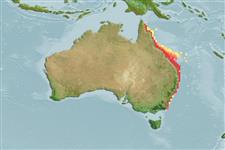
marien; brak water demersaal; standvastig; diepte 0 - 50 m (Ref. 6205). Subtropical; 12°S - 39°S, 143°E - 157°E (Ref. 6205)
Western Pacific: endemic to Australia. Records of this species from western Australia or northern Australia refer to Sillago burrus. Also very similar to Sillago aeolus from southeast Asia (Sunda Shelf). Occurrence in Tanzania (Ref. 2871) is probably a misidentification.
Lengte bij maturiteit / Grootte / Gewicht / Leeftijd
Maturiteit: Lm 19.0 range ? - ? cm
Max length : 30.0 cm TL mannelijk / geslacht onbekend; (Ref. 6205); common length : 25.0 cm SL mannelijk / geslacht onbekend; (Ref. 9679)
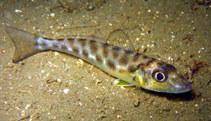
Dorsale stekels (totaal) : 12 - 13; Dorsale zachte stralen (totaal) : 19 - 21; Anale stekels: 2; Anale zachte stralen: 19 - 20; Wervels: 34 - 36. Anterolateral extensions of swim bladder recurved posteriorly to reach level of vent. Base of pectoral fin with black spot, back and sides with dark blotches. The upper and lower blotches are frequently joined, at least posteriorly, the upper blotches are generally larger; the opercle is dull or with an inner dark blotch showing through. Coloration is similar to S. burrus and S. aeolus.
Body shape (shape guide): elongated; Cross section: circular.
Occur on silty and muddy substrates in the deeper water of bays, but also frequenting the mouths of rivers, estuaries, and mangrove creeks. Juveniles abound in estuaries and shallow water during summer, moving deeper as they mature. Diet of juveniles consist largely of small crustaceans and that of the adult fish consist mainly of polychaete worms and bivalve mollusks. Oviparous (Ref. 205). Spawn throughout the year with peaks in Dec.-Feb. (Ref. 6390). Marketed fresh (Ref. 9987) and chilled (Ref. 6390).
They spawn several times each year (Ref. 26745).
McKay, R.J., 1992. FAO Species Catalogue. Vol. 14. Sillaginid fishes of the world (family Sillaginidae). An annotated and illustrated catalogue of the sillago, smelt or Indo-Pacific whiting species known to date. Rome: FAO. FAO Fish. Synop. 125(14):87p. (Ref. 6205)
Status op de Rode Lijst van het IUCN (Ref. 130435: Version 2025-1)
Gevaar voor de mens
Harmless
Gebruik door de mens
Visserij: van minder commercieel belang; Aquacultuur: experimenteel; sportvis: ja
Tools
Speciale rapporten
Download XML
Internetbronnen
Estimates based on models
Preferred temperature (Ref.
123201): 20.2 - 26.9, mean 25.1 °C (based on 98 cells).
Fylogenetische diversiteitsindex (Ref.
82804): PD
50 = 0.5000 [Uniqueness, from 0.5 = low to 2.0 = high].
Bayesian length-weight: a=0.00631 (0.00372 - 0.01070), b=3.10 (2.95 - 3.25), in cm total length, based on LWR estimates for this species & Genus-body shape (Ref.
93245).
Trofisch niveau (Ref.
69278): 3.3 ±0.1 se; based on diet studies.
Weerstandsvermogen (Ref.
120179): Hoog, minimale populatieverdubbelingstijd minder dan 15 maanden (Preliminary K or Fecundity.).
Fishing Vulnerability (Ref.
59153): Low vulnerability (20 of 100).
🛈
Nutrients (Ref.
124155): Calcium = 349 [80, 974] mg/100g; Iron = 1.27 [0.47, 3.58] mg/100g; Protein = 20.9 [18.2, 23.2] %; Omega3 = 0.235 [0.104, 0.516] g/100g; Selenium = 20.5 [6.3, 76.8] μg/100g; VitaminA = 20.7 [4.0, 113.7] μg/100g; Zinc = 0.976 [0.489, 2.344] mg/100g (wet weight);