>
Scombriformes (Mackerels) >
Nomeidae (Driftfishes)
Etymology: Cubiceps: Latin, cubus = cube + Latin, ceps = head (Ref. 45335).
Eponymy: Thomas Whitelegge (1850–1927) was an English naturalist who emigrated (1883) to Sydney, Australia, where he joined the Linnean Society of New South Wales. [...] (Ref. 128868), visit book page.
More on author: Waite.
Environment: milieu / climate zone / kisaran kedalaman / distribution range
Ekologi
laut bentopelagis; kisaran kedalaman 180 - 550 m (Ref. 9834), usually 300 - 450 m (Ref. 9834). Tropical
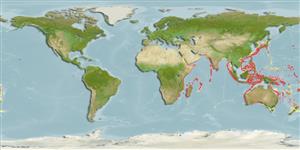
Indo-West Pacific: probably widely distribtuted in tropical and warm-temperate waters of the Indian Ocean (excluding the Red Sea) and from Japan to eastern Australia.
Size / Weight / umur
Kematangan: Lm ? range ? - ? cm
Max length : 21.0 cm SL jantan/; (Ref. 54802); common length : 15.0 cm SL jantan/; (Ref. 9834); Berat maksimum terpublikasi: 110.00 g (Ref. 54802)
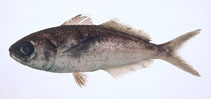
Duri punggung (Keseluruhan (total)) : 11 - 13; duri punggung lunak (Keseluruhan (total)) : 17 - 21; Duri dubur: 2 - 3; Sirip dubur lunak: 17 - 20; vertebrata, bertulang belakang: 31 - 32. Light to dark brown, fins dark; eye blue; young with dark band near base of tail (Ref. 4412). Body moderately elongate and compressed. Ventral profile very convex. Caudal peduncle moderately deep, compressed, lacking scutes or keels. Snout blunt, forehead slightly arched. Mouth small, terminal or slightly inferior, barely reaching beyond anterior margin of eye. Upper jaw not protractile, almost totally covered by lacrimal (preorbital) bone when mouth closed. Eye large , its diameter subequal to snout length, slightly smaller than interorbit, centered on upper half of head. Low ridge extending over eye. Jaw teeth small, in a single series. Palatine teeth more elongate, in single row. Vomerine tooth patch small. Single median row of teeth on tongue (Ref 9834).
Body shape (shape guide): fusiform / normal.
Found near continental and insular margins (Ref. 9834), in deep water on continental slopes (Ref. 30573). Adults are characterized by a demersal mode of life in the upper continental slope, between 180 and 800 m (commonly 300-450 m) and the young are found in mid-water layers (Ref. 54802). Feeds mainly on salps (Ref. 33689). Marketed fresh and could also be used as fishmeal or paste (Ref. 9502).
Haedrich, R.L., 1986. Nomeidae. p. 846-850. In M.M. Smith and P.C. Heemstra (eds.) Smiths' sea fishes. Springer-Verlag, Berlin. (Ref. 4412)
Status IUCN Red List (Ref. 130435: Version 2025-1)
ancaman kepada manusia
Harmless
penggunaan manusia
Perikanan: memiliki potensi kepentingan
Alat, peralatan
laporan khas
muat turun XML
Sumber internet
Estimates based on models
Preferred temperature (Acuan
123201): 8.8 - 15.4, mean 11.1 °C (based on 249 cells).
Phylogenetic diversity index (Acuan
82804): PD
50 = 0.5010 [Uniqueness, from 0.5 = low to 2.0 = high].
Bayesian length-weight: a=0.00955 (0.00409 - 0.02231), b=3.10 (2.89 - 3.31), in cm total length, based on LWR estimates for this (Sub)family-body shape (Ref.
93245).
Trophic level (Acuan
69278): 3.5 ±0.0 se; based on diet studies.
Daya lenting (Acuan
120179): Tinggi, Waktu penggandaan populasi minimum kurang dari 15 bulan (Preliminary K or Fecundity.).
Fishing Vulnerability (Ref.
59153): Low vulnerability (16 of 100).
🛈