Environment: milieu / climate zone / djupintervall / distribution range
Ekologi
marina bottenlevande; djupintervall 2 - 170 m (Ref. 56557), usually 100 - ? m (Ref. 84246). Temperate
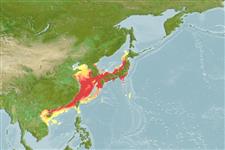
Northwest Pacific: offshore waters around Japan, Korea, China, Taiwan and southern East China Sea.
Size / Vikt / Age
Könsmognad: Lm ? range ? - ? cm
Max length : 30.0 cm SL hane/ej könsbestämd; (Ref. 559); publicerad maxvikt: 1.0 kg (Ref. 56557)
Short description
Bestämningsnycklar | Morfologi | Morfometri
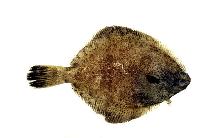
Mjukstrålar i ryggfenan (totalt) : 67 - 81; Mjukstrålar i analfenan: 48 - 58; Ryggkotor: 35 - 37. This species is distinguished by the following characters: scale length (from trunk area) is greater than 1.33% of SL, the whole scale outline oval, exposed margin rounded; scales highly deciduous, longitudinal rows occasionally irregular; upper eye area usually greater than that of lower eye, area ratio 0.93–1.44; central longitudinal scales 75-87, scales below lateral line 47-57; abdominal vertebrae 12-13 (mostly 12) (126213).
Cross section: flattened.
Inhabits sandy and muddy bottoms in coastal areas (Ref. 9137, 11230); but mainly muddy bottoms in offshore deeper (from ca. 40m) waters, possibly due to its highly deciduous scales, it may avoid sandy bottoms. It occurs in lower densities than P. lighti in shallower coastal waters, including the Seto Inland Sea (Ref. 126213). Recorded from several depth ranges from the following localities: 40-60 m off Soma, Fukushima Prefecture; 40-75 m in Kii Channel; ca. 140-150 m off Hamada, Shimane Prefecture; ca. 60 m in Seto Inland Sea; and, 76-143 m in East China Sea. It was also reported from 30 to 140 m in the Kii Channel, being especially numerous from deeper than 100 m (Ref. 84246). The flesh of this species is soft, and the quality declining quickly after death, that the species has a low market value (Ref. 126213).
Life cycle and mating behavior
Könsmognad | Reproduktion | Lek | Ägg | Fecundity | Larver
Vinnikov, K.A., R.C. Thomson and T.A. Munroe, 2018. Revised classification of the righteye flounders (Teleostei: Pleuronectidae) based on multilocus phylogeny with complete taxon sampling. Molecular phylogenetics and evolution, 125:147-162. (Ref. 122998)
IUCN Red List Status (Ref. 130435: Version 2025-1)
Threat to humans
Harmless
Human uses
Fiskeri: kommersiell
Verktyg
Special reports
Download XML
Internet-källor
Estimates based on models
Preferred temperature (Ref.
123201): 13.9 - 25.2, mean 20.7 °C (based on 278 cells).
Phylogenetic diversity index (Ref.
82804): PD
50 = 0.5039 [Uniqueness, from 0.5 = low to 2.0 = high].
Bayesian length-weight: a=0.01479 (0.01036 - 0.02113), b=3.00 (2.90 - 3.10), in cm total length, based on LWR estimates for this species (Ref.
93245).
Trofisk nivå (Ref.
69278): 3.2 ±0.3 se; based on size and trophs of closest relatives
Resiliens (Ref.
120179): Mellan, lägsta populationsfördubblingstid 1,4-4,4 år (K=0.16).
Fishing Vulnerability (Ref.
59153): Moderate vulnerability (39 of 100).
🛈