


Waarneming toevoegen in Fish Watcher
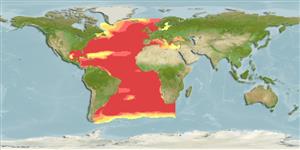
| Native range | All suitable habitat | Point map | Year 2050 |
|
| This map was computer-generated and has not yet been reviewed. |
| Thunnus thynnus AquaMaps Data sources: GBIF OBIS |
Uploaden van uw Foto's en video's
Afbeeldingen | video's | Postzegels, munten, diversen. | Google afbeelding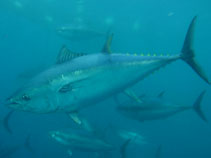 Thunnus thynnus
Afbeelding van Ticina, V.
Afbeeldingen | video's | Postzegels, munten, diversen. | Google afbeelding
Afbeelding van Ticina, V.
Classificatie / Namen Lokale namen | Synoniemen | Catalog of Fishes(Genus, Soort(en)) | ITIS | CoL | WoRMS | Cloffa
> Scombriformes (Mackerels) > Scombridae (Mackerels, tunas, bonitos) > Scombrinae
Etymology: Thunnus: Greek, thynnos = tunna (Ref. 45335).
More on author: Linnaeus.
Etymology: Thunnus: Greek, thynnos = tunna (Ref. 45335).
More on author: Linnaeus.
Milieu: milieu / Klimaatzone / Diepte / verspreidingsgebied Ecologie
marien; brak water pelagic-oceanic; oceanodroom (Ref. 71039); diepte 0 - 985 m (Ref. 55291), usually 0 - 100 m. Subtropical; 3°C - 30°C (Ref. 88796); 69°N - 58°S, 99°W - 42°E
Verspreiding Gebieden | FAO regio's | Ecosystemen | Voorkomen | Verspreidingskaart | Introducties | Faunafri
Western Atlantic: Labrador and Newfoundland to Gulf of Mexico, and Caribbean Sea to Venezuela and Brazil. Eastern Atlantic: Lofoten Islands off Norway to Canary Islands, including the Mediterranean and the southern part of the Black Sea (Ref. 6769). Reported from Mauritania (Ref. 5377). There is a subpopulation off South Africa. Highly migratory species.
Lengte bij maturiteit / Grootte / Gewicht / Leeftijd
Maturiteit: Lm 103.5, range 97 - 110 cm
Max length : 458 cm TL mannelijk / geslacht onbekend; (Ref. 26340); common length : 200 cm FL mannelijk / geslacht onbekend; (Ref. 168); max. gepubliceerd gewicht: 684.0 kg (Ref. 26340); max. gerapporteerde leeftijd: 32 Jaren (Ref. 5810)
Max length : 458 cm TL mannelijk / geslacht onbekend; (Ref. 26340); common length : 200 cm FL mannelijk / geslacht onbekend; (Ref. 168); max. gepubliceerd gewicht: 684.0 kg (Ref. 26340); max. gerapporteerde leeftijd: 32 Jaren (Ref. 5810)
Korte beschrijving Determinatiesleutels | Morfologie | Morfometrie
Dorsale stekels (totaal) : 12 - 14; Dorsale zachte stralen (totaal) : 13 - 15; Anale stekels: 0; Anale zachte stralen: 13 - 16; Wervels: 39. A very large species, deepest near the middle of the first dorsal fin base. The second dorsal fin higher than the first; the pectoral fins are very short, less than 80% of head length. Swim bladder present. Lower sides and belly silvery white with colorless transverse lines alternated with rows of colorless dots. The first dorsal fin is yellow or bluish; the second reddish-brown; the anal fin and finlets dusky yellow and edged with black; the median caudal keel is black in adults. May be confused with several other tunas, these are typically much smaller and easily distinguished by specific patterns of stripes, bands or dots.
Body shape (shape guide): fusiform / normal; Cross section: oval.
Body shape (shape guide): fusiform / normal; Cross section: oval.
Oceanic but seasonally coming close to shore. They school by size, sometimes together with albacore, yellowfin, bigeye, skipjack etc. Visual predators (Ref. 88866) preying on small schooling fishes (anchovies, sauries, hakes) or on squids and red crabs. Live up to 40 years in the western Atlantic (Ref. 88822). Weight up to 900 kg (Ref. 88823). Eggs and larvae are pelagic (Ref. 6769). Juvenile growth is rapid (about 30 cm / year) but slower than in other tuna
and billfish species (Ref. 88867). Adult growth is considerably slower, with about 10 years needed to reach two thirds of maximum length. Become rare because of massive overfishing (Ref. 35388).
Levenscyclus en paargedrag Maturiteit | Voortplanting | Paaien | Eieren | Fecunditeit | Larven
Oviparous batch spawner, with an inter-spawning interval of 1-2 days in the Mediterranean Sea (Ref. 88871). Females larger than 205 cm fork length are estimated to have a mean fecundity of 30-60 and 13-15 million eggs, in the western and eastern Atlantic respectively (Ref. 40805, Ref. 88871). Spawning occurs when sea surface temperatures are between 22.6-27.5 ºC and 22.5-25.5 ºC in the Gulf of Mexico and Mediterranean Sea respectively (88868). Spawning occurs between June and August in the Mediterranean Sea (Ref. 88868). Eggs are released directly to the water column and hatch after 2 days (Ref. 88823). At 24°C, embryo development lasts about 32 hours and larval stages about 30 days. Egg size 1.0 mm, larval length at hatching 2.8 mm.
Spawning grounds are mainly known from the Gulf of Mexico and the Mediterranean Sea, but the presence of mature individuals and larvae far from these areas (e.g. Bahamas and central North Atlantic Ocean) suggest that other spawning grounds may also be utilized (Ref. 88873, Ref. 88874, Ref. 88872). Appears to display homing behaviour with (western-tagged individuals migrating back to specific spawning sites either in the Gulf of Mexico or the Mediterranean Sea) (Ref. 88872, Ref. 88870). Fidelity to natal areas seem to occur once individuals reach maturity, i.e. after returning to either the western or eastern spawning grounds (Ref. 88868).
Hoofdreferentie
Upload uw referenties | Referenties | Coördinator : Collette, Bruce B. | Medewerkers
Collette, B.B., 1999. Mackerels, molecules, and morphology. p. 149-164. In B. Séret and J.-Y. Sire (eds.) Proc. 5th Indo-Pac. Fish Conf., Noumea, Paris. (Ref. 33246)
Status op de Rode Lijst van het IUCN (Ref. 130435: Version 2025-2 (Global))
Niet bedreigd (LC) ; Date assessed: 15 January 2021
CITES
Not Evaluated
Gevaar voor de mens
Harmless
Gebruik door de mens
Visserij: commercieel; Aquacultuur: commercieel; sportvis: ja
FAO - Aquacultuursystemen: productie; visserij: aanvoer, soortsprofiel; Publication: search | FIRMS - Stock assessments | FishSource | Sea Around Us
Meer informatie
Trofische ecologie
Voedsel (prooien)
Dieetsamenstelling
Voedselconsumptie
Voedselrantsoenen
Predatoren
Voedsel (prooien)
Dieetsamenstelling
Voedselconsumptie
Voedselrantsoenen
Predatoren
Populatiedynamica
Groeiparameters
Max. leeftijden / maten
Lengte-gewicht rel.
Lengte-lengte rel.
Lengtefrequenties
Massaconversie
Rekrutering
Abundantie
Groeiparameters
Max. leeftijden / maten
Lengte-gewicht rel.
Lengte-lengte rel.
Lengtefrequenties
Massaconversie
Rekrutering
Abundantie
Fysiologie
Lichaamssamenstelling
Voedingsstoffen
Zuurstofverbruik
Type zwemmen
Zwemsnelheid
Visuele pigmenten
Vis geluid
Ziekten en parasieten
Toxiciteit (LC50)
Lichaamssamenstelling
Voedingsstoffen
Zuurstofverbruik
Type zwemmen
Zwemsnelheid
Visuele pigmenten
Vis geluid
Ziekten en parasieten
Toxiciteit (LC50)
Menselijk gerelateerd
Aquacultuursystemen
Aquacultuurprofielen
Kweeklijnen
Ciguatera gevallen
Postzegels, munten, diversen.
Aquacultuursystemen
Aquacultuurprofielen
Kweeklijnen
Ciguatera gevallen
Postzegels, munten, diversen.
Tools
Biologische quiz | E-boek | Veldgids | Determinatiesleutels | Lengtefrequentie Tool | Levenscyclus tool | Verspreidingskaart |
Vangst-MSY |
Speciale rapporten
Bekijk gegevens voor het houden in een aquarium | Bekijk Fact Sheets voor de soort | Bekijk Aquacultuur Fact Sheets
Download XML
Internetbronnen
AFORO (otoliths) | Aquatic Commons | BHL | Cloffa | Websites from users | Bekijk FishWatcher | CISTI | Catalog of Fishes: Genus, Soort(en) | DiscoverLife | ECOTOX | FAO - Aquacultuursystemen: productie; visserij: aanvoer, soortsprofiel; Publication: search | Faunafri | Fishipedia | Fishtrace | GloBI | Google Books | Google Scholar | Google | IGFA World Record | Nationale databanken | OneZoom | Open Tree of Life | Otolith Atlas of Taiwan Fishes | Publieke aquaria | PubMed | Reef Life Survey | Socotra Atlas | TreeBase | Tree of Life | Wikipedia: ga naar, zoek | World Records Freshwater Fishing | Zoological Record
Schattingen op basis van modellen
Gewenste temperatuur (Ref. 123201): 7.5 - 24.7, mean 12.6 °C (based on 3084 cells).
Fylogenetische diversiteitsindex (Ref. 82804): PD50 = 0.5039 [Uniqueness, from 0.5 = low to 2.0 = high].
Bayesian length-weight: a=0.01230 (0.00999 - 0.01515), b=3.03 (3.00 - 3.06), in cm total length, based on LWR estimates for this species (Ref. 93245).
Trofisch niveau (Ref. 69278): 4.5 ±0.8 se; based on diet studies.
Generation time: 12.8 (9.2 - 16.3) years. Estimated as median ln(3)/K based on 21 growth studies.
Weerstandsvermogen (Ref. 120179): laag, minimale populatieverdubbelingstijd 4,5-14 jaar (K=0.09; tm=3-5; tmax=32).
Prior r = 0.24, 95% CL = 0.16 - 0.35, Based on 5 full stock assessments.
Voedingsstoffen (Ref. 124155): Calcium = 13.1 [7.2, 24.7] mg/100g; Iron = 2.09 [0.85, 5.36] mg/100g; Protein = 24.2 [22.6, 25.6] %; Omega3 = 0.393 [0.229, 0.689] g/100g; Selenium = 53.2 [20.7, 152.4] μg/100g; VitaminA = 17.3 [2.2, 167.3] μg/100g; Zinc = 0.319 [0.187, 0.655] mg/100g (wet weight); based on nutrient studies.