


Добавить Ваши наблюдения в Fish Watcher
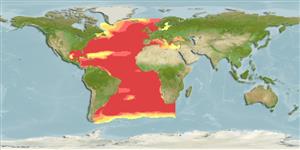
| Native range | All suitable habitat | Point map | Year 2050 |
|
| This map was computer-generated and has not yet been reviewed. |
| Thunnus thynnus AquaMaps Data sources: GBIF OBIS |
Загрузить свой Фото и Видео
изображения | Видео | Марки, монеты и прочее. | Изображение на Google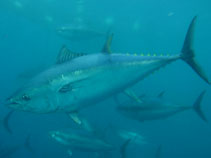 Thunnus thynnus
Изображение сделано Ticina, V.
изображения | Видео | Марки, монеты и прочее. | Изображение на Google
Изображение сделано Ticina, V.
Классификация / Имена народные названия | синонимы | Catalog of Fishes(род, виды) | ITIS | CoL | WoRMS | Cloffa
> Scombriformes (Mackerels) > Scombridae (Mackerels, tunas, bonitos) > Scombrinae
Etymology: Thunnus: Greek, thynnos = tunna (Ref. 45335).
More on author: Linnaeus.
Etymology: Thunnus: Greek, thynnos = tunna (Ref. 45335).
More on author: Linnaeus.
Окружающая среда: среда / климатическая зона / пределы глубины / диапазон распространения экология
морской; солоноватоводный pelagic-oceanic; мигрирует в океане (Ref. 71039); пределы глубины 0 - 985 m (Ref. 55291), usually 0 - 100 m. Subtropical; 3°C - 30°C (Ref. 88796); 69°N - 58°S, 99°W - 42°E
распространение Территории | регионы FAO | Экосистемы | места находок | карта точек | интродукции | Faunafri
Western Atlantic: Labrador and Newfoundland to Gulf of Mexico, and Caribbean Sea to Venezuela and Brazil. Eastern Atlantic: Lofoten Islands off Norway to Canary Islands, including the Mediterranean and the southern part of the Black Sea (Ref. 6769). Reported from Mauritania (Ref. 5377). There is a subpopulation off South Africa. Highly migratory species.
Длина при первой зрелости / Размер / Вес / Возраст
половая зрелость: Lm 103.5, range 97 - 110 cm
Max length : 458 cm TL самец/пол неопределен; (Ref. 26340); common length : 200 cm FL самец/пол неопределен; (Ref. 168); наибольший вес (опубликованные данные): 684.0 kg (Ref. 26340); наибольший возраст (опубликованны данные): 32 годы (Ref. 5810)
Max length : 458 cm TL самец/пол неопределен; (Ref. 26340); common length : 200 cm FL самец/пол неопределен; (Ref. 168); наибольший вес (опубликованные данные): 684.0 kg (Ref. 26340); наибольший возраст (опубликованны данные): 32 годы (Ref. 5810)
Краткое описание определительные ключи | морфология | морфометрия
колючие лучи спинного плавника (общее число) : 12 - 14; членистые (мягкие) лучи спинного плавника (общее число) : 13 - 15; колючие лучи анального плавника: 0; членистые (мягкие) лучи анального плавника: 13 - 16; позвонки: 39. A very large species, deepest near the middle of the first dorsal fin base. The second dorsal fin higher than the first; the pectoral fins are very short, less than 80% of head length. Swim bladder present. Lower sides and belly silvery white with colorless transverse lines alternated with rows of colorless dots. The first dorsal fin is yellow or bluish; the second reddish-brown; the anal fin and finlets dusky yellow and edged with black; the median caudal keel is black in adults. May be confused with several other tunas, these are typically much smaller and easily distinguished by specific patterns of stripes, bands or dots.
Body shape (shape guide): fusiform / normal; Cross section: oval.
Body shape (shape guide): fusiform / normal; Cross section: oval.
Oceanic but seasonally coming close to shore. They school by size, sometimes together with albacore, yellowfin, bigeye, skipjack etc. Visual predators (Ref. 88866) preying on small schooling fishes (anchovies, sauries, hakes) or on squids and red crabs. Live up to 40 years in the western Atlantic (Ref. 88822). Weight up to 900 kg (Ref. 88823). Eggs and larvae are pelagic (Ref. 6769). Juvenile growth is rapid (about 30 cm / year) but slower than in other tuna
and billfish species (Ref. 88867). Adult growth is considerably slower, with about 10 years needed to reach two thirds of maximum length. Become rare because of massive overfishing (Ref. 35388).
Жизненный цикл и брачное поведение половая зрелость | размножение | нерест | икра | Плодовитость | личинки
Oviparous batch spawner, with an inter-spawning interval of 1-2 days in the Mediterranean Sea (Ref. 88871). Females larger than 205 cm fork length are estimated to have a mean fecundity of 30-60 and 13-15 million eggs, in the western and eastern Atlantic respectively (Ref. 40805, Ref. 88871). Spawning occurs when sea surface temperatures are between 22.6-27.5 ºC and 22.5-25.5 ºC in the Gulf of Mexico and Mediterranean Sea respectively (88868). Spawning occurs between June and August in the Mediterranean Sea (Ref. 88868). Eggs are released directly to the water column and hatch after 2 days (Ref. 88823). At 24°C, embryo development lasts about 32 hours and larval stages about 30 days. Egg size 1.0 mm, larval length at hatching 2.8 mm.
Spawning grounds are mainly known from the Gulf of Mexico and the Mediterranean Sea, but the presence of mature individuals and larvae far from these areas (e.g. Bahamas and central North Atlantic Ocean) suggest that other spawning grounds may also be utilized (Ref. 88873, Ref. 88874, Ref. 88872). Appears to display homing behaviour with (western-tagged individuals migrating back to specific spawning sites either in the Gulf of Mexico or the Mediterranean Sea) (Ref. 88872, Ref. 88870). Fidelity to natal areas seem to occur once individuals reach maturity, i.e. after returning to either the western or eastern spawning grounds (Ref. 88868).
Основная ссылка
Загрузите свои рекомендации | ссылки | координатор : Collette, Bruce B. | соавторы
Collette, B.B., 1999. Mackerels, molecules, and morphology. p. 149-164. In B. Séret and J.-Y. Sire (eds.) Proc. 5th Indo-Pac. Fish Conf., Noumea, Paris. (Ref. 33246)
Статус Красного Списка МСОП (Ref. 130435: Version 2025-2 (Global))
Не вызывающий беспокойства (LC) ; Date assessed: 15 January 2021
CITES
Not Evaluated
Угроза для людей
Harmless
Использование человеком
рыболовство: коммерческий; аквакультура (рыбоводство): коммерческий; объект спортивного рыболовства: да
FAO - Системы аквакультуры: Производство; рыболовство: посадки, Видовой профиль; Publication: search | FIRMS - Stock assessments | FishSource | Море вокруг нас
дополнительная информация
Трофическая экология
Пищевые предметы (добыча)
состав пищи
потребление пищи
Продовольственные пайки
хищники
Пищевые предметы (добыча)
состав пищи
потребление пищи
Продовольственные пайки
хищники
Динамика численности населения
Параметры роста
Макс. возраст / размер
Отношение длины к весу.
Отношение длины к длине.
Размерный состав
Преобразование массы
пополнение
численность
Параметры роста
Макс. возраст / размер
Отношение длины к весу.
Отношение длины к длине.
Размерный состав
Преобразование массы
пополнение
численность
Физиология
Состав тела
Питательные вещества
Потребление кислорода
Тип плавания
Скорость плавания
Зрительные пигменты
Звук рыбы
Болезни и паразиты
Токсичность (LC50s)
Состав тела
Питательные вещества
Потребление кислорода
Тип плавания
Скорость плавания
Зрительные пигменты
Звук рыбы
Болезни и паразиты
Токсичность (LC50s)
Связанные с человеком
Системы аквакультуры
особенности рыбоводства
степень растяжения
Случаи заболевания сигуатерой
Марки, монеты и прочее.
Системы аквакультуры
особенности рыбоводства
степень растяжения
Случаи заболевания сигуатерой
Марки, монеты и прочее.
инструменты
Органическая викторина | Электронная книга | полевой определитель | определительные ключи | Длина-Частота | онтогенез | карта точек |
Catch-MSY |
Специальные отчеты
Проверить содержание в аквариумах | Проверить опубликованные видовые данные | Проверить опубликованные данные по аквакультуре
Скачать в формате XML
ресурсы в Интернет
AFORO (otoliths) | Aquatic Commons | BHL | Cloffa | Websites from users | Проверить FishWatcher | CISTI | Catalog of Fishes: род, виды | DiscoverLife | ECOTOX | FAO - Системы аквакультуры: Производство; рыболовство: посадки, Видовой профиль; Publication: search | Faunafri | Fishipedia | Fishtrace | GloBI | Google Books | Google Scholar | Google | IGFA World Record | национальные базы данных | OneZoom | Open Tree of Life | Otolith Atlas of Taiwan Fishes | общественные аквариумы | PubMed | Reef Life Survey | Socotra Atlas | TreeBase | Tree of Life | Wikipedia: Вперёд, поиск | World Records Freshwater Fishing | Зоологическая летопись
Оценки, основанные на моделях
Предпочтительная температура (ссылка 123201): 7.5 - 24.7, mean 12.6 °C (based on 3084 cells).
Индекс филогенетического разнообразия (ссылка 82804): PD50 = 0.5039 [Uniqueness, from 0.5 = low to 2.0 = high].
Bayesian length-weight: a=0.01230 (0.00999 - 0.01515), b=3.03 (3.00 - 3.06), in cm total length, based on LWR estimates for this species (Ref. 93245).
Трофический уровень (ссылка 69278): 4.5 ±0.8 se; based on diet studies.
Generation time: 12.8 (9.2 - 16.3) years. Estimated as median ln(3)/K based on 21 growth studies.
устойчивость к внешним воздействиям (ссылка 120179): низкий, минимальное время удвоения популяции 4.5-14 лет (K=0.09; tm=3-5; tmax=32).
Prior r = 0.24, 95% CL = 0.16 - 0.35, Based on 5 full stock assessments.
Питательные вещества (Ref. 124155): Calcium = 13.1 [7.2, 24.7] mg/100g; Iron = 2.09 [0.85, 5.36] mg/100g; Protein = 24.2 [22.6, 25.6] %; Omega3 = 0.393 [0.229, 0.689] g/100g; Selenium = 53.2 [20.7, 152.4] μg/100g; VitaminA = 17.3 [2.2, 167.3] μg/100g; Zinc = 0.319 [0.187, 0.655] mg/100g (wet weight); based on nutrient studies.