


Oncorhynchus gorbuscha (Walbaum, 1792)
Pink salmon
Waarneming toevoegen in Fish Watcher
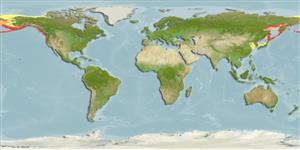
| Native range | All suitable habitat | Point map | Year 2050 |
|
| This map was computer-generated and has not yet been reviewed. |
| Oncorhynchus gorbuscha AquaMaps Data sources: GBIF OBIS |
Uploaden van uw Foto's en video's
Afbeeldingen | video's | Google afbeelding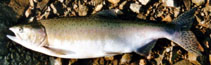 Oncorhynchus gorbuscha
Female Afbeelding van Østergaard, T.
Afbeeldingen | video's | Google afbeelding
Female Afbeelding van Østergaard, T.
Classificatie / Namen Lokale namen | Synoniemen | Catalog of Fishes(Genus, Soort(en)) | ITIS | CoL | WoRMS | Cloffa
> Salmoniformes (Salmons) > Salmonidae (Salmonids) > Salmoninae
Etymology: Oncorhynchus: Greek, onyx, -ychos = nail + Greek, rhyngchos = snout (Ref. 45335); gorbuscha: gorbuscha which is the Russian name for this fish in Alaska (Ref. 1998).
More on author: Walbaum.
Etymology: Oncorhynchus: Greek, onyx, -ychos = nail + Greek, rhyngchos = snout (Ref. 45335); gorbuscha: gorbuscha which is the Russian name for this fish in Alaska (Ref. 1998).
More on author: Walbaum.
Milieu: milieu / Klimaatzone / Diepte / verspreidingsgebied Ecologie
marien; zoet water; brak water demersaal; anadroom (Ref. 132363); diepte 0 - 250 m (Ref. 50550). Subtropical; ? - 21°C (Ref. 12741); 79°N - 32°N, 117°E - 120°W (Ref. 117423)
Verspreiding Gebieden | FAO regio's | Ecosystemen | Voorkomen | Verspreidingskaart | Introducties | Faunafri
Arctic and Pacific drainages from Mackenzie River delta, Northwest Territories, Canada to Sacramento River drainage, in California, USA; occasionally as far as La Jolla, southern California; also in northeast Asia (Ref. 86798). On Asia side, from North Korea to Jana and Lena drainages in Artic Russia. In Bering Sea north of about 40°N and from Bering Strait northeast to Point Barrow and northwest to Lena estuary (Ref. 59043). Introduced elsewhere. Occasionally hybridizes with Oncorhynchus keta producing fertile offspring (Ref. 28983).
Lengte bij maturiteit / Grootte / Gewicht / Leeftijd
Maturiteit: Lm 45.0, range 40 - 50 cm
Max length : 76.0 cm TL mannelijk / geslacht onbekend; (Ref. 86798); common length : 50.5 cm TL mannelijk / geslacht onbekend; (Ref. 12193); max. gepubliceerd gewicht: 7.0 kg (Ref. 57875); max. gerapporteerde leeftijd: 3.00 Jaren (Ref. 27547)
Max length : 76.0 cm TL mannelijk / geslacht onbekend; (Ref. 86798); common length : 50.5 cm TL mannelijk / geslacht onbekend; (Ref. 12193); max. gepubliceerd gewicht: 7.0 kg (Ref. 57875); max. gerapporteerde leeftijd: 3.00 Jaren (Ref. 27547)
Korte beschrijving Determinatiesleutels | Morfologie | Morfometrie
Dorsale stekels (totaal) : 0; Dorsale zachte stralen (totaal) : 10 - 15; Anale stekels: 0; Anale zachte stralen: 11 - 19; Wervels: 63 - 72. Distinguished by the presence of large black spots on the back and on both lobes of the caudal fin; the young have no parr marks (Ref. 27547). Body fusiform, streamlined, somewhat laterally compressed; moderately, deeper in breeding males (Ref. 1998). Mouth terminal, normally very little oblique but greatly deformed in breeding males, with lower jaw enlarged, turned up at tip, mouth unable to close (Ref. 1998). Adipose fin large; pelvic fins with axillary process (Ref. 27547). Fish in the sea are steel blue to blue-green on the back, silver on the sides and white on the belly; large oval spots present on the back, adipose fin and both lobes of the caudal fin (Ref. 27547). Breeding males become dark on the back, red with brownish green blotches on the sides; breeding females are similar but less distinctly colored (Ref. 27547). Differs from Oncorhynchus mykiss by having the following unique characters: anal fin with 11-15½ (usually 13½ ) branched rays; 177-240 scales in midlateral row; 26-33 gill rakers; large mature males with enormous hump; juveniles lacking parr marks; and lacking pink to red stripe on flank (Ref. 59043).
Body shape (shape guide): fusiform / normal; Cross section: compressed.
Body shape (shape guide): fusiform / normal; Cross section: compressed.
An anadromous species which inhabits ocean and coastal streams (Ref. 5723, 86798). Epipelagic (Ref. 58426). Pelagic at the sea. In freshwater, lives in Montane and Piedmont rivers with moderate to fast current and gravel bottom. Spawns in riffles or at head of riffles in shallow water with current up to 1.5 m/s, and clean coarse gravel (Ref. 59043). Spends 18 months at sea after which spawning migration to the natal river or stream occurs; but because the species is less certain of its homing and there is a certain degree of wandering, streams as much as 640 km from natal streams may be used (Ref. 1998, 27547). Upon emerging from the gravel, fry immediately move downstream and remain inshore for a few months before going out to sea. Fry may feed on nymphal and larval insects while in fresh water, but may not feed at all. In the sea, young feed on copepods and larvacean tunicates, its diet shifting to amphipods, euphausiids and fishes as the fish grows (Ref. 27547). Other food include ostracods, decapod larvae, cirripeds, tunicates, dipterous insects (Ref. 1998, 27547). Fry may be preyed upon by birds and mammals while adults by marine mammals and large fish (Ref. 1998). Mostly sold canned (Ref. 1998) but also utilized fresh, smoked, and frozen; also valued for caviar, especially in Japan; eaten steamed, fried, broiled, boiled, microwaved, and baked (Ref. 9988). The smallest of the true salmon (Ref. 12218).
Levenscyclus en paargedrag Maturiteit | Voortplanting | Paaien | Eieren | Fecunditeit | Larven
Adults develop secondary sexual characteristics during their upstream migration (Ref. 1998), which occurs any time from June to late September, depending on location (Ref. 27547). Male develop a humpback, an enlarged head and large teeth on both jaws that form a pronounced hooked type (Ref. 59043). The upstream run seems to be triggered by high water (Ref. 27547). Female builds the redd by lying on one side and using its tail, it displaces silt and light gravel to produce a deep trough. Male spends most of the time driving off intruding males. When the redd is completed, the female drops into it, followed immediately by the male. They open their mouths, vibrate and release eggs and sperm. In some cases, several males spawn with a single female. The eggs are then covered as the female digs a new redd at the upstream edge of the previous one. Adults live up to a few weeks after spawning before they die (Ref. 1998, 27547). Reported to die 10-20 days after spawning (Ref. 59043). About 1200-1800 eggs are laid. After hatching and the yellow egg yolk is absorbed, if the hatchling doesn't have a parr mark they go to the ocean and come again to the same birthplace stream the next year during spring after growing for 16-18 months. Survival rates are low, at 1-25% (taken from a Canadian river) (Ref. 12218). Reproductive strategy: synchronous ovarian organization, determinate fecundity (Ref. 51846).
Hoofdreferentie
Upload uw referenties | Referenties | Coördinator | Medewerkers
Page, L.M. and B.M. Burr, 2011. A field guide to freshwater fishes of North America north of Mexico. Boston : Houghton Mifflin Harcourt, 663p. (Ref. 86798)
Status op de Rode Lijst van het IUCN (Ref. 130435: Version 2025-2 (Global))
Niet bedreigd (LC) ; Date assessed: 23 July 2020
CITES
Not Evaluated
Gevaar voor de mens
Harmless
Gebruik door de mens
Visserij: van groot commercieel belang; Aquacultuur: commercieel; sportvis: ja
FAO - visserij: aanvoer, soortsprofiel; Publication: search | FishSource | Sea Around Us
Meer informatie
Trofische ecologie
Voedsel (prooien)
Dieetsamenstelling
Voedselconsumptie
Voedselrantsoenen
Predatoren
Voedsel (prooien)
Dieetsamenstelling
Voedselconsumptie
Voedselrantsoenen
Predatoren
Populatiedynamica
Groeiparameters
Max. leeftijden / maten
Lengte-gewicht rel.
Lengte-lengte rel.
Lengtefrequenties
Massaconversie
Rekrutering
Abundantie
Groeiparameters
Max. leeftijden / maten
Lengte-gewicht rel.
Lengte-lengte rel.
Lengtefrequenties
Massaconversie
Rekrutering
Abundantie
Levenscyclus
Voortplanting
Maturiteit
Rijpheid/kieuwen rel.
Fecunditeit
Paaien
Paaibestanden
Eieren
Ontwikkeling van de eieren
Larven
Larvale populatiedynamiek
Voortplanting
Maturiteit
Rijpheid/kieuwen rel.
Fecunditeit
Paaien
Paaibestanden
Eieren
Ontwikkeling van de eieren
Larven
Larvale populatiedynamiek
Anatomie
Kieuwoppervlak
Hersenen
Otoliet
Kieuwoppervlak
Hersenen
Otoliet
Fysiologie
Lichaamssamenstelling
Voedingsstoffen
Zuurstofverbruik
Type zwemmen
Zwemsnelheid
Visuele pigmenten
Vis geluid
Ziekten en parasieten
Toxiciteit (LC50)
Lichaamssamenstelling
Voedingsstoffen
Zuurstofverbruik
Type zwemmen
Zwemsnelheid
Visuele pigmenten
Vis geluid
Ziekten en parasieten
Toxiciteit (LC50)
Menselijk gerelateerd
Aquacultuursystemen
Aquacultuurprofielen
Kweeklijnen
Ciguatera gevallen
Postzegels, munten, diversen.
Aquacultuursystemen
Aquacultuurprofielen
Kweeklijnen
Ciguatera gevallen
Postzegels, munten, diversen.
Tools
Biologische quiz | E-boek | Veldgids | Determinatiesleutels | Lengtefrequentie Tool | Levenscyclus tool | Verspreidingskaart |
Vangst-MSY |
Speciale rapporten
Bekijk gegevens voor het houden in een aquarium | Bekijk Fact Sheets voor de soort | Bekijk Aquacultuur Fact Sheets
Download XML
Internetbronnen
AFORO (otoliths) | Exoten/Invasieve soorten database | Aquatic Commons | BHL | Cloffa | Websites from users | Bekijk FishWatcher | CISTI | Catalog of Fishes: Genus, Soort(en) | DiscoverLife | ECOTOX | FAO - visserij: aanvoer, soortsprofiel; Publication: search | Faunafri | Fishipedia | Fishtrace | GloBI | Google Books | Google Scholar | Google | IGFA World Record | Nationale databanken | OceanAdapt | OneZoom | Open Tree of Life | Otolith Atlas of Taiwan Fishes | PubMed | Reef Life Survey | RFE identificatie | Socotra Atlas | TreeBase | Tree of Life | Wikipedia: ga naar, zoek | World Records Freshwater Fishing | Zoological Record
Schattingen op basis van modellen
Gewenste temperatuur (Ref. 123201): 0.5 - 9.3, mean 3.3 °C (based on 572 cells).
Fylogenetische diversiteitsindex (Ref. 82804): PD50 = 0.5000 [Uniqueness, from 0.5 = low to 2.0 = high].
Bayesian length-weight: a=0.01148 (0.00639 - 0.02064), b=3.08 (2.93 - 3.23), in cm total length, based on LWR estimates for this species & Genus-body shape (Ref. 93245).
Trofisch niveau (Ref. 69278): 4.5 ±0.4 se; based on diet studies.
Weerstandsvermogen (Ref. 120179): Gemiddeld, minimale populatieverdubbelingstijd 1,4-4,4 jaar (tm=2; tmax=3; Fec=800).
Prior r = 0.55, 95% CL = 0.37 - 0.83, Based on 4 full stock assessments.
Voedingsstoffen (Ref. 124155): Calcium = 45.6 [17.1, 112.4] mg/100g; Iron = 1.15 [0.61, 2.52] mg/100g; Protein = 19.6 [18.5, 20.7] %; Omega3 = 1.17 [0.59, 2.42] g/100g; Selenium = 186 [56, 609] μg/100g; VitaminA = 12.2 [3.4, 44.5] μg/100g; Zinc = 0.496 [0.313, 0.982] mg/100g (wet weight); based on nutrient studies.