


Carregue seu(sua) Fotos e vídeos
Fotos | Imagem do Google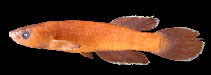 Nimbapanchax maeseni
Foto de RMCA/Musschoot, T.
Fotos | Imagem do Google
Foto de RMCA/Musschoot, T.
Classificação / Nomes Nomes comuns | Sinônimos | Catalog of Fishes(Gênero, Espécies) | ITIS | CoL | WoRMS | Cloffa
> Cyprinodontiformes (Rivulines, killifishes and live bearers) > Nothobranchiidae (African rivulines)
Eponymy: ‘A Maesen’ was one of the collectors of this species, probably referring to Belgian ethnologist Albert Maesen (1915–1992), who explored the Ivory Coast (the type locality) with his professor Frans Olbrechts (q. [...] (Ref. 128868), visit book page.
More on author: Poll.
Eponymy: ‘A Maesen’ was one of the collectors of this species, probably referring to Belgian ethnologist Albert Maesen (1915–1992), who explored the Ivory Coast (the type locality) with his professor Frans Olbrechts (q. [...] (Ref. 128868), visit book page.
More on author: Poll.
Taxonomic Remarks
Treated as Aphyosemion maeseni (Ref. 126460), but here placed in Nimbapanchax; this is based on the fan-shaped neural process of the second vertebra of this species, a morphological condition unique to species of Nimbapanchax among nothobranchiids (Ref. 126460).
Meio ambiente: milieu / Zona climática / intervalo de profundidade / faixa de distribuição Ecologia
; Água doce pelágico(a,os,as); dH range: 4 - 12; não migratória. Tropical; 20°C - 24°C (Ref. 2060)
Distribuição Territórios | Áreas da FAO | Ecossistemas | Ocorrências | Mapa de pontos | Introduções | Faunafri
Africa: northeastern Liberia, southeastern Guinea and western Ivory Coast (Ref. 82704).
Tamanho / Peso / Idade
Descrição suscinta Chaves de identificação | Morfologia | Morfometria
Espinhos dorsais (total) : 0; Raios dorsais (total) : 10 - 14; Espinhos anais: 0; Raios anais : 14 - 18; Vértebras: 29 - 30. Diagnosis: Nimbapanchax maeseni, N. melanopterygius, N. viridis and N. jeanpoli are distinguished from N. petersi and Aphyosemion guineense by a white or light blue margin around caudal fin, not always completely closed, a small dark brown or reddish submarginal stripe and brown blotches between fin rays, no yellow zone in fins, females without or with small spaced dark bars on side versus an often broad yellow to yellow-greenish or whitish marginal or submarginal zone on anal and lower caudal fin, females on side with wide spaced dark bars in N. petersi and an asymmetrically coloured caudal with white upper and lower margin, a dark brown or red submarginal line and alternating white and brown or red streaks from center to posterior fin margin, sometimes fin center blue-greenish and alternating pattern only in posterior caudal fin in Aphyosemion guineense (Ref. 82704). Nimbapanchax maeseni, N. melanopterygius, N. petersi, N. viridis and Aphyosemion guineense are distinguished from N. jeanpoli by the lack of broad brown or red-brown vertical bars or blotches on side in males; N. maeseni and N. melanopterygius can be distinguished from N. viridis and N. jeanpoli by brown sides of males with center of many scales metallic blue-green, only little red pigmentation on head and sides and a dark brown or red blotch above and slightly posterior to the insertion of pectoral fin on side in females versus blue-green scales with only narrow brown scale margins on the side of males with distinct red dots forming lines or horizontal stripes in N. viridis or the before mentioned brown or red-brown vertical bars or blotches on upper half of side in N. jeanpoli, and no dark blotch above insertion of pectoral fin in females (Ref. 82704). It is distinguished from N. melanopterygius by a white or light blue margin and a dark brown or red submarginal band in the anal fin and a blue-green center in unpaired fins with small dark brown or red dots versus a black, dark brown, or dark red marginal, sometimes white submarginal band in anal fin and a less dense pattern of brown or dark red blotches in anal and caudal fin in N. melanopterygius (Ref. 82704). Nimbapanchax maeseni is distinguished from Aphyosemion guineense, N. melanopterygius, N. jeanpoli and N. viridis by a pattern of vertical stripes on sides formed by metallic blue-greenish scales in young males and a similar pattern of brown stripes in females versus absence of vertical striped pattern or broad, dark brown stripes or blotches on upper half in N. jeanpoli, and vertical stripes only faint in frightened females of N. melanopterygius (Ref. 82704).
Found in brooks, pools and small streams in the forested savanna (Ref. 3788). Not a seasonal killifish; very difficult to maintain in aquarium (Ref. 27139).
Ciclo de vida ou comportamento de acasalamento Maturidade | Reprodução | Desova | Ovos | Fecundidade | Larvas
Referência principal
Carregar suas referências | Referências | Coordenador | Colaboradores
Romand, R., J.-F. Agnèse and W.J.E.M. Costa, 2020. On the identity of the West African killifish Aphyosemion maeseni Poll, 1941 (Cyprinodontiformes: Aplocheilidae). Cybium 44(3):179-183. (Ref. 126460)
Status na Lista Vermelha da UICN (Ref. 130435: Version 2025-2 (Global))
Segura ou pouco preocupante (LC) ; Date assessed: 25 October 2019
CITES
Not Evaluated
Ameaça para os humanos
Harmless
Uso pelos humanos
Aquário: Espécies comerciais
FAO - Publication: search | FishSource |
Mais informação
Ecologia Trófica
Itens alimentares (presas)
Composição da dieta
Consumo alimentar
Rações alimentares
Predadores
Itens alimentares (presas)
Composição da dieta
Consumo alimentar
Rações alimentares
Predadores
Ecologia
Ecologia
Ecologia
Dinâmica populacional
Parâmetros de crescimento
Idade máxima / tamanhos
Relação comprimento-peso.
Relação comprimento-comprimento.
Frequências de comprimento
Conversão de massa
Recrutamento
Abundância
Parâmetros de crescimento
Idade máxima / tamanhos
Relação comprimento-peso.
Relação comprimento-comprimento.
Frequências de comprimento
Conversão de massa
Recrutamento
Abundância
Ciclo de vida
Reprodução
Maturidade
Maturidade/Rel. das guelras
Fecundidade
Desova
Agregações de desova
Ovos
Desenvolvimento dos ovos
Larvas
Dinâmica larval
Reprodução
Maturidade
Maturidade/Rel. das guelras
Fecundidade
Desova
Agregações de desova
Ovos
Desenvolvimento dos ovos
Larvas
Dinâmica larval
Anatomia
Área branquial
Cérebro
Otólito
Área branquial
Cérebro
Otólito
Fisiologia
Composição corporal
Nutrientes
Consumo de oxigênio
Tipo de natação
Velocidade de natação
Pigmentos visuais
Som de peixe
Doenças e Parasitas
Toxicidade (LC50s)
Composição corporal
Nutrientes
Consumo de oxigênio
Tipo de natação
Velocidade de natação
Pigmentos visuais
Som de peixe
Doenças e Parasitas
Toxicidade (LC50s)
Relacionado a humanos
Sistemas de aquicultura
Perfis para aquacultura
Estirpes
Casos de Ciguatera
Selos, moedas, diversos.
Sistemas de aquicultura
Perfis para aquacultura
Estirpes
Casos de Ciguatera
Selos, moedas, diversos.
Ferramentas
Livro eletrônico | Guia de campo | Chaves de identificação | Ferramenta auxiliar de frequências de comprimento | Ferramenta sobre a história de vida | Mapa de pontos |
Catch-MSY |
Relatórios especiais
Checar Manutenção em Aquário | Checar Planilhas de Fatos sobre as Espécies | Checar Planilhas de Fatos sobre Aquicultura
Baixar XML
Fontes da internet
AFORO (otoliths) | Aquatic Commons | BHL | Cloffa | Websites from users | Checar Observador de Peixes (FishWatcher) | CISTI | Catalog of Fishes: Gênero, Espécies | DiscoverLife | ECOTOX | FAO - Publication: search | Faunafri | Fishipedia | Fishtrace | GloBI | Google Books | Google Scholar | Google | IGFA World Record | OneZoom | Open Tree of Life | Otolith Atlas of Taiwan Fishes | PubMed | Reef Life Survey | Socotra Atlas | TreeBase | Árvore da vida | Wikipedia: Ir para, procura | World Records Freshwater Fishing | Registro zoológico
Estimativas baseadas em modelos
Índice de diversidade filogenética (Ref. 82804): PD50 = 0.5312 [Uniqueness, from 0.5 = low to 2.0 = high].
Bayesian length-weight: a=0.00603 (0.00250 - 0.01453), b=3.13 (2.93 - 3.33), in cm total length, based on LWR estimates for this (Sub)family-body shape (Ref. 93245).
Nível Trófico (Ref. 69278): 3.2 ±0.5 se; based on size and trophs of closest relatives