>
Eupercaria/misc (Various families in series Eupercaria) >
Scaridae (Parrotfishes) > Scarinae
Etymology: Scarus: Greek, skaros = a fish described by anciente writers as a parrot fish; 1601 (Ref. 45335).
Eponymy: Hermann Schlegel (1804–1884) was a German-born zoologist who spent much of his life in the Netherlands. [...] (Ref. 128868), visit book page.
More on author: Bleeker.
Environment: milieu / climate zone / distribuzione batimetrica / distribution range
Ecologia
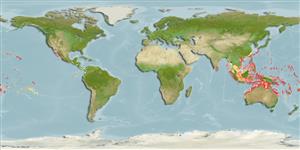
marino associati a barriera corallina; distribuzione batimetrica 1 - 50 m (Ref. 37816). Tropical; 30°N - 28°S, 94°E - 124°W
Pacific Ocean: Cocos (Ref. 9399) and Christmas (Ref. 30874) islands in the eastern Indian Ocean; then from Moluccas to the Tuamoto and Austral islands, north to the Ryukyu Islands, south to Shark Bay and the southern Great Barrier Reef and Rapa.
Size / Peso / Age
Maturità: Lm ? range ? - ? cm
Max length : 40.0 cm TL maschio/sesso non determinato; (Ref. 9137); 30.0 cm TL (female)
Short description
Chiavi di identificazione | Morfologia | Morfometria
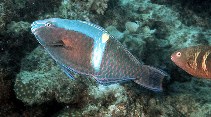
Spine dorsali (totale) : 9; Raggi dorsali molli (totale) : 10; Spine anali: 3; Raggi anali molli: 9. Scales large. 4 median predorsal scales; 2 scale rows on cheek. Caudal fin slightly rounded in initial phase, retained in terminal males with protruding lobes giving a double emarginate effect. Lips cover or nearly cover dental plates. Initial-phase fish without canines; terminal males usually with 1 upper canine and 2 on lower. The initial phase is characterized by a series of irregular dark chevrons which may be difficult to see on dark individuals (Ref. 1602). The basic color may range from a pale gray to a deep mahogany (Ref. 1602). Large initial phase fish develop the dark greenish markings around the lip found in the terminal phase (Ref. 1602).
Body shape (shape guide): fusiform / normal; Cross section: compressed.
Inhabits lagoon and seaward reefs from 1 to over 50 m depth. Adults are common in areas with rich coral and high vertical relief (Ref. 9710, 48636). A solitary species (Ref. 90102). Juveniles may school with other species. Form feeding aggregations on rubble and mixed rubble-coral slopes rather than on flats. Females often in schools of mixed species when feeding, males usually seen separate (Ref. 48636). Feeds on benthic algae (Ref. 89972). Males exhibit territorial tendencies.
Life cycle and mating behavior
Maturità | Riproduzione | Deposizione | Uova | Fecundity | Larve
Oviparous, distinct pairing during breeding (Ref. 205).
Randall, J.E., G.R. Allen and R.C. Steene, 1990. Fishes of the Great Barrier Reef and Coral Sea. University of Hawaii Press, Honolulu, Hawaii. 506 p. (Ref. 2334)
IUCN Red List Status (Ref. 130435: Version 2025-1)
Threat to humans
Harmless
Human uses
Pesca: commerciale; Acquario: Commerciale
Strumenti
Special reports
Download XML
Fonti Internet
Estimates based on models
Preferred temperature (Fonte Biblio.
123201): 24.5 - 28.8, mean 27.6 °C (based on 432 cells).
Phylogenetic diversity index (Fonte Biblio.
82804): PD
50 = 0.5000 [Uniqueness, from 0.5 = low to 2.0 = high].
Bayesian length-weight: a=0.01660 (0.01093 - 0.02521), b=3.03 (2.91 - 3.15), in cm total length, based on LWR estimates for this species & Genus-body shape (Ref.
93245).
Trophic level (Fonte Biblio.
69278): 2.0 ±0.0 se; based on diet studies.
Resilienza (Fonte Biblio.
120179): Medio, tempo minimo di raddoppiamento della popolazione 1.4 - 4.4 anni (K=0.22).
Fishing Vulnerability (Ref.
59153): Low to moderate vulnerability (32 of 100).
🛈
Nutrients (Ref.
124155): Calcium = 36.2 [23.6, 62.3] mg/100g; Iron = 0.715 [0.503, 1.097] mg/100g; Protein = 18.5 [16.5, 20.3] %; Omega3 = 0.0925 [, ] g/100g; Selenium = 20.5 [12.5, 32.8] μg/100g; VitaminA = 53.7 [16.6, 172.4] μg/100g; Zinc = 2.23 [1.68, 2.88] mg/100g (wet weight);