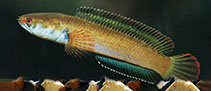
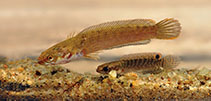
Channa orientalis, Walking snakehead : fisheries, aquarium

Channa orientalis Bloch & Schneider, 1801

Walking snakehead
上傳你的 相片 和 影像
照片 | 影像 | Google 影像

分類 / 名稱 俗名 | 同種異名 | Catalog of Fishes(, ) | ITIS | CoL | WoRMS | Cloffa

Teleostei > Anabantiformes (Gouramies, snakeheads) 鱸形目 (Gouramies, snakeheads) > Channidae (Snakeheads) 鱧科 (Snakeheads)
Etymology: Channa: Greek, channe, -es = an anchovy (Ref. 45335).
More on authors: Bloch & Schneider.

環境: 環境 / 氣候帶 / 深度上下限 / 配送範圍 生態學

; 淡水; 半鹹淡水 底中水層性; pH range: 6.0 - 8.0; dH range: 5 - 19; 河川洄游 (Ref. 51243). 熱帶; 23°C - 26°C (Ref. 1672)

分布 領土 | FAO區域 | 生態系 | 發現紀錄 | 分布圖 | 簡介 | Faunafri

Asia: Afghanistan and Baluchistan southward to Sri Lanka and eastward to Indonesia.
亞洲: 阿富汗與巴錄區斯坦向南至斯里蘭卡而且向東至印尼。

大小 / 重量 / 年齡

成熟度: Lm ?  range ? - ? cm
Max length : 33.0 cm TL 雄魚/尚未辨別雌雄; (Ref. 41236); common length : 16.0 cm TL 雄魚/尚未辨別雌雄; (Ref. 41236)

簡短描述 檢索表 | 型態特徵 | 形態測量圖

背的軟條 (總數) : 33 - 36; 臀鰭軟條: 21 - 23. Caudal fin roundly pointed.
Body shape (shape guide): elongated; Cross section: oval.
尾鰭圓圓尖。

生物學特性     字彙 (例如 epibenthic)

Obligate air-breathing (Ref. 126274); Are broadly adapted species occurring in rivers, lakes, ponds, mountain streams and even brackish water (Ref. 12693). Usually hide under the cover of marginal roots and bogwood. Found in quiet, shaded, clear, flowing water with a silt or gravel substrate (Ref. 6028). Can tolerate very stagnant, poorly oxygenated and turbid water. They also tolerate very foul water (Ref. 1479). Feed largely on insects and crustaceans. A small percentage of fish is also included in the diet. Spawn in shallow water with a silt or gravel substrate. Can tolerate a temperature of 36.5°C.

被出現在河,湖,池塘,山地溪流的一個寬廣地適應的種甚至半淡鹹水.(參考文獻 12693) 通常藏在邊緣根的表面與 bogwood 下。 發現於了安靜的﹐陰暗的﹐和清澈又流動的水具有一個淤泥或礫石底部。 (參考文獻 6028) 能容忍非常污濁的﹐溶氧量低的與混濁的水。 也容忍非常污穢的瓦蓋上水。 (參考文獻 1479) 主要地吃昆蟲與甲殼動物。 一種小的百分比的魚也被包含在食性內。 產卵在淺水區具有一個淤泥或礫石底部。 容忍一個 36.5個 ° C. 的溫度

生命週期和交配行為 成熟度 | 繁殖 | 產卵場 | | 孕卵數 | 仔魚

Exhibits mouthbrooding. Eggs hatch in the mouth of the male and either parent may keep the brood in its mouth for protection after hatching. Fry have been found to feed on successive batches of eggs laid by the female.亞洲: 阿富汗與巴錄區斯坦向南至斯里蘭卡而且向東至印尼。

主要參考資料 上傳您的推薦信 | 參考文獻 | 合作者 | 合作者

Talwar, P.K. and A.G. Jhingran, 1991. Inland fishes of India and adjacent countries. Volume 2. A.A. Balkema, Rotterdam, i-xxii + 543-1158, 1 pl. (Ref. 4833)

IUCN 瀕危狀態 (Ref. 130435: Version 2025-2 (Global))

  易受傷害 (VU) (B1ab(iii)+2ab(iii)); Date assessed: 06 August 2019

CITES

Not Evaluated

CMS (Ref. 116361)

Not Evaluated

對人類具威脅

  無害處的


人類使用

漁業: 低經濟; 水族館: 商業性
FAO - Publication: search | FishSource |

更多資訊

營養生態學
食物項目(獵物)
食性組成
食物消耗量
食物配給
捕食者
生態學
生態學
人口動態
成長參數
最大年齡/尺寸
長度重量比
長度關係
長度-頻率
質量轉換
入添量
豐度
生命週期
繁殖
成熟度
成熟度/鰓部相對
孕卵數
產卵場
產卵聚集

卵發育
仔魚
稚魚動力學
分布
領土
FAO區域
生態系
發現紀錄
簡介
BRUVS - 影片
解剖學
鰓區
腦部
耳石
生理學
身體成分
營養素
耗氧量
游泳類型
游泳速度
視覺色素
魚聲
疾病與寄生蟲
毒性 (LC50s)
遺傳學
基因組
遺傳學
異種性
遺傳率
遺傳多樣性
人類相關
水產養殖系統
水產養殖描述
品種
雪卡毒病例
郵票、錢幣、雜項
外展服務
合作者
參考文獻
參考文獻

工具

特別的報告

下載 XML

網路資源

AFORO (otoliths) | Aquatic Commons | BHL | Cloffa | Websites from users | 檢查 FishWatcher | CISTI | Catalog of Fishes: , | DiscoverLife | ECOTOX | FAO - Publication: search | Faunafri | Fishipedia | Fishtrace | GloBI | Google Books | Google Scholar | Google | IGFA World Record | 國家資料庫 | OneZoom | Open Tree of Life | Otolith Atlas of Taiwan Fishes | PubMed | Reef Life Survey | Socotra Atlas | TreeBase | 樹狀分類階層 | Wikipedia: , 搜尋 | World Records Freshwater Fishing | Zoobank | 動物學的記錄

基於模型的估計

系統發育多樣性指數 (參考文獻 82804):  PD50 = 0.5000   [Uniqueness, from 0.5 = low to 2.0 = high].
Bayesian length-weight: a=0.00933 (0.00560 - 0.01554), b=3.03 (2.89 - 3.17), in cm total length, based on LWR estimates for this species & Genus-body shape (Ref. 93245).
營養階層 (參考文獻 69278):  3.8   ±0.59 se; based on food items.
回復力 (參考文獻 120179):  中等的, 族群倍增時間最少 1.4 - 4.4年 (Fec = 933).
釣魚的脆弱性 (Ref. 59153):  Low vulnerability (23 of 100). 🛈
價格種類 (Ref. 80766):   Unknown.
營養素 (Ref. 124155):  Calcium = 112 [59, 246] mg/100g; Iron = 0.785 [0.520, 1.153] mg/100g; Protein = 17.6 [16.7, 18.6] %; Omega3 = 0.139 [0.071, 0.272] g/100g; Selenium = 25.7 [11.0, 60.9] μg/100g; VitaminA = 49.8 [21.1, 112.2] μg/100g; Zinc = 1.23 [0.86, 1.86] mg/100g (wet weight);