


Aphyosemion fellmanni Van der Zee & Sonnenberg, 2018
Envoyez vos Photos et vidéos
Images | Images Google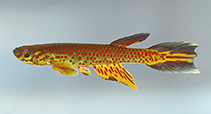 Aphyosemion fellmanni
Male Photo de Chirio, L.
Images | Images Google
Male Photo de Chirio, L.
Classification / Noms Noms communs | Synonymes | Catalog of Fishes(Genre, Espèce) | ITIS | CoL | WoRMS | Cloffa
> Cyprinodontiformes (Rivulines, killifishes and live bearers) > Nothobranchiidae (African rivulines)
Etymology: Aphyosemion: Greek, aphye, -es, sardine, anchovy + Greek, semeion = mark, signal (Ref. 45335); fellmanni: The new species is named after Emmanuel Fellmann, the collector of the new species; Fellmann made four expeditions to the Republic of the Congo to study killifishes and get a better insight in the distribution of Aphyosemion and Epiplatys species in the southern part of the country (Ref. 119321).
Eponymy: Emmanuel Fellmann is a French aquarist who collected this species in the Congo. [...] (Ref. 128868), visit book page.
Etymology: Aphyosemion: Greek, aphye, -es, sardine, anchovy + Greek, semeion = mark, signal (Ref. 45335); fellmanni: The new species is named after Emmanuel Fellmann, the collector of the new species; Fellmann made four expeditions to the Republic of the Congo to study killifishes and get a better insight in the distribution of Aphyosemion and Epiplatys species in the southern part of the country (Ref. 119321).
Eponymy: Emmanuel Fellmann is a French aquarist who collected this species in the Congo. [...] (Ref. 128868), visit book page.
Environnement : milieu / zone climatique / profondeur / gamme de distribution Écologie
; eau douce pélagique. Tropical
Distribution Territoires | Zones FAO | Écosystèmes | Occurrences | Carte par point | Introductions | Faunafri
Africa: Djouari River basin, tributary of Djoué River, in Republic of the Congo (Ref. 119321).
Taille / Poids / Âge
Description synthétique Clés d'identification | Morphologie | Morphométrie
Épines dorsales (Total) : 0; Rayons mous dorsaux (Total) : 7 - 9; Épines anales: 0; Rayons mous anaux: 13 - 14; Vertèbres: 28. Diagnosis: With the exception of Aphyosemion congicum, males of A. fellmanni can be distinguished from all other Aphyosemion species by the wide black margins of the dorsal and caudal fin, up to50% of dorsal fin versus 23% in other species, up to 22% of fin height in caudal fin versus 14% in other species; these margins sometimes seem to be blueish white to grey depending on light incidence, as is also the case in A. congicum (Ref. 119321). Males differ from A. congicum by having many red spots on the flanks versus few red spots, more than 70 versus 30 or less; striped red markings in the caudal fin, versus red spots; red spots on the base of the pectoral fin, versus unspotted pectoral fins; presence of a buccal red band and red pigmented throat, versus unmarked throat; ventral black edge in caudal fin as wide as dorsal edge, versus ventral black edge much wider than dorsal edge; and many stripes or large red spots in anal fin, versus only single or a small number of tiny red spots (Ref. 119321). Although it has narrower dark fin edges, Aphyosemion rectogoense resembles A. fellmanni in colour pattern of sides and anal fin, but the interradial red streaks of the anal fin often forms a broad red band at the anal fin base in A. rectogoense; furthermore the pectoral fins of A. fellmanni are mainly yellow with some red spots at the proximal part of the fin, sometimes forming a horizontal red stripe at about fin centre, whereas pectoral fins of A. rectogoense are mainly red with a yellow or whitish edge (Ref. 119321). The sympatric occurring A. schioetzi sometimes has dark red, not black, fin edges, but these are narrow, less than 23% of dorsal fin height and less than 12% of caudal fin height, and it has no red streaks in the unpaired fins and unspotted pectoral fins (Ref. 119321). Aphyosemion labarrei and A. teugelsi are the only other species of Aphyosemion s.l. of which at least some populations have broad black edges in the caudal fin; these species however can easily be distinguished from A. fellmanni by their robust general appearance and the higher number of dorsal fin rays, 7-9 versus 12-14 in A. labarrei and 10-13 in A. teugelsi (Ref. 119321).
Body shape (shape guide): elongated.
Body shape (shape guide): elongated.
Cycle de vie et comportement reproducteur Maturité | Reproduction | Frai | Œufs | Fécondité | Larves
Référence principale
Téléchargez vos références | Références | Coordinateur | Collaborateurs
Van der Zee, J.R. and R. Sonnenberg, 2018. A new Aphyosemion species from the Djoué River (Congo River basin), Republic of the Congo (Teleostei: Cyprinodontiformes: Nothobranchiidae), with remarks on the type locality of Aphyosemion congicum (Ahl, 1924). Killi-Data Ser. 2018:4-19. (Ref. 119321)
CITES
Not Evaluated
Menace pour l'homme
Harmless
Utilisations par l'homme
FAO - Publication: search | FishSource |
Plus d'informations
Écologie trophique
Aliments (proies)
Composition du régime alimentaire
Consommation alimentaire
Rations alimentaires
Prédateurs
Aliments (proies)
Composition du régime alimentaire
Consommation alimentaire
Rations alimentaires
Prédateurs
Écologie
Écologie
Écologie
Dynamique des populations
Paramètres de croissance
Âges / tailles maximales
Longueur-poids rel.
Rel. longueur-longueur.
Fréquences de longueurs
Conversion de masse
Recrutement
Abondance
Paramètres de croissance
Âges / tailles maximales
Longueur-poids rel.
Rel. longueur-longueur.
Fréquences de longueurs
Conversion de masse
Recrutement
Abondance
Cycle de vie
Reproduction
Maturité
Maturité/épines rel.
Fécondité
Frai
Agrégats de frai
Œufs
Développement de l'œuf
Larves
Dynamique des populations larvaires
Reproduction
Maturité
Maturité/épines rel.
Fécondité
Frai
Agrégats de frai
Œufs
Développement de l'œuf
Larves
Dynamique des populations larvaires
Anatomie
Surface branchiale
Cerveau
Otolithe
Surface branchiale
Cerveau
Otolithe
Physiologie
Composition corporelle
Nutriments
Consommation d'oxygène
Type de natation
Vitesse de nage
Pigments visuels
Son de poisson
Maladies et parasites
Toxicité (CL50)
Composition corporelle
Nutriments
Consommation d'oxygène
Type de natation
Vitesse de nage
Pigments visuels
Son de poisson
Maladies et parasites
Toxicité (CL50)
Génétique
génôme
Génétique
Hétérozygotie
Héritabilité
Diversité génétique
génôme
Génétique
Hétérozygotie
Héritabilité
Diversité génétique
Liées à l'homme
Systèmes d'aquaculture
Profils d'aquaculture
Souches
Cas de ciguatera
Timbres, pièces de monnaie, divers
Systèmes d'aquaculture
Profils d'aquaculture
Souches
Cas de ciguatera
Timbres, pièces de monnaie, divers
Outils
E-book | Guide de terrain | Générateur de fréquences de longueur | Outil de dynamique de population | Carte par point |
Capture-MSY |
Articles particuliers
Télécharger en XML
Sources Internet
AFORO (otoliths) | Aquatic Commons | BHL | Cloffa | Websites from users | FishWatcher | CISTI | Catalog of Fishes: Genre, Espèce | DiscoverLife | ECOTOX | FAO - Publication: search | Faunafri | Fishipedia | Fishtrace | GloBI | Google Books | Google Scholar | Google | IGFA World Record | OneZoom | Open Tree of Life | Otolith Atlas of Taiwan Fishes | PubMed | Reef Life Survey | Socotra Atlas | TreeBase | Arbre de Vie | Wikipedia: aller à, chercher | World Records Freshwater Fishing | Zoobank | Zoological Record
Estimations basées sur des modèles
Indice de diversité phylogénétique (Réf. 82804): PD50 = 0.5000 [Uniqueness, from 0.5 = low to 2.0 = high].
Bayesian length-weight: a=0.00603 (0.00250 - 0.01453), b=3.13 (2.93 - 3.33), in cm total length, based on LWR estimates for this (Sub)family-body shape (Ref. 93245).
Niveau trophique (Réf. 69278): 3.1 ±0.4 se; based on size and trophs of closest relatives