


Aphyosemion fellmanni Van der Zee & Sonnenberg, 2018
Carica il tuo foto e Video
Immagini | Google image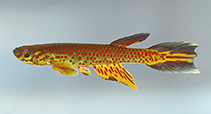 Aphyosemion fellmanni
Male Immagine di Chirio, L.
Immagini | Google image
Male Immagine di Chirio, L.
Classificazione / Nomi Nomi Comuni | Sinonimi | Catalog of Fishes(Genere, Specie) | ITIS | CoL | WoRMS | Cloffa
> Cyprinodontiformes (Rivulines, killifishes and live bearers) > Nothobranchiidae (African rivulines)
Etymology: Aphyosemion: Greek, aphye, -es, sardine, anchovy + Greek, semeion = mark, signal (Ref. 45335); fellmanni: The new species is named after Emmanuel Fellmann, the collector of the new species; Fellmann made four expeditions to the Republic of the Congo to study killifishes and get a better insight in the distribution of Aphyosemion and Epiplatys species in the southern part of the country (Ref. 119321).
Eponymy: Emmanuel Fellmann is a French aquarist who collected this species in the Congo. [...] (Ref. 128868), visit book page.
Etymology: Aphyosemion: Greek, aphye, -es, sardine, anchovy + Greek, semeion = mark, signal (Ref. 45335); fellmanni: The new species is named after Emmanuel Fellmann, the collector of the new species; Fellmann made four expeditions to the Republic of the Congo to study killifishes and get a better insight in the distribution of Aphyosemion and Epiplatys species in the southern part of the country (Ref. 119321).
Eponymy: Emmanuel Fellmann is a French aquarist who collected this species in the Congo. [...] (Ref. 128868), visit book page.
Ambiente: milieu / zona climatica / distribuzione batimetrica / gamma di distribuzione Ecologia
; acqua dolce pelagico. Tropical
Distribuzione Territories | Aree FAO | Ecosistemi | Presenze | Mappa dei ritrovamenti | Introduzioni | Faunafri
Africa: Djouari River basin, tributary of Djoué River, in Republic of the Congo (Ref. 119321).
Dimensione / Peso / Età
Breve descrizione Chiavi di identificazione | Morfologia | Morfometria
Spine dorsali (totale) : 0; Raggi dorsali molli (totale) : 7 - 9; Spine anali: 0; Raggi anali molli: 13 - 14; Vertebre: 28. Diagnosis: With the exception of Aphyosemion congicum, males of A. fellmanni can be distinguished from all other Aphyosemion species by the wide black margins of the dorsal and caudal fin, up to50% of dorsal fin versus 23% in other species, up to 22% of fin height in caudal fin versus 14% in other species; these margins sometimes seem to be blueish white to grey depending on light incidence, as is also the case in A. congicum (Ref. 119321). Males differ from A. congicum by having many red spots on the flanks versus few red spots, more than 70 versus 30 or less; striped red markings in the caudal fin, versus red spots; red spots on the base of the pectoral fin, versus unspotted pectoral fins; presence of a buccal red band and red pigmented throat, versus unmarked throat; ventral black edge in caudal fin as wide as dorsal edge, versus ventral black edge much wider than dorsal edge; and many stripes or large red spots in anal fin, versus only single or a small number of tiny red spots (Ref. 119321). Although it has narrower dark fin edges, Aphyosemion rectogoense resembles A. fellmanni in colour pattern of sides and anal fin, but the interradial red streaks of the anal fin often forms a broad red band at the anal fin base in A. rectogoense; furthermore the pectoral fins of A. fellmanni are mainly yellow with some red spots at the proximal part of the fin, sometimes forming a horizontal red stripe at about fin centre, whereas pectoral fins of A. rectogoense are mainly red with a yellow or whitish edge (Ref. 119321). The sympatric occurring A. schioetzi sometimes has dark red, not black, fin edges, but these are narrow, less than 23% of dorsal fin height and less than 12% of caudal fin height, and it has no red streaks in the unpaired fins and unspotted pectoral fins (Ref. 119321). Aphyosemion labarrei and A. teugelsi are the only other species of Aphyosemion s.l. of which at least some populations have broad black edges in the caudal fin; these species however can easily be distinguished from A. fellmanni by their robust general appearance and the higher number of dorsal fin rays, 7-9 versus 12-14 in A. labarrei and 10-13 in A. teugelsi (Ref. 119321).
Body shape (shape guide): elongated.
Body shape (shape guide): elongated.
Ciclo vitale e comportamento di accoppiamento Maturità | Riproduzione | Deposizione | Uova | Fecondità | Larve
Riferimento principale
Caricare le referenze | Bibliografia | Coordinatore | Collaboratori
Van der Zee, J.R. and R. Sonnenberg, 2018. A new Aphyosemion species from the Djoué River (Congo River basin), Republic of the Congo (Teleostei: Cyprinodontiformes: Nothobranchiidae), with remarks on the type locality of Aphyosemion congicum (Ahl, 1924). Killi-Data Ser. 2018:4-19. (Ref. 119321)
CITES
Not Evaluated
Minaccia per l'uomo
Harmless
Usi umani
FAO - Publication: search | FishSource |
Informazioni ulteriori
Ecologia trofica
Articoli alimentari (prede)
Alimentazione
Consumo di cibo
Razioni alimentari
Predatori
Articoli alimentari (prede)
Alimentazione
Consumo di cibo
Razioni alimentari
Predatori
Ecologia
Ecologia
Ecologia
Dinamica della popolazione
Parametri di crescita
Età massima / dimensioni massime
Rapporto lunghezza-peso.
Lunghezza-lunghezza rel.
Lunghezza-frequenze
Conversione di massa
Reclutamento
Abbondanza
Parametri di crescita
Età massima / dimensioni massime
Rapporto lunghezza-peso.
Lunghezza-lunghezza rel.
Lunghezza-frequenze
Conversione di massa
Reclutamento
Abbondanza
Ciclo di vita
Riproduzione
Maturità
Maturità/Gli occhielli sono relativi.
Fecondità
Deposizione
Aggregazioni riproduttive
Uova
Sviluppo delle uova
Larve
Dinamica popolazioni larvali
Riproduzione
Maturità
Maturità/Gli occhielli sono relativi.
Fecondità
Deposizione
Aggregazioni riproduttive
Uova
Sviluppo delle uova
Larve
Dinamica popolazioni larvali
Anatomia
Area branchiale
Cervello
Otolite
Area branchiale
Cervello
Otolite
Fisiologia
Composizione corporea
Nutrienti
Consumo di ossigeno
Tipo di nuoto
Velocità di nuoto
Pigmenti visivi
Suono del pesce
Malattie e parassiti
Tossicità (LC50)
Composizione corporea
Nutrienti
Consumo di ossigeno
Tipo di nuoto
Velocità di nuoto
Pigmenti visivi
Suono del pesce
Malattie e parassiti
Tossicità (LC50)
Genetica
Genome
Genetica
Eterozigosi
Ereditarietà
Diversità genetica
Genome
Genetica
Eterozigosi
Ereditarietà
Diversità genetica
Legato all'uomo
Sistemi di acquacoltura
Profili di acquacoltura
Varietà
Casi di Ciguatera
Francobolli, monete, materiale vario.
Sistemi di acquacoltura
Profili di acquacoltura
Varietà
Casi di Ciguatera
Francobolli, monete, materiale vario.
Strumenti
Libro elettronico | Giuda pratica | Generatore frequenze di lunghezza | Strumento Parametri Biologici | Mappa dei ritrovamenti |
Cattura-MSY |
Rapporti speciali
Controllo della manutenzione dell'acquario | Verificare la presenza di schede informative sulle specie | Verifica delle schede informative sull'acquacoltura
Scarica XML
Fonti Internet
AFORO (otoliths) | Aquatic Commons | BHL | Cloffa | Websites from users | Check FishWatcher | CISTI | Catalog of Fishes: Genere, Specie | DiscoverLife | ECOTOX | FAO - Publication: search | Faunafri | Fishipedia | Fishtrace | GloBI | Google Books | Google Scholar | Google | IGFA World Record | OneZoom | Open Tree of Life | Otolith Atlas of Taiwan Fishes | PubMed | Reef Life Survey | Socotra Atlas | TreeBase | Tree of Life | Wikipedia: Go, ricerca | World Records Freshwater Fishing | Zoobank | Record zoologico
Stime basate su modelli
Indice di diversità filogenetica (Fonte Biblio. 82804): PD50 = 0.5000 [Uniqueness, from 0.5 = low to 2.0 = high].
Bayesian length-weight: a=0.00603 (0.00250 - 0.01453), b=3.13 (2.93 - 3.33), in cm total length, based on LWR estimates for this (Sub)family-body shape (Ref. 93245).
Livello trofico (Fonte Biblio. 69278): 3.1 ±0.4 se; based on size and trophs of closest relatives