


Aphyosemion fellmanni Van der Zee & Sonnenberg, 2018
アップロード 写真 そして ビデオ
画像 | グーグルの画像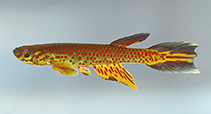 Aphyosemion fellmanni
Male 画像によって Chirio, L.
画像 | グーグルの画像
Male 画像によって Chirio, L.
分類 / 名前 共通名の | 類義語 | Catalog of Fishes(部類, 種) | ITIS | CoL | WoRMS | Cloffa
> Cyprinodontiformes (Rivulines, killifishes and live bearers) > Nothobranchiidae (African rivulines)
Etymology: Aphyosemion: Greek, aphye, -es, sardine, anchovy + Greek, semeion = mark, signal (Ref. 45335); fellmanni: The new species is named after Emmanuel Fellmann, the collector of the new species; Fellmann made four expeditions to the Republic of the Congo to study killifishes and get a better insight in the distribution of Aphyosemion and Epiplatys species in the southern part of the country (Ref. 119321).
Eponymy: Emmanuel Fellmann is a French aquarist who collected this species in the Congo. [...] (Ref. 128868), visit book page.
Etymology: Aphyosemion: Greek, aphye, -es, sardine, anchovy + Greek, semeion = mark, signal (Ref. 45335); fellmanni: The new species is named after Emmanuel Fellmann, the collector of the new species; Fellmann made four expeditions to the Republic of the Congo to study killifishes and get a better insight in the distribution of Aphyosemion and Epiplatys species in the southern part of the country (Ref. 119321).
Eponymy: Emmanuel Fellmann is a French aquarist who collected this species in the Congo. [...] (Ref. 128868), visit book page.
環境:環境 / 気候帯 / 深さの範囲 / 分布範囲 生態学
; 新鮮な水 外洋の. Tropical
分布 領土 | 国連食糧農業機関の区域 | エコシステム | 事件 | 目的のマップ | 導入 | Faunafri
Africa: Djouari River basin, tributary of Djoué River, in Republic of the Congo (Ref. 119321).
サイズ / 重さ / 年齢
簡単な記述 検索表 | 形態学 | 形態計測学
背面の脊椎 (合計) : 0; 背鰭 (合計) : 7 - 9; 肛門の骨: 0; 臀鰭: 13 - 14; 脊つい: 28. Diagnosis: With the exception of Aphyosemion congicum, males of A. fellmanni can be distinguished from all other Aphyosemion species by the wide black margins of the dorsal and caudal fin, up to50% of dorsal fin versus 23% in other species, up to 22% of fin height in caudal fin versus 14% in other species; these margins sometimes seem to be blueish white to grey depending on light incidence, as is also the case in A. congicum (Ref. 119321). Males differ from A. congicum by having many red spots on the flanks versus few red spots, more than 70 versus 30 or less; striped red markings in the caudal fin, versus red spots; red spots on the base of the pectoral fin, versus unspotted pectoral fins; presence of a buccal red band and red pigmented throat, versus unmarked throat; ventral black edge in caudal fin as wide as dorsal edge, versus ventral black edge much wider than dorsal edge; and many stripes or large red spots in anal fin, versus only single or a small number of tiny red spots (Ref. 119321). Although it has narrower dark fin edges, Aphyosemion rectogoense resembles A. fellmanni in colour pattern of sides and anal fin, but the interradial red streaks of the anal fin often forms a broad red band at the anal fin base in A. rectogoense; furthermore the pectoral fins of A. fellmanni are mainly yellow with some red spots at the proximal part of the fin, sometimes forming a horizontal red stripe at about fin centre, whereas pectoral fins of A. rectogoense are mainly red with a yellow or whitish edge (Ref. 119321). The sympatric occurring A. schioetzi sometimes has dark red, not black, fin edges, but these are narrow, less than 23% of dorsal fin height and less than 12% of caudal fin height, and it has no red streaks in the unpaired fins and unspotted pectoral fins (Ref. 119321). Aphyosemion labarrei and A. teugelsi are the only other species of Aphyosemion s.l. of which at least some populations have broad black edges in the caudal fin; these species however can easily be distinguished from A. fellmanni by their robust general appearance and the higher number of dorsal fin rays, 7-9 versus 12-14 in A. labarrei and 10-13 in A. teugelsi (Ref. 119321).
Body shape (shape guide): elongated.
Body shape (shape guide): elongated.
ライフサイクルと交尾行動 成熟 | 繁殖 | 放精 | 卵 | 生産力 | 幼生
主な参考文献
参考文献のアップロード | 参考文献 | コーディネーター | 協力者
Van der Zee, J.R. and R. Sonnenberg, 2018. A new Aphyosemion species from the Djoué River (Congo River basin), Republic of the Congo (Teleostei: Cyprinodontiformes: Nothobranchiidae), with remarks on the type locality of Aphyosemion congicum (Ahl, 1924). Killi-Data Ser. 2018:4-19. (Ref. 119321)
CITES
Not Evaluated
人間に対する脅威
Harmless
人間の用途
FAO - Publication: search | FishSource |
より多くの情報
養殖生態
食料品(獲物)
餌の構成
摂食量
食料配給
捕食動物
食料品(獲物)
餌の構成
摂食量
食料配給
捕食動物
生態学
生態学
生態学
人口動態
成長のパラメーター
最大年齢/サイズ
長さ-重量比。
長短関係。
体長組成
質量変換
補充
豊度
成長のパラメーター
最大年齢/サイズ
長さ-重量比。
長短関係。
体長組成
質量変換
補充
豊度
ライフサイクル
繁殖
成熟
成熟度/エラ
生産力
放精
産卵群
卵
卵の開発
幼生
幼生の動力
繁殖
成熟
成熟度/エラ
生産力
放精
産卵群
卵
卵の開発
幼生
幼生の動力
解剖学
カマ
脳
オトリス
カマ
脳
オトリス
生理学
体組成
栄養素
酸素消費
水泳タイプ
泳ぐ速さ
視覚色素
フィッシュ・サウンド
病気と寄生虫
毒性(LC50)
体組成
栄養素
酸素消費
水泳タイプ
泳ぐ速さ
視覚色素
フィッシュ・サウンド
病気と寄生虫
毒性(LC50)
遺伝子の
ゲノム
遺伝子の
ヘテロ接合性
遺伝
遺伝的多様性
ゲノム
遺伝子の
ヘテロ接合性
遺伝
遺伝的多様性
用具
特記事項
XMLをダウンロードして下さい
インターネットの情報源
AFORO (otoliths) | Aquatic Commons | BHL | Cloffa | Websites from users | Check FishWatcher | CISTI | Catalog of Fishes: 部類, 種 | DiscoverLife | ECOTOX | FAO - Publication: search | Faunafri | Fishipedia | Fishtrace | GloBI | Google Books | Google Scholar | Google | IGFA World Record | OneZoom | Open Tree of Life | Otolith Atlas of Taiwan Fishes | PubMed | Reef Life Survey | Socotra Atlas | TreeBase | 生命の木 | Wikipedia: 行く, 検索する | World Records Freshwater Fishing | Zoobank | 動物に関する記録
モデルに基づく推定値
系統多様性指数 (参照 82804): PD50 = 0.5000 [Uniqueness, from 0.5 = low to 2.0 = high].
Bayesian length-weight: a=0.00603 (0.00250 - 0.01453), b=3.13 (2.93 - 3.33), in cm total length, based on LWR estimates for this (Sub)family-body shape (Ref. 93245).
栄養段階 (参照 69278): 3.1 ±0.4 se; based on size and trophs of closest relatives