


Aphyosemion fellmanni Van der Zee & Sonnenberg, 2018
Adicionar o seu Fotografias e vídeos
Fotografias | Imagem do Google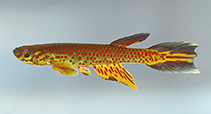 Aphyosemion fellmanni
Male Fotografia de Chirio, L.
Fotografias | Imagem do Google
Male Fotografia de Chirio, L.
Classificação / Nomes Nomes comuns | Sinónimos | Catalog of Fishes(Género, Espécies) | ITIS | CoL | WoRMS | Cloffa
> Cyprinodontiformes (Rivulines, killifishes and live bearers) > Nothobranchiidae (African rivulines)
Etymology: Aphyosemion: Greek, aphye, -es, sardine, anchovy + Greek, semeion = mark, signal (Ref. 45335); fellmanni: The new species is named after Emmanuel Fellmann, the collector of the new species; Fellmann made four expeditions to the Republic of the Congo to study killifishes and get a better insight in the distribution of Aphyosemion and Epiplatys species in the southern part of the country (Ref. 119321).
Eponymy: Emmanuel Fellmann is a French aquarist who collected this species in the Congo. [...] (Ref. 128868), visit book page.
Etymology: Aphyosemion: Greek, aphye, -es, sardine, anchovy + Greek, semeion = mark, signal (Ref. 45335); fellmanni: The new species is named after Emmanuel Fellmann, the collector of the new species; Fellmann made four expeditions to the Republic of the Congo to study killifishes and get a better insight in the distribution of Aphyosemion and Epiplatys species in the southern part of the country (Ref. 119321).
Eponymy: Emmanuel Fellmann is a French aquarist who collected this species in the Congo. [...] (Ref. 128868), visit book page.
Ambiente: milieu / zona climática / intervalo de profundidade / gama de distribuição Ecologia
; Água doce pelágico(a,os,as). Tropical
Distribuição Territórios | Áreas FAO | Ecossistemas | Ocorrências | Mapa dos pontos | Introduções | Faunafri
Africa: Djouari River basin, tributary of Djoué River, in Republic of the Congo (Ref. 119321).
Tamanho / Peso / Idade
Descrição breve Chaves de identificação | Morfologia | Morfometria
Espinhos dorsais (total) : 0; Raios dorsais moles (total) : 7 - 9; Espinhos anais: 0; Raios anais moles: 13 - 14; Vértebras: 28. Diagnosis: With the exception of Aphyosemion congicum, males of A. fellmanni can be distinguished from all other Aphyosemion species by the wide black margins of the dorsal and caudal fin, up to50% of dorsal fin versus 23% in other species, up to 22% of fin height in caudal fin versus 14% in other species; these margins sometimes seem to be blueish white to grey depending on light incidence, as is also the case in A. congicum (Ref. 119321). Males differ from A. congicum by having many red spots on the flanks versus few red spots, more than 70 versus 30 or less; striped red markings in the caudal fin, versus red spots; red spots on the base of the pectoral fin, versus unspotted pectoral fins; presence of a buccal red band and red pigmented throat, versus unmarked throat; ventral black edge in caudal fin as wide as dorsal edge, versus ventral black edge much wider than dorsal edge; and many stripes or large red spots in anal fin, versus only single or a small number of tiny red spots (Ref. 119321). Although it has narrower dark fin edges, Aphyosemion rectogoense resembles A. fellmanni in colour pattern of sides and anal fin, but the interradial red streaks of the anal fin often forms a broad red band at the anal fin base in A. rectogoense; furthermore the pectoral fins of A. fellmanni are mainly yellow with some red spots at the proximal part of the fin, sometimes forming a horizontal red stripe at about fin centre, whereas pectoral fins of A. rectogoense are mainly red with a yellow or whitish edge (Ref. 119321). The sympatric occurring A. schioetzi sometimes has dark red, not black, fin edges, but these are narrow, less than 23% of dorsal fin height and less than 12% of caudal fin height, and it has no red streaks in the unpaired fins and unspotted pectoral fins (Ref. 119321). Aphyosemion labarrei and A. teugelsi are the only other species of Aphyosemion s.l. of which at least some populations have broad black edges in the caudal fin; these species however can easily be distinguished from A. fellmanni by their robust general appearance and the higher number of dorsal fin rays, 7-9 versus 12-14 in A. labarrei and 10-13 in A. teugelsi (Ref. 119321).
Body shape (shape guide): elongated.
Body shape (shape guide): elongated.
Ciclo de vida e comportamento de acasalamento Maturidade | Reprodução | Desova | Ovos | Fecundidade | Larvas
Referência principal
Carregar as suas referências | Referências | Coordenador | Colaboradores
Van der Zee, J.R. and R. Sonnenberg, 2018. A new Aphyosemion species from the Djoué River (Congo River basin), Republic of the Congo (Teleostei: Cyprinodontiformes: Nothobranchiidae), with remarks on the type locality of Aphyosemion congicum (Ahl, 1924). Killi-Data Ser. 2018:4-19. (Ref. 119321)
CITES
Not Evaluated
Ameaça para o homem
Harmless
Utilização humana
FAO - Publication: search | FishSource |
Mais informação
Ecologia Trófica
Produtos alimentares (presas)
Composição da dieta
Consumo alimentar
Rações alimentares
Predadores
Produtos alimentares (presas)
Composição da dieta
Consumo alimentar
Rações alimentares
Predadores
Ecologia
Ecologia
Ecologia
Dinâmica das populações
Parâmetros de crescimento
Idades / tamanhos máximos
Comprimento-peso rel.
Comprimento-comprimento rel.
Frequência de comprimento
Conversão de massa
Recrutamento
Abundância
Parâmetros de crescimento
Idades / tamanhos máximos
Comprimento-peso rel.
Comprimento-comprimento rel.
Frequência de comprimento
Conversão de massa
Recrutamento
Abundância
Ciclo de vida
Reprodução
Maturidade
Maturidade/Rel. das guelras
Fecundidade
Desova
Agregações de desova
Ovos
Desenvolvimento dos ovos
Larvas
Dinâmica larvar
Reprodução
Maturidade
Maturidade/Rel. das guelras
Fecundidade
Desova
Agregações de desova
Ovos
Desenvolvimento dos ovos
Larvas
Dinâmica larvar
Anatomia
Área branquial
Cérebro
Otólitos
Área branquial
Cérebro
Otólitos
Fisiologia
Composição corporal
Nutrientes
Consumo de oxigénio
Tipo de natação
Velocidade de natação
Pigmentos visuais
Som de peixe
Doenças e Parasitas
Toxicidade (LC50s)
Composição corporal
Nutrientes
Consumo de oxigénio
Tipo de natação
Velocidade de natação
Pigmentos visuais
Som de peixe
Doenças e Parasitas
Toxicidade (LC50s)
Genética
genoma
Genética
Heterozigotia
Hereditariedade
Diversidade genética
genoma
Genética
Heterozigotia
Hereditariedade
Diversidade genética
Relacionado com o ser humano
Sistemas de aquacultura
Perfis para aquacultura
Estirpes
Casos de Ciguatera
Selos, moedas, diversos.
Sistemas de aquacultura
Perfis para aquacultura
Estirpes
Casos de Ciguatera
Selos, moedas, diversos.
Ferramentas
E-book | Guia de campo | Ferramenta auxiliar de frequências de comprimento | Ferramenta sobre a história de vida | Mapa dos pontos |
Captura-MSY |
Relatórios especiais
Descarregue XML
Fontes da internet
AFORO (otoliths) | Aquatic Commons | BHL | Cloffa | Websites from users | Consultar FishWatcher | CISTI | Catalog of Fishes: Género, Espécies | DiscoverLife | ECOTOX | FAO - Publication: search | Faunafri | Fishipedia | Fishtrace | GloBI | Google Books | Google Scholar | Google | IGFA World Record | OneZoom | Open Tree of Life | Otolith Atlas of Taiwan Fishes | PubMed | Reef Life Survey | Socotra Atlas | TreeBase | Árvore da vida | Wikipedia: ir para, procurar | World Records Freshwater Fishing | Zoobank | Registo zoológico
Estimativas baseadas em modelos
Índice de diversidade filogenética (Ref. 82804): PD50 = 0.5000 [Uniqueness, from 0.5 = low to 2.0 = high].
Bayesian length-weight: a=0.00603 (0.00250 - 0.01453), b=3.13 (2.93 - 3.33), in cm total length, based on LWR estimates for this (Sub)family-body shape (Ref. 93245).
Nível Trófico (Ref. 69278): 3.1 ±0.4 se; based on size and trophs of closest relatives